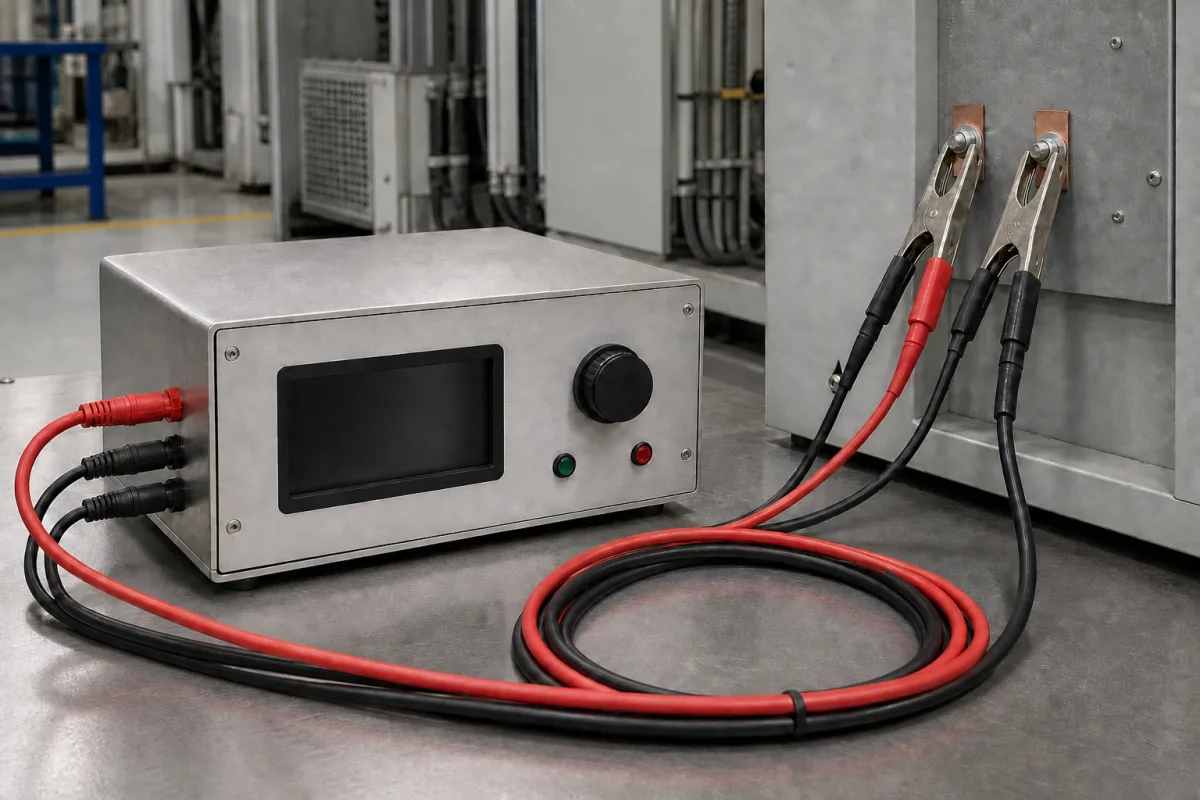
Ground continuity and ground bond testers · Low-current check vs high-current bond test, test current, milliohm resolution, lead compensation
A ground continuity tester passes a known current through a protective earth or grounding connection and reports its resistance, confirming that exposed metal or equipment is solidly connected to earth, as with the bench tester pictured with its leads clamped to earth terminals on a cabinet. Ask three things first: whether you need a low-current continuity check or a high-current bond test, the test current and resistance range, and how the tester removes the resistance of its own leads.
Instruments that measure the resistance of protective earth and grounding connections: ground continuity and ground bond testers for electrical products, and grounding-conductivity testers for equipment earth leads in power installations. Earth electrode (soil) resistance testers (see earth electrode), insulation and hipot testers, and multimeters are outside this page.
CNFX editorial research · Sources checked October 12, 2026 · 4 sources
Decide between a continuity check and a ground bond test
Chroma explains that a ground continuity test verifies that every conductive part a user can touch is connected to the power-line ground, so that an insulation fault trips a breaker or blows a fuse instead of passing current through the user. It says "ground continuity tests are normally performed with a low current DC signal" to check that the ground connection is below 1 Ω, while a ground bond test applies a high current — "one common method of ground bond testing, applies a 25A source" between the protective earth terminal and accessible conductive parts, and measures the voltage drop to show the bond can carry the specified current. [1]
GW Instek describes ground bond testing as driving 25 to 40 A so that 4–12 V appears across the grounding wire, giving a result at milliohm level, with test times of two minutes under some standards or at least 5 to 10 seconds; its ground continuity function uses a small current like a multimeter's continuity check, takes about 1 second and resolves only to ohm level. [2]
The UK HSE notes that earthed (Class I) equipment relies on its exposed metal parts being effectively earthed, and that faults such as a broken earth wire inside a flexible cable cannot be detected by visual examination alone, only by combined inspection and test. [3]
Give the supplier the product or installation to be tested, the standard and pass limit you work to, the test current and duration required, whether testing is in production (pass/fail, interfacing) or in the field (portable, battery or mains), and the lead length needed.
02
Match test current, resolution and lead compensation to the job
Chroma warns that because ground resistance is very low, the resistance of the tester's own leads can cause errors, corrected either by measuring and subtracting the lead resistance or by a Kelvin setup with an extra sensing lead; it states that "most standards recommend a ground resistance of <100 milliohms, excluding the power cable". Its 19572 ground bond tester sources 3–45 A AC at 50 or 60 Hz and resolves 0.1–510 mΩ. [1]
For grounding devices in power installations, Wuhan UHV says its UHV-810 tester is built to DL/T 475-2006, which it cites as calling for 1 mΩ resolution. The tester offers fixed DC currents of 1, 2, 5 and 10 A, a range of 1–1999 mΩ with 1 mΩ resolution, accuracy of ±(0.5% + 2 digits), a 50 m measuring radius and continuous operation; the maker says the 10 A output breaks through contact oxidation films. [4]
Editorial calculation: by Ohm's law, a 25 A bond test across a 100 mΩ connection produces a 2.5 V drop, and a 10 A DC test across a 50 mΩ grounding lead produces 0.5 V; at 10 A, a 1 mΩ resolution step corresponds to 10 mV.
03
Wuhan UHV's UHV-810 DC tester for grounding leads
Wuhan UHV lists the UHV-810 for grounding devices in power installations, a DC 1–10 A instrument reading 1–1999 mΩ, unlike the 3–45 A AC Chroma 19572 bond tester described above. [4][1]
Ask any supplier for the test current (AC or DC) and its range, resistance range and resolution, accuracy, lead set and compensation method, test timer and pass/fail limits, power supply, operating conditions and calibration certificate.
04
Current source, voltage sensing, leads and clamps, limits display, timer and power supply
Chroma warns that at milliohm level the tester's own leads can cause errors, so the leads row is where to specify lead-resistance subtraction or a Kelvin setup with an extra sensing lead. [1]
Test current, milliohm range, accuracy, ambient limits, weight and size for a tester order
Filled values mix Chroma's 3–45 A AC bond tester with Wuhan UHV's DC 1–10 A grounding tester, so check which instrument a figure belongs to; rows without a citation have no published value.
Field
What it means and published values
Ask the supplier for
Test current (A, AC or DC)
Bond test e.g. 25 A; 3–45 A AC; DC 1–10 A for grounding devices. [1][4]
1 company lists this product among what they make. Company figures are quoted from each
company's own website; every card states where the relationship came from.
Wuhan UHV Power Technology Co.,Ltd.
Manufacturing site to be confirmed for the order
Lists the UHV-810 ground continuity tester (DC 1–10 A, 1–1999 mΩ) with other power test instruments.
Explore company information and manufacturing capabilities, then discuss the scope of your project with a relevant supplier.
Share this page
Compiled and source-reviewed by the CNFX editorial team.
Each manufacturer above links to the page on that company's own website where the product is listed, with the date we checked it. How we source and review
· Page last updated 13 October 2026
Buyer questions
What is the difference between ground continuity and ground bond tests?
Chroma describes continuity as a low-current DC check that the ground connection is under 1 Ω, and ground bond as a high-current test — "one common method" applies 25 A — that measures the voltage drop to show the bond can carry the specified current. [1]
How do I stop test lead resistance spoiling the reading?
Chroma says to measure and subtract the lead resistance, or use a Kelvin setup with an extra lead that compensates automatically. [1]
What tester is used for substation grounding leads?
Wuhan UHV's UHV-810 uses DC 1, 2, 5 or 10 A with a 1–1999 mΩ range and 1 mΩ resolution, citing DL/T 475-2006. [4]
Sources and what still needs a direct check
Sources checked 2026-10-12. Chroma and GW Instek make electrical safety testers; the HSE is the UK safety regulator; Wuhan UHV is the supplier linked to this page.