Industry-Verified Manufacturing Data (2026)

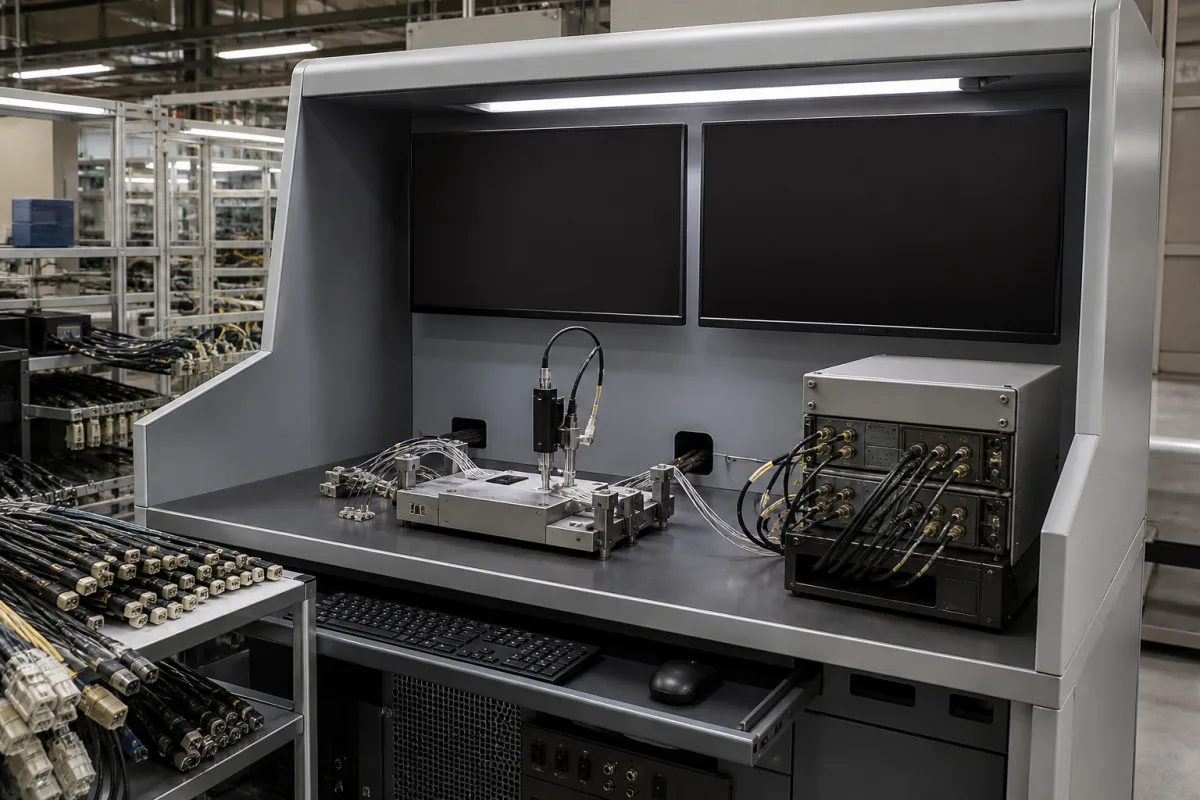
Electrical Testing Station

Based on aggregated insights from multiple verified factory profiles within the CNFX directory, the standard Electrical Testing Station used in the Computer, Electronic and Optical Product Manufacturing sector typically supports operational capacities ranging from standard industrial configurations to heavy-duty production requirements.

Technical Definition & Core Assembly

A canonical Electrical Testing Station is characterized by the integration of Test Fixture and High Voltage Test Module. In industrial production environments, manufacturers listed on CNFX commonly emphasize Stainless steel frame construction to support stable, high-cycle operation across diverse manufacturing scenarios.

A specialized station within an automated assembly line that performs electrical safety and functional tests on LED luminaires.
Product Specifications

Technical details and manufacturing context for Electrical Testing Station

Definition
The Electrical Testing Station is a critical component of the Automated LED Luminaire Assembly System responsible for verifying the electrical integrity and performance of assembled LED lighting fixtures. It conducts comprehensive tests including insulation resistance, dielectric strength, ground continuity, power consumption, and functional light output verification to ensure products meet safety standards and quality specifications before proceeding to packaging.
Working Principle
The station uses automated test equipment (ATE) with programmable test sequences. Fixtures are positioned on test contacts, and the system applies controlled voltages and currents while measuring responses. Test results are compared against predefined pass/fail criteria, with data logged to the manufacturing execution system (MES) for traceability.
Common Materials
Stainless steel frame, Industrial-grade electrical contacts, Insulating polymers, Copper wiring
Technical Parameters
  • Station dimensions for integration into assembly line (mm) Customizable
Components / BOM
  • Test Fixture
    Holds and positions LED luminaires during testing with precise electrical contact alignment
    Material: Anodized aluminum
  • High Voltage Test Module
    Generates and applies dielectric withstand voltage for insulation testing
    Material: Insulated electronics enclosure
  • Ground Continuity Tester
    Measures resistance between accessible metal parts and ground connection
    Material: Copper test probes
  • Power Analyzer
    Measures input power, current, power factor, and harmonic distortion
    Material: Electronic measurement circuitry
  • Photometric Sensor
    Measures light output, color temperature, and chromaticity coordinates
    Material: Calibrated silicon photodiode
Engineering Reasoning
85-265 VAC, 47-63 Hz, 0-40°C ambient temperature, 20-80% relative humidity non-condensing
Dielectric breakdown at >1500 VAC test voltage, insulation resistance <100 MΩ at 500 VDC, leakage current >0.5 mA at 110% rated voltage
Design Rationale: Partial discharge in air gaps at >3 kV/mm electric field strength, thermal runaway in semiconductor junctions above 150°C junction temperature, electrochemical migration at >85% relative humidity with ionic contamination
Risk Mitigation (FMEA)
Trigger Transient voltage surge exceeding 6 kV with 1.2/50 μs waveform
Mode: Arc flash across test probes causing carbon tracking on PCB
Strategy: Gas discharge tubes with 350 V DC sparkover voltage placed 5 mm from test contacts
Trigger Cumulative 10^8 mechanical cycles at 2 N contact force
Mode: Pogo pin wear exceeding 0.2 mm causing intermittent contact resistance >100 mΩ
Strategy: Gold-over-nickel plating (1.27 μm Au, 2.54 μm Ni) on spring-loaded test probes

Industry Taxonomies & Aliases

Commonly used trade names and technical identifiers for Electrical Testing Station.

Industrial Ecosystem & Supply Chain DNA

Complementary Systems
Downstream Applications
Specialized Tooling

Application Fit & Sizing Matrix

Operational Limits
pressure: Atmospheric only (no pressure/vacuum requirements)
other spec: Humidity: 20-80% non-condensing, Power: 100-240V AC, 50/60Hz, 10A max
temperature: 15°C to 40°C (operating), 0°C to 50°C (storage)
Media Compatibility
✓ LED luminaires (IP20-IP67 rated) ✓ Electronic drivers/power supplies ✓ Wiring harnesses with connectors
Unsuitable: Explosive atmospheres (ATEX Zone 0/1) or environments with conductive dust/particulates
Sizing Data Required
  • Maximum luminaire dimensions (LxWxH)
  • Production rate (units/hour)
  • Test protocol complexity (safety/functional tests required)

Reliability & Engineering Risk Analysis

Failure Mode & Root Cause
Insulation breakdown
Cause: Thermal cycling, moisture ingress, or contamination degrading dielectric properties, leading to arcing or short circuits.
Contact degradation
Cause: Oxidation, pitting, or wear from repeated mechanical operation and electrical arcing, increasing resistance and overheating.
Maintenance Indicators
  • Audible buzzing, crackling, or intermittent operation indicating loose connections or arcing.
  • Visible discoloration, scorch marks, or unusual odors from components signaling overheating or insulation failure.
Engineering Tips
  • Implement regular thermographic inspections to detect hotspots and schedule proactive maintenance before failures occur.
  • Establish a predictive maintenance program using vibration analysis and partial discharge testing to monitor electrical and mechanical integrity.

Compliance & Manufacturing Standards

Reference Standards
IEC 61010-1: Safety requirements for electrical equipment for measurement, control, and laboratory use ISO/IEC 17025: General requirements for the competence of testing and calibration laboratories UL 61010-1: Standard for Safety - Electrical Equipment for Measurement, Control, and Laboratory Use
Manufacturing Precision
  • Voltage measurement accuracy: +/-0.5% of reading
  • Temperature stability: +/-1°C over 8-hour operation
Quality Inspection
  • Dielectric withstand test (hipot test)
  • Calibration verification against traceable standards

Factories Producing Electrical Testing Station

Verified manufacturers with capability to produce this product in China

✓ 95% Supplier Capability Match Found

P Project Engineer from Brazil Feb 02, 2026
★★★★★
"As a professional in the Computer, Electronic and Optical Product Manufacturing sector, I confirm this Electrical Testing Station meets all ISO standards."
Technical Specifications Verified
S Sourcing Manager from Canada Jan 30, 2026
★★★★★
"Standard OEM quality for Computer, Electronic and Optical Product Manufacturing applications. The Electrical Testing Station arrived with full certification."
Technical Specifications Verified
P Procurement Specialist from United States Jan 27, 2026
★★★★★
"Great transparency on the Electrical Testing Station components. Essential for our Computer, Electronic and Optical Product Manufacturing supply chain."
Technical Specifications Verified
Verification Protocol

“Feedback is collected from verified sourcing managers during RFQ (Request for Quote) and factory evaluation processes on CNFX. These reports represent historical performance data and technical audit summaries from our B2B manufacturing network.”

5 sourcing managers are analyzing this specification now. Last inquiry for Electrical Testing Station from Turkey (1h ago).

Supply Chain Compatible Machinery & Devices

Industrial IoT Gateway

Edge computing device connecting industrial equipment to cloud platforms.

Explore Specs →
Modular Industrial Edge Computing Device

Rugged computing platform for industrial data processing at the network edge

Explore Specs →
Industrial Smart Camera Module

Embedded vision system for industrial automation and quality inspection.

Explore Specs →
Industrial Wireless Power Transfer Module

Wireless power transfer module for industrial equipment applications

Explore Specs →

Frequently Asked Questions

What types of electrical tests does this station perform on LED luminaires?

The station performs comprehensive electrical safety tests including ground continuity verification and high voltage insulation testing, plus functional tests like power analysis and photometric measurements to ensure LED luminaires meet quality and safety standards.

How does this testing station integrate with automated assembly lines?

Designed with a stainless steel frame and industrial-grade electrical contacts, the station seamlessly integrates into automated production lines, featuring standardized interfaces and test fixtures that allow for continuous, high-throughput testing without disrupting manufacturing flow.

What are the key components in the testing station's BOM for reliable operation?

Key components include a Ground Continuity Tester for safety compliance, High Voltage Test Module for insulation checks, Photometric Sensor for light output verification, Power Analyzer for electrical performance, and a durable Test Fixture to securely hold luminaires during testing.

Can I contact factories directly on CNFX?

CNFX is an open directory, not a transaction platform. Each factory profile provides direct contact information and production details to help you initiate direct inquiries with Chinese suppliers.

Get Quote for Electrical Testing Station

Request technical pricing, lead times, or customized specifications for Electrical Testing Station directly from verified manufacturing units.

Your business information is encrypted and only shared with verified Electrical Testing Station suppliers.

Thank you! Your message has been sent. We'll respond within 1–3 business days.

Need to Manufacture Electrical Testing Station?

Connect with verified factories specializing in this product category

Add Your Factory Contact Us
Previous Product
Electrical Testing Chamber
Next Product
Electrode array