Industry-Verified Manufacturing Data (2026)

Heating Element Module

Based on aggregated insights from multiple verified factory profiles within the CNFX directory, the standard Heating Element Module used in the Electrical Equipment Manufacturing sector typically supports operational capacities ranging from standard industrial configurations to heavy-duty production requirements.

Technical Definition & Core Assembly

A canonical Heating Element Module is characterized by the integration of Heating Coil and Thermocouple. In industrial production environments, manufacturers listed on CNFX commonly emphasize Nickel-chromium alloy construction to support stable, high-cycle operation across diverse manufacturing scenarios.

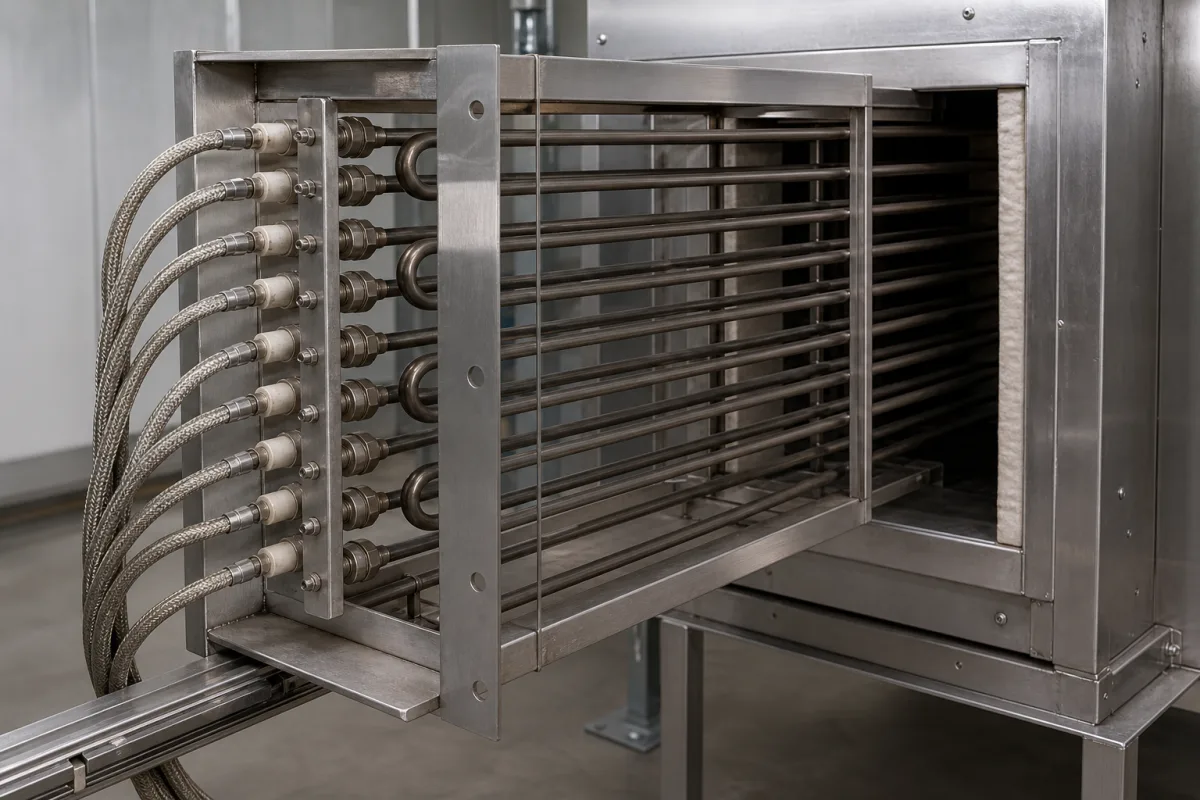
A modular heating component designed for precise temperature control within industrial systems.
Product Specifications

Technical details and manufacturing context for Heating Element Module

Definition
The Heating Element Module is a critical component of the Temperature Management Unit, responsible for generating and regulating heat to maintain specific temperature ranges in industrial processes. It integrates heating elements, temperature sensors, and control circuitry in a compact, replaceable unit.
Working Principle
Converts electrical energy into thermal energy through resistive heating elements, with integrated sensors providing feedback to control systems for precise temperature regulation.
Common Materials
Nickel-chromium alloy, Ceramic insulation, Stainless steel housing
Technical Parameters
  • Power rating of the heating element (W) Per Request
Components / BOM
  • Heating Coil
    Primary heat generation through electrical resistance
    Material: Nickel-chromium alloy
  • Thermocouple
    Temperature sensing and feedback
    Material: Type K thermocouple wire
  • Insulation Layer
    Thermal and electrical insulation
    Material: Ceramic fiber
  • Terminal Block
    Electrical connection interface
    Material: High-temperature plastic
Engineering Reasoning
20-400°C with ±0.5°C control accuracy at 240V AC, 50-60Hz, 1.5-3.0kW power range
Thermal runaway initiates at 450°C due to positive temperature coefficient exceeding 0.0035/°C, mechanical failure occurs at 550°C from differential thermal expansion exceeding 15μm/mm
Design Rationale: Thermal fatigue from cyclic heating (ΔT>200°C) causes microcrack propagation following Paris' law (da/dN=C(ΔK)^m where C=1.5e-11, m=3.2), accelerated by oxidation at Arrhenius rate with activation energy 180kJ/mol
Risk Mitigation (FMEA)
Trigger Insulation breakdown at 6kV/mm dielectric strength due to moisture ingress exceeding 1000ppm
Mode: Ground fault current exceeding 30mA causes protective device tripping within 0.1s
Strategy: Hermetic sealing with IP68 rating and continuous insulation monitoring with 1MΩ threshold
Trigger Thermocouple decalibration drift exceeding 2°C/1000h at 300°C operating temperature
Mode: Control loop instability causing temperature oscillations of ±15°C at 0.1Hz frequency
Strategy: Redundant Type K thermocouples with 3-wire configuration and automatic calibration every 24h

Industry Taxonomies & Aliases

Commonly used trade names and technical identifiers for Heating Element Module.

Applied To / Applications

This component is essential for the following industrial systems and equipment:

Industrial Ecosystem & Supply Chain DNA

Complementary Systems
Downstream Applications
Specialized Tooling

Application Fit & Sizing Matrix

Operational Limits
pressure: Maximum working pressure: 10 bar (145 psi)
flow rate: Compatible with flow rates up to 50 L/min
temperature: Operating range: -20°C to 400°C, with precise control ±1°C
slurry concentration: Suitable for slurries up to 30% solids by weight
Media Compatibility
✓ Water-based heat transfer fluids ✓ Industrial oils and lubricants ✓ Non-corrosive chemical solutions
Unsuitable: Highly corrosive acidic environments (e.g., concentrated sulfuric acid)
Sizing Data Required
  • Required heating power (kW)
  • System flow rate (L/min)
  • Target temperature rise (ΔT in °C)

Reliability & Engineering Risk Analysis

Failure Mode & Root Cause
Thermal fatigue cracking
Cause: Repeated heating and cooling cycles causing expansion/contraction stress, often due to rapid temperature changes or poor thermal management
Electrical insulation breakdown
Cause: Degradation of insulating materials from moisture ingress, contamination, or overheating leading to short circuits or ground faults
Maintenance Indicators
  • Visible hotspots or discoloration on the heating element surface indicating uneven heating or impending failure
  • Audible arcing, buzzing, or popping sounds during operation signaling electrical insulation breakdown
Engineering Tips
  • Implement controlled ramp-up/down procedures to minimize thermal shock and reduce thermal stress on heating elements
  • Maintain clean, dry operating environment with proper sealing to prevent contamination and moisture ingress that degrades electrical insulation

Compliance & Manufacturing Standards

Reference Standards
ISO 9001:2015 Quality Management Systems IEC 60335-1 Household and similar electrical appliances - Safety ASTM B496 Standard Specification for Compacted Round Stranded Copper Conductors
Manufacturing Precision
  • Resistance: +/-5% of nominal value
  • Surface flatness: 0.15mm across heating surface
Quality Inspection
  • Insulation Resistance Test (minimum 100 MΩ at 500V DC)
  • Thermal Cycling Test (minimum 1000 cycles from ambient to max operating temperature)

Factories Producing Heating Element Module

Verified manufacturers with capability to produce this product in China

✓ 96% Supplier Capability Match Found

S Sourcing Manager from Australia Jan 28, 2026
★★★★★
"Testing the Heating Element Module now; the technical reliability results are within 1% of the laboratory datasheet."
Technical Specifications Verified
P Procurement Specialist from Singapore Jan 25, 2026
★★★★☆
"Impressive build quality. Especially the technical reliability is very stable during long-term operation. (Delivery took slightly longer than expected, but technical support was excellent.)"
Technical Specifications Verified
T Technical Director from Germany Jan 22, 2026
★★★★★
"As a professional in the Electrical Equipment Manufacturing sector, I confirm this Heating Element Module meets all ISO standards."
Technical Specifications Verified
Verification Protocol

“Feedback is collected from verified sourcing managers during RFQ (Request for Quote) and factory evaluation processes on CNFX. These reports represent historical performance data and technical audit summaries from our B2B manufacturing network.”

11 sourcing managers are analyzing this specification now. Last inquiry for Heating Element Module from Germany (1h ago).

Supply Chain Compatible Machinery & Devices

Circuit Breaker Arc Chute

Electrical component that extinguishes arcs in circuit breakers

Explore Specs →
Medium Voltage Switchgear Assembly Line

Automated production system for assembling medium voltage electrical switchgear.

Explore Specs →
Motor Terminal Block

Electrical connection interface for motor windings

Explore Specs →
PLC Control System

A digital industrial computer control system that monitors inputs, makes decisions based on a custom program, and controls outputs to automate industrial processes.

Explore Specs →

Frequently Asked Questions

What are the key benefits of using a modular heating element in industrial systems?

Modular heating elements offer precise temperature control, easy maintenance and replacement, enhanced durability with materials like nickel-chromium alloy and stainless steel, and flexibility for integration into various industrial setups.

How does the ceramic insulation improve the heating element module's performance?

Ceramic insulation provides excellent thermal resistance, preventing heat loss and ensuring efficient energy transfer to the target area. It also enhances electrical insulation, safety, and longevity by protecting components from overheating.

What industrial applications are suitable for this heating element module?

This module is ideal for applications requiring precise temperature control, such as industrial ovens, furnaces, plastic molding equipment, food processing machinery, and laboratory instruments, due to its durable materials and modular design.

Can I contact factories directly on CNFX?

CNFX is an open directory, not a transaction platform. Each factory profile provides direct contact information and production details to help you initiate direct inquiries with Chinese suppliers.

Get Quote for Heating Element Module

Request technical pricing, lead times, or customized specifications for Heating Element Module directly from verified manufacturing units.

Your business information is encrypted and only shared with verified Heating Element Module suppliers.

Thank you! Your message has been sent. We'll respond within 1–3 business days.

Need to Manufacture Heating Element Module?

Connect with verified factories specializing in this product category

Add Your Factory Contact Us
Previous Product
Heating Element Grid
Next Product
High Voltage Generator