Current measurement · Resistance alloy and TCR, four-terminal Kelvin connection, power and voltage drop, thermal EMF
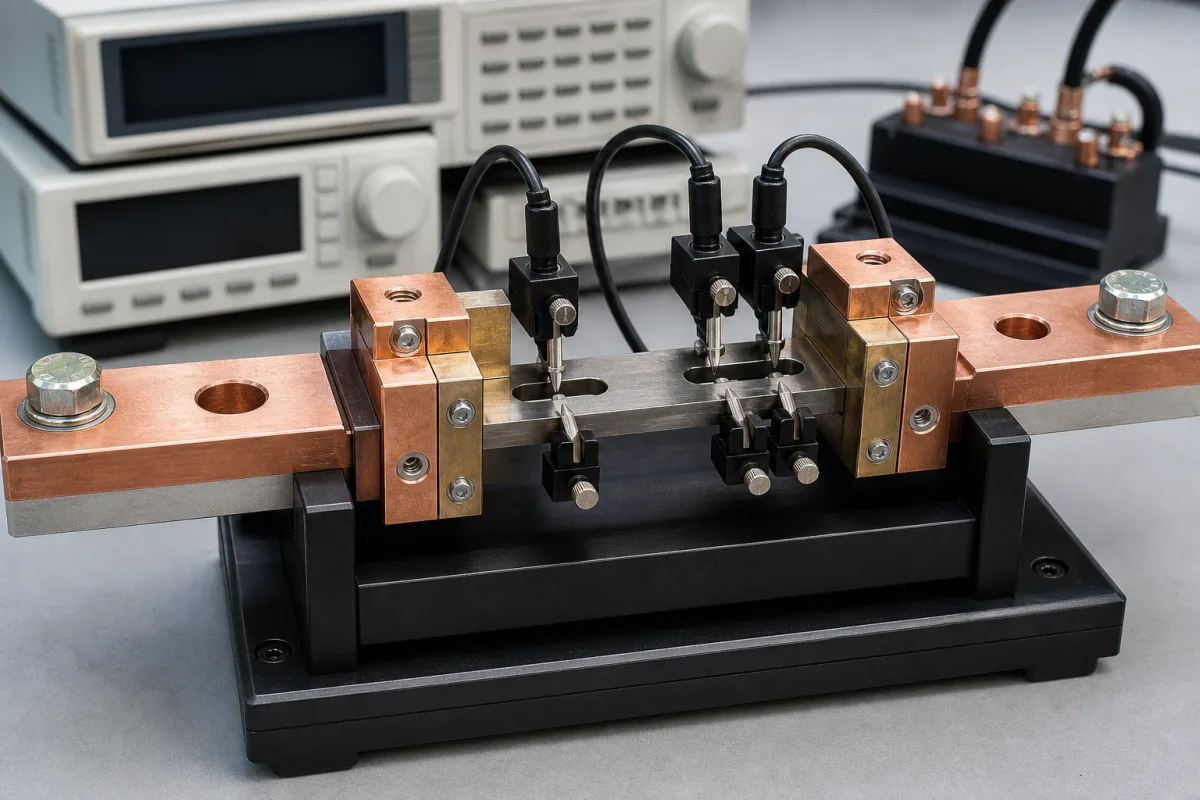
A precision current shunt is a low-value resistor, for example 200 µΩ to 3 mΩ in one maker's range, placed in the current path so that the small voltage across it measures the current. Ask three things first: which resistance alloy and temperature coefficient hold accuracy at your operating temperature, how the sense terminals are arranged for a four-terminal (Kelvin) measurement, and how much power the shunt dissipates at full current.
Low-value current-sensing shunt resistors: busbar and block shunts for panel meters and battery systems, and four-terminal surface-mount and module shunts for power electronics. General-purpose surface-mount chip resistors, Hall-effect current sensors and shunt trip coils for circuit-breakers are outside this page.
CNFX editorial research · Sources checked October 12, 2026 · 4 sources
Isabellenhütte's MANGANIN datasheet (CuMn12Ni, material 2.1362) describes it as the standard material for precision, standard and shunt resistors because of its low temperature coefficient between +20 and +50 °C with a parabolic R(T) curve, high long-term stability and extremely low thermal EMF against copper. It lists a temperature coefficient of ±10 × 10⁻⁶/K between +20 and +50 °C, resistivity of 43 µΩ·cm at +20 °C (tolerance ±5%), and thermal EMF against copper of −1.00 µV/K standard or ±0.20 µV/K special. [1]
The datasheet gives a maximum working temperature in air of +140 °C, warning that exceeding it can cause resistance drift through oxidation, and says precision resistors with the highest requirements should be carefully stabilised and kept below +60 °C. [1]
Isabellenhütte's BVR series, as listed by its distributor Rhopoint, is a four-terminal surface-mount shunt in a 4026 package from 0.2 to 3 mΩ, with TCR below 20 or 50 ppm/°C between +20 and +60 °C, tolerance ±1% or ±5%, power up to 12 W at 70 °C, −65 to +170 °C range, continuous current up to 160 A at 0.2 mΩ and AEC-Q200 qualification, offered in MANGANIN and other alloys. [2]
Give the supplier the maximum and continuous current, the voltage drop you can accept, accuracy needed and over what temperature range, ambient and cooling, mounting (busbar, PCB, module), terminal and sense-lead arrangement, isolation voltage, and calibration certificate requirements.
02
Wire the sense terminals as a Kelvin connection
TI's layout guidance for its LMP8640 current-sense amplifier says to use four-wire (Kelvin) connections to the sense resistor, connecting at points outside the direct high-current path and never sharing part of the sense path with load current. Sense traces should follow the same path, closely spaced and ideally on the same copper layer, with continuous plated vias to avoid creating thermocouples. [3]
TI advises avoiding jumpers and connectors in the sense inputs, since even the best introduce thermal errors, giving each input the same number of junctions if they cannot be avoided, equal copper mass and equal distance from heat sources, and keeping the amplifier away from heat and high-velocity air. [3]
Editorial calculation: at its rated 160 A, a 0.2 mΩ BVR shunt drops 160 × 0.0002 = 32 mV and dissipates 160² × 0.0002 ≈ 5.1 W, within its 12 W rating at 70 °C. [2] If the two sense junctions differ by 5 K, MANGANIN's −1.0 µV/K thermal EMF against copper would add about 5 µV, roughly 0.016% of that 32 mV signal; the error grows as the shunt value or current falls. [1]
03
Compare what suppliers offer
Suppliers linked to this page list current shunt resistors; each card links to the page reviewed.
Listings include FL-series busbar shunts for panel meters, precision shunts for battery and power systems, and current-sensing chip resistors.
04
Check the finished shunt's TCR, not only the alloy's
Vishay Dale's WSMS5515 datasheet (revision 27 February 2025) describes a Power Metal Strip meter shunt with a four-terminal (Kelvin) design, all-welded construction, inductance below 0.5 nH and thermal EMF below 3 µV/°C. It is rated 3.0 W at 70 °C with ±5% tolerance, from 50 µΩ to 1000 µΩ, over −65 to +170 °C, with maximum current given as (P/R)^½. Its 100 to 300 µΩ values use a Mn-Cu element and the 500 µΩ value Fe-Cr, yet the finished part's temperature coefficient is ±325 ppm/°C at 100 µΩ, ±225 at 160–250 µΩ and ±175 at 300–500 µΩ. The datasheet marks the part end of life, with a last purchase date of 21 July 2025. [4]
Its test table limits resistance change to ±0.5% after 1,000 thermal-shock cycles from −55 to +150 °C and after 5 × rated power for 5 s, and to ±1.0% after 1,000 h of load life at +70 °C and 1,000 h at +170 °C. [4]
Editorial calculation: at 200 µΩ and 3.0 W, (P/R)^½ gives about 122 A. Over the 30 K span from +20 to +50 °C, ±225 ppm/°C shifts resistance by up to about ±0.68%, against about ±0.03% for MANGANIN's ±10 × 10⁻⁶/K alloy coefficient. Ask for the TCR of the finished shunt including terminals, the drift limits after load life, and whether the part is still in production. [4][1]
Fill the specification fields with values for your circuit
A shunt quotation needs values for your current and accuracy. The table explains each field, gives published values where a reviewed source states them, and says what to obtain from the supplier.
Explore company information and manufacturing capabilities, then discuss the scope of your project with a relevant supplier.
Share this page
Compiled and source-reviewed by the CNFX editorial team.
Published product pages show what a company offers, not tested performance. Confirm the legal seller, factory and scope for your order. How we source and review
· Page last updated 13 October 2026
Buyer questions
Why are precision shunts made of manganin?
Isabellenhütte cites its ±10 ppm/K temperature coefficient between 20 and 50 °C, long-term stability and low thermal EMF against copper. [1]
What is a Kelvin connection on a shunt?
TI's layout guidance describes four-wire sense connections made at points outside the direct high-current path, never sharing the load current path. [3]
How much power does a shunt dissipate?
P = I²R; a 0.2 mΩ shunt at 160 A dissipates about 5.1 W (editorial calculation). [2]
Is a shunt's temperature coefficient the same as its alloy's?
Not necessarily: Vishay's WSMS5515 datasheet lists ±175 to ±325 ppm/°C for the finished shunt, including values with a Mn-Cu element. [4]
Sources and what still needs a direct check
Sources checked 2026-10-12. Isabellenhütte is an alloy and resistor maker (BVR data via its distributor Rhopoint); TI is an amplifier maker. Values are for their products and should be confirmed for the shunt you buy.