Industry-Verified Manufacturing Data (2026)

Precision Shear

Based on aggregated insights from multiple verified factory profiles within the CNFX directory, the standard Precision Shear used in the Electrical Equipment Manufacturing sector typically supports operational capacities ranging from standard industrial configurations to heavy-duty production requirements.

Technical Definition & Core Assembly

A canonical Precision Shear is characterized by the integration of Cutting Blade and Clamping Mechanism. In industrial production environments, manufacturers listed on CNFX commonly emphasize Tool steel construction to support stable, high-cycle operation across diverse manufacturing scenarios.

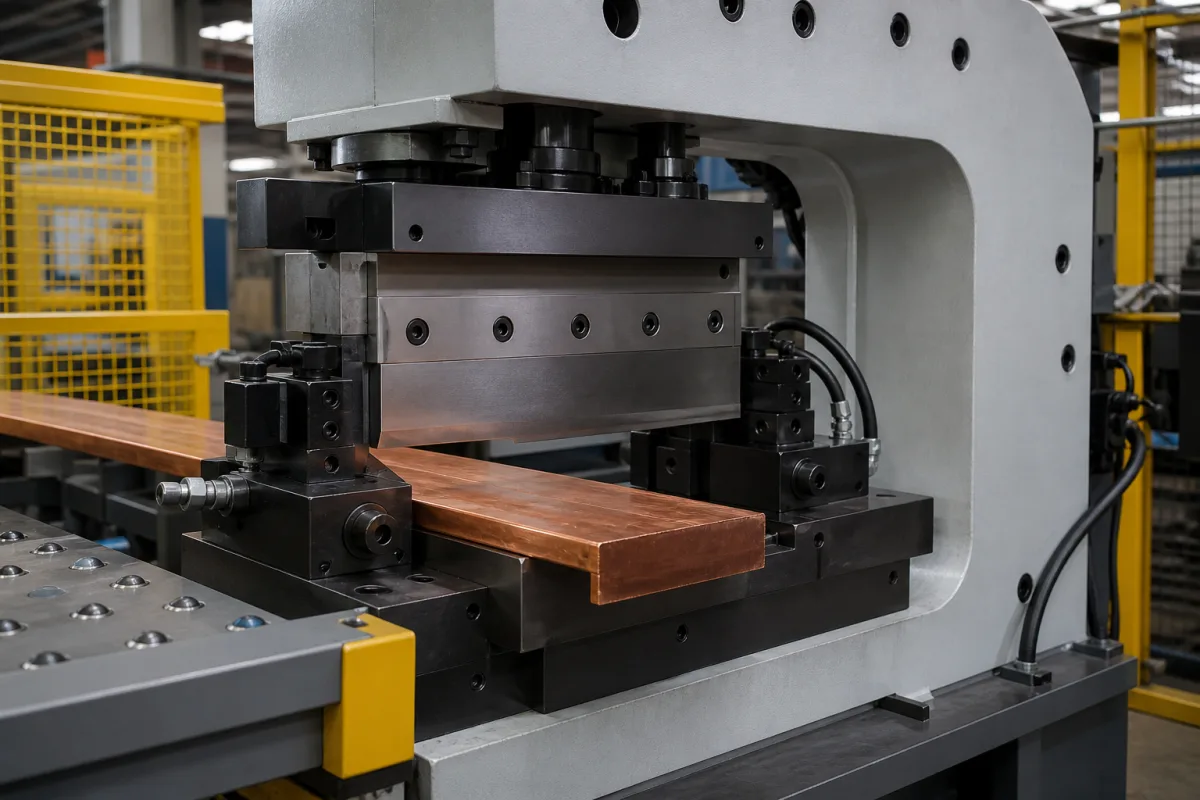
A high-accuracy cutting mechanism within busbar processing equipment

Product Specifications

Technical details and manufacturing context for Precision Shear

Definition
The Precision Shear is a critical component of the Busbar Processing Module designed to make clean, accurate cuts on copper or aluminum busbars with minimal deformation or burrs. It ensures precise lengths and square edges for proper electrical connections in switchgear, panel boards, and other electrical distribution systems.
Working Principle
The shear operates using a mechanical or hydraulic system where a sharp blade descends vertically or at an angle onto the busbar, which is securely clamped in place. The cutting action is controlled to minimize material distortion, often incorporating features like adjustable blade clearance and controlled cutting speed to achieve clean shearing without crushing the conductive material.
Common Materials
Tool steel, High-strength alloy steel
Technical Parameters
  • Maximum busbar thickness and width capacity (mm) Standard Spec
Components / BOM
  • Cutting Blade
    Primary cutting edge that contacts and severs the busbar material
    Material: Tool steel
  • Clamping Mechanism
    Secures the busbar in position during cutting to prevent movement
    Material: Hardened steel
  • Blade Holder/Assembly
    Houses and supports the cutting blade, often allowing for blade adjustment and replacement
    Material: Steel alloy
  • Actuation System
    Mechanical, hydraulic, or pneumatic system that drives the blade movement
    Material: Various (steel, aluminum, seals)
Engineering Reasoning
0.5-2.5 kN cutting force, 0.01-0.05 mm positional accuracy, 20-80 Hz vibration frequency
Cutting force exceeds 3.0 kN, blade deflection exceeds 0.08 mm, vibration amplitude surpasses 0.15 mm
Design Rationale: Fatigue fracture at blade root due to cyclic stress concentration exceeding 450 MPa yield strength of tungsten carbide, thermal expansion mismatch between blade (α=4.5×10⁻⁶/K) and holder (α=11×10⁻⁶/K) causing 0.12 mm displacement at 150°C
Risk Mitigation (FMEA)
Trigger Hydraulic pressure surge exceeding 210 bar due to accumulator precharge loss
Mode: Blade impact velocity exceeds 2.5 m/s causing edge chipping
Strategy: Install 200 bar pressure relief valve with 10 ms response time and 5 μm filtration
Trigger Servo motor encoder resolution degradation below 0.001°
Mode: Angular positioning error accumulates to 0.07° causing material tearing
Strategy: Implement dual redundant 20-bit absolute encoders with 0.0005° resolution and thermal compensation

Industry Taxonomies & Aliases

Commonly used trade names and technical identifiers for Precision Shear.

Applied To / Applications

This component is essential for the following industrial systems and equipment:

Industrial Ecosystem & Supply Chain DNA

Complementary Systems
Downstream Applications
Specialized Tooling

Application Fit & Sizing Matrix

Operational Limits
pressure: Max 10 bar hydraulic pressure
other spec: Max busbar thickness: 12mm, Cutting accuracy: ±0.1mm, Cycle rate: ≤30 cuts/min
temperature: 5°C to 40°C (operating), -10°C to 60°C (storage)
Media Compatibility
✓ Copper busbars (electrolytic grade) ✓ Aluminum busbars (6061/6063 alloys) ✓ Tin-plated copper busbars
Unsuitable: Abrasive composite materials with embedded grit or ceramics
Sizing Data Required
  • Busbar material type and hardness (e.g., Cu-ETP, Al-6061)
  • Maximum busbar thickness and width (mm)
  • Required production rate (cuts per hour)

Reliability & Engineering Risk Analysis

Failure Mode & Root Cause
Blade edge degradation
Cause: Progressive wear from cutting hard materials, improper blade alignment causing uneven stress, or insufficient lubrication leading to increased friction and heat
Hydraulic system failure
Cause: Contamination of hydraulic fluid causing valve sticking or pump wear, seal degradation leading to pressure loss, or overheating from inadequate cooling or excessive cycling
Maintenance Indicators
  • Increased vibration or audible knocking during operation indicating blade misalignment or bearing wear
  • Visible hydraulic fluid leaks around cylinders or connections, or inconsistent cutting pressure resulting in incomplete cuts
Engineering Tips
  • Implement a strict blade inspection and rotation schedule based on material cut counts, using precision alignment tools to ensure parallel blade positioning and optimal clearance settings
  • Establish a proactive hydraulic maintenance program with regular fluid analysis, filtration system checks, and temperature monitoring to prevent contamination and thermal degradation

Compliance & Manufacturing Standards

Reference Standards
ISO 12164-2:2001 - Tool holders with cylindrical shank - Part 2: Dimensions and designation of shanks for power driven tools ANSI B94.19-1997 - Cutting Tools - Milling Cutters and End Mills DIN 1838:1985-12 - Cutting tools; end mills with parallel shank; dimensions
Manufacturing Precision
  • Blade parallelism: +/-0.01mm per 100mm length
  • Cutting edge sharpness: Radius not exceeding 0.02mm
Quality Inspection
  • Hardness testing (Rockwell C scale) for blade material
  • Surface roughness measurement (Ra ≤ 0.8μm) on cutting edges

Factories Producing Precision Shear

Verified manufacturers with capability to produce this product in China

✓ 95% Supplier Capability Match Found

S Sourcing Manager from Brazil Feb 25, 2026
★★★★★
"Great transparency on the Precision Shear components. Essential for our Electrical Equipment Manufacturing supply chain."
Technical Specifications Verified
P Procurement Specialist from Canada Feb 22, 2026
★★★★☆
"The Precision Shear we sourced perfectly fits our Electrical Equipment Manufacturing production line requirements. (Delivery took slightly longer than expected, but technical support was excellent.)"
Technical Specifications Verified
T Technical Director from United States Feb 19, 2026
★★★★★
"Found 44+ suppliers for Precision Shear on CNFX, but this spec remains the most cost-effective."
Technical Specifications Verified
Verification Protocol

“Feedback is collected from verified sourcing managers during RFQ (Request for Quote) and factory evaluation processes on CNFX. These reports represent historical performance data and technical audit summaries from our B2B manufacturing network.”

12 sourcing managers are analyzing this specification now. Last inquiry for Precision Shear from India (30m ago).

Supply Chain Compatible Machinery & Devices

Circuit Breaker Trip Unit

Protective control module for electrical circuit breakers

Explore Specs →
Circuit Breaker Arc Chute

Electrical component that extinguishes arcs in circuit breakers

Explore Specs →
Medium Voltage Switchgear Assembly Line

Automated production system for assembling medium voltage electrical switchgear.

Explore Specs →
Motor Terminal Block

Electrical connection interface for motor windings

Explore Specs →

Frequently Asked Questions

What materials are used in the precision shear for durability?

The precision shear is constructed from tool steel and high-strength alloy steel to ensure long-lasting performance and resistance to wear in electrical equipment manufacturing applications.

How does the precision shear ensure accurate busbar cutting?

It features a high-accuracy cutting mechanism with components like the actuation system, blade holder/assembly, clamping mechanism, and cutting blade, all designed for precise alignment and clean cuts.

What are the main components in the precision shear's BOM?

The bill of materials includes the actuation system, blade holder/assembly, clamping mechanism, and cutting blade, each engineered for reliable operation in busbar processing.

Can I contact factories directly on CNFX?

CNFX is an open directory, not a transaction platform. Each factory profile provides direct contact information and production details to help you initiate direct inquiries with Chinese suppliers.

Get Quote for Precision Shear

Request technical pricing, lead times, or customized specifications for Precision Shear directly from verified manufacturing units.

Your business information is encrypted and only shared with verified Precision Shear suppliers.

Thank you! Your message has been sent. We'll respond within 1–3 business days.

Need to Manufacture Precision Shear?

Connect with verified factories specializing in this product category

Add Your Factory Contact Us
Previous Product
Precision Reflector Assembly
Next Product
Precision Stacking Head