Industry-Verified Manufacturing Data (2026)

Separator Feeding & Tensioning Unit

Based on aggregated insights from multiple verified factory profiles within the CNFX directory, the standard Separator Feeding & Tensioning Unit used in the Electrical Equipment Manufacturing sector typically supports operational capacities ranging from standard industrial configurations to heavy-duty production requirements.

Technical Definition & Core Assembly

A canonical Separator Feeding & Tensioning Unit is characterized by the integration of Unwind Stand with Brake and Tension Sensor (Load Cell/Dancer). In industrial production environments, manufacturers listed on CNFX commonly emphasize Aluminum alloy (frame and rollers) construction to support stable, high-cycle operation across diverse manufacturing scenarios.

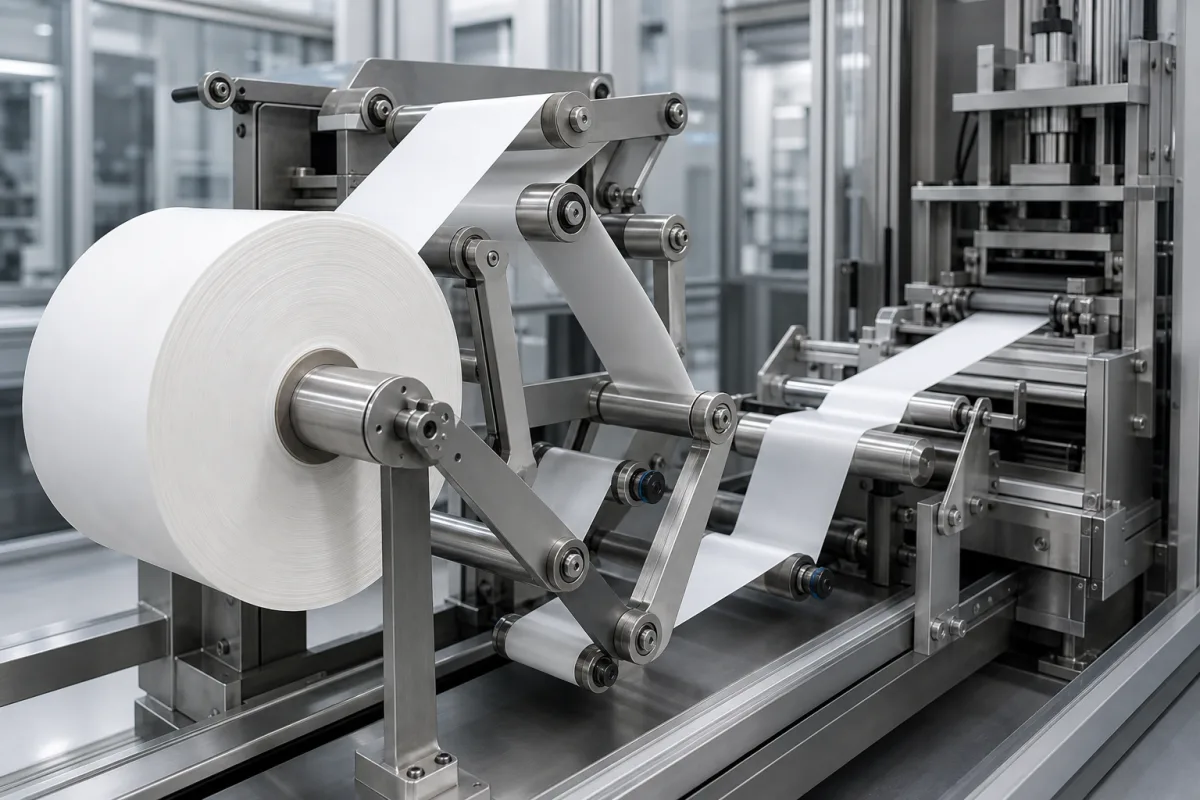
A precision component within battery manufacturing equipment that precisely feeds and maintains tension on separator material during electrode stacking.
Product Specifications

Technical details and manufacturing context for Separator Feeding & Tensioning Unit

Definition
The Separator Feeding & Tensioning Unit is a critical sub-assembly within the Electrode Stacking Module of battery production lines. Its primary function is to accurately unwind separator material from a roll, maintain precise tension control throughout the feeding process, and deliver the separator to the stacking station where it is interleaved between anode and cathode electrodes. This unit ensures wrinkle-free, properly aligned separator placement, which is essential for battery safety, performance, and manufacturing yield.
Working Principle
The unit typically consists of an unwind mechanism with a brake or servo motor for controlled material release, a series of guide rollers to direct the separator path, and a tension sensing system (often using load cells or dancer rollers) that provides feedback to the control system. Based on tension measurements, the system adjusts the braking force or motor torque to maintain a constant, predetermined tension on the separator web as it feeds into the stacking area. This prevents slack (which can cause misalignment) or excessive tension (which can stretch or tear the delicate separator material).
Common Materials
Aluminum alloy (frame and rollers), Stainless steel (shafts and bearings), Polyurethane or rubber (roller surfaces), Anodized aluminum (structural components)
Technical Parameters
  • Tension range typically maintained on the separator material, critical for preventing damage and ensuring proper layering. (N/m) Customizable
Components / BOM
  • Unwind Stand with Brake
    Holds the separator roll and provides controlled resistance to unwind material.
    Material: Steel/aluminum frame, electromagnetic or pneumatic brake
  • Tension Sensor (Load Cell/Dancer)
    Measures real-time tension on the separator web and sends feedback to controller.
    Material: Stainless steel load cell, aluminum dancer arm
  • Guide Rollers
    Directs the separator path, minimizes friction, and helps maintain web alignment.
    Material: Aluminum or steel core with polyurethane coating
  • Servo Motor/Actuator
    Adjusts braking force or roller position based on tension feedback to maintain set tension.
    Material: Steel, copper windings, rare-earth magnets
Engineering Reasoning
0.5-5.0 N·m torque at 10-100 mm/s feed rate with 0.1-2.0 N tension force
Tension force exceeds 2.5 N causing separator elongation beyond 0.5% plastic deformation threshold
Design Rationale: Hooke's Law elastic limit violation: σ = Eε where E = 1.2 GPa for polyolefin separator material, exceeding yield strength of 6 MPa
Risk Mitigation (FMEA)
Trigger Servo motor encoder resolution degradation below 12-bit precision
Mode: Positional error accumulation exceeding ±25 μm tolerance
Strategy: Dual redundant absolute encoders with 16-bit resolution and Kalman filtering
Trigger Roller surface roughness increase beyond Ra 0.4 μm due to ceramic coating wear
Mode: Friction coefficient variation from 0.15 to 0.35 causing tension fluctuations
Strategy: Diamond-like carbon coating with hardness >20 GPa and in-situ laser profilometry monitoring

Industry Taxonomies & Aliases

Commonly used trade names and technical identifiers for Separator Feeding & Tensioning Unit.

Applied To / Applications

This component is essential for the following industrial systems and equipment:

Industrial Ecosystem & Supply Chain DNA

Complementary Systems
Downstream Applications
Specialized Tooling

Application Fit & Sizing Matrix

Operational Limits
pressure: Max 0.5 bar (tension control), 0.1-0.3 bar typical
other spec: Separator width: 50-500 mm, Line speed: 0.5-10 m/min, Tension accuracy: ±1% FS
temperature: 15-35°C (operating), 5-45°C (storage)
Media Compatibility
✓ Polyolefin separators (PE/PP) ✓ Ceramic-coated separators ✓ Dry-process polymer separators
Unsuitable: Wet environments or direct liquid electrolyte exposure
Sizing Data Required
  • Separator material type and thickness (μm)
  • Maximum web width and line speed (m/min)
  • Required tension range and control accuracy (N/m ±%)

Reliability & Engineering Risk Analysis

Failure Mode & Root Cause
Belt misalignment and tracking failure
Cause: Worn or damaged guide rollers, improper tensioning, or accumulation of material on belt edges leading to uneven wear and slippage.
Bearing seizure in tensioning rollers
Cause: Inadequate lubrication, ingress of contaminants (dust, moisture), or excessive load due to improper tension settings causing overheating and premature failure.
Maintenance Indicators
  • Audible squealing or grinding noises from rollers or bearings indicating friction or misalignment
  • Visible belt wander or edge damage, with material spillage or uneven wear patterns on the belt surface
Engineering Tips
  • Implement regular laser alignment checks and automated tension monitoring systems to maintain optimal belt tracking and tension, preventing uneven wear and reducing mechanical stress.
  • Establish a proactive lubrication schedule using high-temperature, contaminant-resistant greases for all roller bearings, and install protective seals or shields to minimize environmental ingress.

Compliance & Manufacturing Standards

Reference Standards
ISO 9001:2015 - Quality Management Systems ANSI B11.19 - Performance Requirements for Risk Reduction and Safeguarding CE Marking - Machinery Directive 2006/42/EC
Manufacturing Precision
  • Shaft Alignment: +/-0.05mm
  • Roller Parallelism: 0.1mm per meter
Quality Inspection
  • Load Cell Calibration Verification
  • Dimensional Accuracy Check via CMM

Factories Producing Separator Feeding & Tensioning Unit

Verified manufacturers with capability to produce this product in China

✓ 98% Supplier Capability Match Found

T Technical Director from Singapore Jan 07, 2026
★★★★★
"As a professional in the Electrical Equipment Manufacturing sector, I confirm this Separator Feeding & Tensioning Unit meets all ISO standards."
Technical Specifications Verified
P Project Engineer from Germany Jan 04, 2026
★★★★☆
"Standard OEM quality for Electrical Equipment Manufacturing applications. The Separator Feeding & Tensioning Unit arrived with full certification. (Delivery took slightly longer than expected, but technical support was excellent.)"
Technical Specifications Verified
S Sourcing Manager from Brazil Jan 01, 2026
★★★★★
"Great transparency on the Separator Feeding & Tensioning Unit components. Essential for our Electrical Equipment Manufacturing supply chain."
Technical Specifications Verified
Verification Protocol

“Feedback is collected from verified sourcing managers during RFQ (Request for Quote) and factory evaluation processes on CNFX. These reports represent historical performance data and technical audit summaries from our B2B manufacturing network.”

16 sourcing managers are analyzing this specification now. Last inquiry for Separator Feeding & Tensioning Unit from Brazil (1h ago).

Supply Chain Compatible Machinery & Devices

Transformer Winding Machine

Industrial machine for winding copper wire onto transformer cores

Explore Specs →
Circuit Breaker Trip Unit

Protective control module for electrical circuit breakers

Explore Specs →
Circuit Breaker Arc Chute

Electrical component that extinguishes arcs in circuit breakers

Explore Specs →
Medium Voltage Switchgear Assembly Line

Automated production system for assembling medium voltage electrical switchgear.

Explore Specs →

Frequently Asked Questions

What materials are used in the separator feeding and tensioning unit?

The unit features an aluminum alloy frame and rollers, stainless steel shafts and bearings, polyurethane or rubber roller surfaces, and anodized aluminum structural components for durability and precision.

How does this unit maintain consistent tension during battery manufacturing?

It utilizes a tension sensor (load cell or dancer system) combined with a servo motor/actuator and unwind stand with brake to precisely control and maintain separator material tension throughout the electrode stacking process.

What are the key components in the bill of materials for this unit?

The BOM includes an unwind stand with brake, tension sensor (load cell/dancer), guide rollers, and servo motor/actuator, all designed to work together for precise separator feeding and tension control.

Can I contact factories directly on CNFX?

CNFX is an open directory, not a transaction platform. Each factory profile provides direct contact information and production details to help you initiate direct inquiries with Chinese suppliers.

Get Quote for Separator Feeding & Tensioning Unit

Request technical pricing, lead times, or customized specifications for Separator Feeding & Tensioning Unit directly from verified manufacturing units.

Your business information is encrypted and only shared with verified Separator Feeding & Tensioning Unit suppliers.

Thank you! Your message has been sent. We'll respond within 1–3 business days.

Need to Manufacture Separator Feeding & Tensioning Unit?

Connect with verified factories specializing in this product category

Add Your Factory Contact Us
Previous Product
Selector Switch
Next Product
Servo Bending Unit