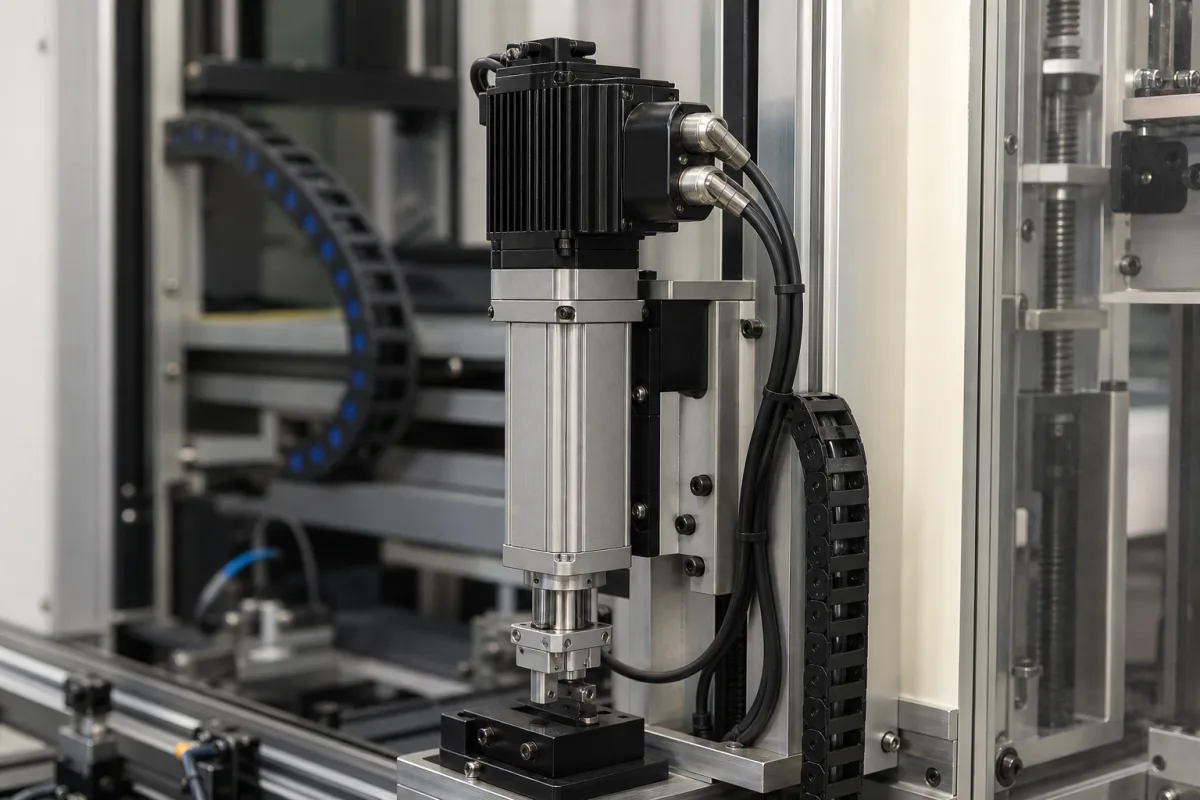
Servo motor actuator for press-fitting (electromechanical servo press module with built-in force sensor)
Servo press modules for press-fitting and joining · peak versus continuous force, built-in load cell range and accuracy, ram position repeatability, stroke and speed
A servo press module puts a servo motor, a ball or planetary roller screw, a ram, a force sensor and position measurement into one actuator, so bearings, bushes, pins and valve seats can be pressed to a set force or position while each stroke is logged. It is chosen on the force it can hold continuously as well as its short-time peak, the range in which its force sensor is accurate, how repeatably the ram returns to a position, the stroke and speed needed, and how much tooling can hang on the ram if power is lost.
Electromechanical servo press modules and servo-driven joining actuators with integrated force measurement, mounted in press frames, C-frames or assembly cells for press-fitting, joining, caulking and similar operations. Servo motors on their own, with their sizing against the speed–torque curve, are covered on the Servo motor page; general electric linear actuators for automation (rod-style and rodless, screw or belt driven) are covered on the Linear actuators (electric, for automation) page. Hydraulic and servo-hydraulic presses are covered on the Hydraulic press page.
CNFX editorial research · Sources checked October 12, 2026 · 3 sources
Short-time peak force against force held at 100% duty
Schmidt rates each ServoPress module twice: a maximum force for S3 intermittent duty at 25%, 20 s, and a lower force at 100% duty. Its range runs from 0.3 kN to 250 kN. [2]
Editorial calculation: the continuous rating is 0.2 ÷ 0.3 ≈ 67% of peak on the 602, 3 ÷ 5 = 60% on the 616, 7.5 ÷ 14 ≈ 54% on the 617 and 20 ÷ 35 ≈ 57% on the 620. A line that presses near the rated force every cycle with little dwell between strokes should be sized on the 100% duty figure, not the headline force. [2]
TOX lists nominal pressing force and a much smaller pulling force for each drive: its extra-short EXe-K 803 drives give 10, 30, 60, 100 and 200 kN pressing against 3, 8, 17, 30 and 60 kN pulling, all on a 150 mm stroke, with maximum speed falling from 300 mm/s on the 10 kN size to 120 mm/s on the 200 kN size. [1] Editorial calculation: pulling force is 30% of pressing force on the 10 kN, 100 kN and 200 kN sizes, about 27% on the 30 kN size and about 28% on the 60 kN size, which matters where the ram must also extract a part or strip a tool.
State the force at each point of the press curve, the number of strokes per minute and the dwell at force, so the supplier can check the continuous rating as well as the peak.
02
Built-in force sensor: measuring range, accuracy and the low-force end
The force sensor sets how well the module can judge a press-fit. TOX's EXe-K drives carry a strain-gauge force transducer measuring 0.1–10 kN up to 2–200 kN, with system accuracy of ±0.5% of nominal pressing force or better and a recommended operating range of 1 to 80% of the measuring range. Its narrow EPMK drives measure 0.5–10 kN and 1.25–25 kN with ±1% of rated force or better and a recommended range of 5 to 100%. [1]
Editorial calculation: ±0.5% of a 30 kN nominal force is ±150 N, and ±1% of 25 kN is ±250 N. A press-fit that ends at 2 kN on a 30 kN drive is still inside TOX's recommended range (1% of 30 kN is 0.3 kN), but the ±150 N band is 7.5% of that 2 kN reading. [1]
Kistler addresses the low-force end with two measuring ranges in one module: its NCFH size 1 joining module has a piezoelectric force sensor with measuring range 1 of 15 kN and range 2 of 2 kN, a 200 mm stroke, a maximum speed of 300 mm/s and a holding brake. [3] Schmidt states force data-acquisition resolution per increment, from 0.4 N on the 602 to 3.75 N on the 617. [2]
Give the supplier the lowest and highest force that must be judged in the curve, not only the maximum force, and ask how the force reading is calibrated.
03
Ram position: repeatability, resolution and tooling weight on the ram
TOX states a distance repeatability of 0.01 mm for both drive families in a thermally stable condition, with theoretical resolver resolution from 0.00106 mm to 0.00198 mm on the EXe-K sizes and 0.00123 mm on the EPMK. [1] Schmidt quotes 0.1 µm resolution for position control on its modules. [2]
Resolution is not repeatability: a resolver step of about 0.002 mm sits below the 0.01 mm repeatability TOX states, and the repeatability holds only once the drive is thermally stable. [1]
Tool weight is a separate limit. Without a brake, the TOX EXe-K 010 takes 10 kg of tooling and the 200 kN size 100 kg; with a safety or motor holding brake these rise to 25 kg and 1000 kg. TOX warns that above the unbraked limit the tool can extend the piston when power is lost. [1] The drives are IP54 (IP65 optional on EXe-K) and rated for +10 to +40 °C, with reduced performance above 40 °C up to 55 °C. [1]
04
What a servo press quote needs
Paste it into your enquiry below or into an email to a maker, then replace every bracket.
Operation: [press-fit, joining, caulking, riveting; part and materials]
Force: [maximum; lowest force to evaluate; pulling force]
Cycle: [strokes per minute; dwell at force]
Stroke and speed: [total stroke; approach and pressing speed]
Position: [end position tolerance; repeatability required]
Tooling: [weight on the ram; brake required]
Monitoring: [force–distance curve evaluation; data output; fieldbus]
Mounting: [C-frame, column frame or in-line cell; ingress protection; ambient temperature]
Explore company information and manufacturing capabilities, then discuss the scope of your project with a relevant supplier.
Share this page
Compiled and source-reviewed by the CNFX editorial team.
Each manufacturer above links to the page on that company's own website where the product is listed, with the date we checked it. How we source and review
· Page last updated 13 October 2026
Buyer questions
Why does a servo press have two force ratings?
Schmidt rates its modules for peak force in S3 25% intermittent duty and for a lower force at 100% duty; the ServoPress 620, for example, gives 35 kN peak and 20 kN at 100% duty. [2]
How accurate is the force sensor in a servo press?
TOX states system accuracy of ±0.5% of nominal pressing force for its EXe-K drives and ±1% of rated force for its EPMK drives, within a recommended part of the measuring range. [1]
Can one servo press measure both small and large forces?
Kistler's NCFH size 1 module has a piezoelectric sensor with two measuring ranges, 15 kN and 2 kN, in one 200 mm stroke unit. [3]
Sources and what still needs a direct check
Sources checked 2026-10-12. TOX, Schmidt and Kistler publish these ratings for their own servo press modules; figures are maker data under the conditions they state.