Editorial Technical Reference

Stripping Blade Assembly

This page explains how Stripping Blade Assembly is classified within Electrical Equipment Manufacturing. Technical values and manufacturer relationships are research references; confirm the current specification and supplier evidence for each order.

Technical Definition & Core Assembly

A precision assembly of cutting blades designed to remove insulation from electrical wires without damaging the conductor.
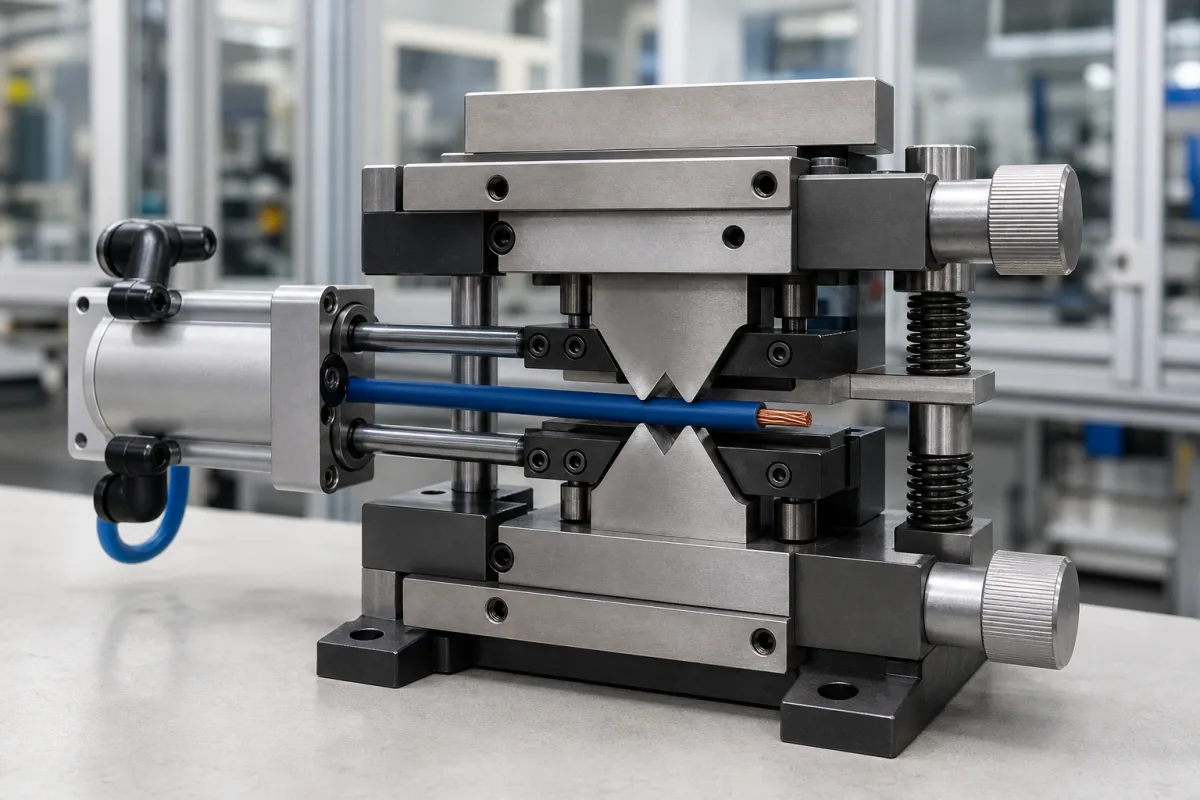
Representative product image. Confirm appearance and specifications with the manufacturer.

Product Specifications

Technical details and manufacturing context for Stripping Blade Assembly

Definition
The Stripping Blade Assembly is a critical component within an Automated Wire Stripping and Termination Machine. It consists of precisely aligned, adjustable blades that work in concert to cleanly cut and remove the insulation from electrical wires of various gauges. Its primary role is to prepare wire ends for subsequent termination processes, such as crimping or soldering, by exposing the conductive core with minimal nicking or deformation. The assembly is designed for use in electrical equipment manufacturing, where consistent and reliable wire processing is essential. The blades are typically made from tool steel or carbide, with the specific material grade (e.g., SK5 high carbon steel) and hardness (50–55 HRC) influencing wear resistance and cutting performance. The blade thickness ranges from 0.5 to 0.8 mm, and the assembly can handle wire cutting diameters from 0.5 to 6.0 mm. Stripping length accuracy is maintained within ±0.1 mm, ensuring precise insulation removal. The assembly operates within a temperature range of -20°C to 80°C and can withstand a maximum operating pressure of 1.6 MPa. It has an ingress protection rating of IP54, offering protection against dust and water splashes. The weight of the assembly is between 0.15 and 0.25 kg, making it suitable for integration into automated machinery. For specific applications, it is essential to verify that the assembly's parameters match the requirements of the wire type and the machine's specifications. Always confirm model-specific values and standards with the legal manufacturer or supplier before procurement.
Working Principle
The assembly operates by positioning the wire between two or more opposing blades. The blades are then actuated (often pneumatically or via a servo motor) to close with a controlled force and depth. A precise cutting motion severs the insulation, which is then pulled away as the wire is retracted or the blades open. Adjustments allow for setting the cut depth to match specific insulation thicknesses and wire diameters. The blade geometry and alignment are critical to ensure a clean cut without damaging the conductor. The cutting action is typically synchronized with the wire feed mechanism to achieve consistent strip lengths. The assembly may include features for quick blade replacement and adjustment to accommodate different wire sizes. Proper maintenance, including regular inspection for blade wear and alignment, is necessary to maintain performance. If the assembly is subjected to conditions beyond its specified operating limits (e.g., temperature, pressure, or cutting diameter), it may fail to strip correctly or cause damage to the wire or the machine.
Common Materials
Tool Steel, Carbide
Technical Parameters
ParameterTypical rangeNotes & selection driver
Blade MaterialSK5High carbon steel for wear resistanceJIS G4401
Blade Hardness50–55 HRCBalances sharpness and toughnessISO 6508
Blade Thickness0.5–0.8 mmAffects cutting precision
Cutting Diameter Range0.5–6.0 mmFor wire insulation stripping
Stripping Length Accuracy±0.1 mmEnsures consistent strip length
Max Operating Temperature80 °CAbove this, blade material may soften
Min Operating Temperature-20 °CBelow this, blade may become brittle
Max Operating Pressure1.6 MPaExceeding may damage assembly
Ingress Protection RatingIP54Protection against dust and water splashesIEC 60529
Weight0.15–0.25 kgLightweight for handheld tools

Ranges are indicative industry figures for RFQ preparation, not a supplier commitment. Confirm every value and standard with the legal manufacturer before ordering.

Components / BOM
  • Upper Blade Holder
    Secures and positions the upper cutting blade(s). Often includes adjustment mechanisms for depth and alignment.
    Material: Hardened Steel
  • Lower Blade Holder Part
    Secures and positions the lower cutting blade(s), opposing the upper blades to create the cutting action.
    Material: Hardened Steel
  • Cutting Blades Part
    The sharp, replaceable edges that perform the actual cutting of the wire insulation. Typically V-shaped or semi-circular to cradle the wire.
    Material: Carbide or Tool Steel
  • Adjustment Screws Part
    Allow for fine-tuning of blade gap (for wire diameter) and cutting depth (for insulation thickness).
    Material: Stainless Steel
  • Blade Actuation
    Closes the blades to the set depth and opens them again each cycle.

Industrial Ecosystem & Supply Chain Structure

Complementary Systems
Downstream Applications
Specialized Tooling

Application Fit & Sizing Matrix

Operational Limits
pressure: 0-5 bar
other spec: Wire diameter range: 0.5-10 mm
temperature: -20°C to 80°C
Media Compatibility
✓ PVC insulation ✓ Polyethylene insulation ✓ Rubber insulation
Unsuitable: Abrasive or metallic-coated wires
Sizing Data Required
  • Wire diameter
  • Insulation thickness
  • Production speed

Reliability & Engineering Risk Analysis

Failure Mode & Root Cause
Edge Dulling and Deformation
Cause: High-frequency impact with abrasive materials causing work hardening and plastic deformation, compounded by improper blade material selection for the specific stripping application.
Fatigue Cracking at Mounting Points
Cause: Cyclic loading from repetitive stripping operations leading to stress concentration at bolt holes or attachment interfaces, often accelerated by inadequate torque specifications or worn mounting hardware.
Maintenance Indicators
  • Audible high-pitched squealing or grinding during operation indicating blade-edge deterioration or misalignment
  • Visible uneven wear patterns or localized discoloration (blueing) on blade surfaces signaling overheating and loss of temper
Engineering Tips
  • Implement rotational indexing of multi-blade assemblies to distribute wear evenly across all cutting edges, combined with laser alignment verification during installation
  • Establish predictive maintenance through vibration analysis and thermal imaging to detect early-stage imbalances or friction anomalies before catastrophic failure

Indicative industry ranges for design and RFQ preparation. Confirm the exact figures and applicable standard with the manufacturer before specifying.

Compliance & Manufacturing Standards

Applicable Standards
ANSI B94.50-1975 - Industrial Cutting Tools DIN 8589-3 - Machining Processes - Part 3: Cutting

Quoted from the published standard.

Manufacturing Precision
  • Blade Thickness: +/-0.01mm
  • Mounting Hole Alignment: 0.05mm concentricity
Quality Inspection
  • Hardness Testing (Rockwell C scale)
  • Dimensional Verification with CMM

Manufacturers of Stripping Blade Assembly

Manufacturer profiles associated with Stripping Blade Assembly.

Sourcing Stripping Blade Assembly from China?
Tell us your specification and target quantity — we will match it against manufacturer records and come back with the factories that fit.
Request manufacturers We manufacture this

Manufacturer listings support early research and capability understanding. They are not certification, ranking, or transaction guarantees.

Technical documentation
Request current drawings, revision history, and a signed specification sheet.
Manufacturing capability
Verify equipment lists, process limits, capacity, and representative production evidence.
Inspection readiness
Confirm test methods, calibrated equipment, sampling plans, and traceable reports.
Supplier transparency
Check the legal entity, factory address, ownership, certifications, and direct contacts.

CNFX does not score or rank suppliers. Buyers must verify all claims and documents with the legal manufacturer before ordering.

Supply Chain Compatible Machinery & Devices

Circuit Breaker Arc Chute

The Circuit Breaker Arc Chute is a critical safety component in electrical circuit breakers, designed to rapidly extinguish electric arcs that form during circuit interruption.

Explore Specs →
Medium Voltage Switchgear Assembly Line

Automated production system for assembling medium voltage electrical switchgear.

Explore Specs →
Motor Terminal Block

A motor terminal block is a standardized electrical component that provides secure, insulated connection points for motor winding leads.

Explore Specs →
PLC Control System

A digital industrial computer control system that monitors inputs, makes decisions based on a custom program, and controls outputs to automate industrial processes.

Explore Specs →

Frequently Asked Questions

What materials are the blades made of?

The blades are typically made from tool steel or carbide. The specific material grade on file is SK5 high carbon steel, which provides wear resistance. The hardness is specified as 50–55 HRC, balancing sharpness and toughness.

What is the cutting diameter range?

The assembly is designed to strip insulation from wires with cutting diameters ranging from 0.5 mm to 6.0 mm. This range covers various wire gauges commonly used in electrical equipment manufacturing.

What is the stripping length accuracy?

The stripping length accuracy is ±0.1 mm, ensuring consistent and precise insulation removal. This accuracy is critical for subsequent termination processes like crimping or soldering.

What are the operating temperature limits?

The assembly can operate in temperatures from -20°C to 80°C. Exceeding these limits may affect blade material properties, such as softening at high temperatures or becoming brittle at low temperatures.

Data Basis

Editorial classification, named public sources where available, and source-reviewed manufacturer records.

Preliminary Technical Classification
This page supports structured research, RFQ preparation, and supplier evaluation. It does not replace buyer-led supplier qualification, standards review, or technical approval.
Buyer enquiry

Request manufacturing insight for Stripping Blade Assembly

Ask for use case, specification boundaries, supplier type, and RFQ preparation information for this product.

Where it goes
Straight to the CNFX editorial desk, and to the manufacturer if this product is linked to a claimed profile. Nothing is broadcast to a supplier list.
Your details stay here
We do not sell or rent enquiry data, and we do not add you to a mailing list. Used only to answer this request.
No commission, no middleman
CNFX is a directory. We take no cut of any order and never negotiate on a supplier's behalf.
What we don't claim
A listing is not an endorsement. Qualify every supplier and verify every figure yourself before ordering.

Your business information is used only to process this request.

Thank you! Your message has been sent. We'll respond within 1–3 business days.
Sorry, we couldn't send your message. Please try again, or email us at contact@cnfx.com.

Need to Manufacture Stripping Blade Assembly?

Compare manufacturer profiles with relevant product and process capability.

Previous Product
Wire Tensioning System
Last Product
Get QuotesChat