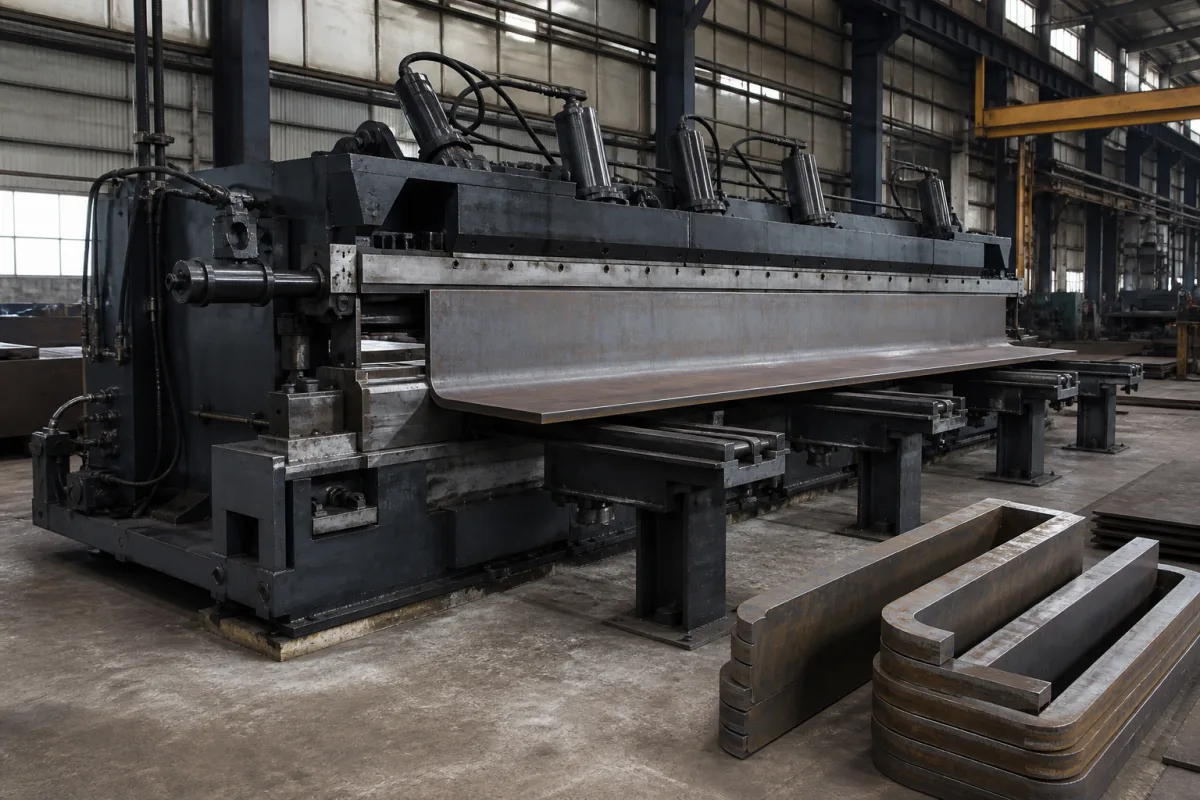
Metal plate folding machine (swing-beam folder that clamps the plate and swivels a folding beam)
Swing-beam folding machines for sheet and plate · Clamp-and-fold bending, 400 N/mm² thickness ratings, working length, upper beam opening and gauging
This page covers the folding machine type of metal plate bending machine: the blank lies on a table, a gauge positions it, the upper and lower beams clamp it, and a folding beam swivels around a pivot to make the bend. Ask three things first: the maximum thickness at 400 N/mm² over your full working length, the upper beam opening and box height your parts need, and the gauging system and automation level.
Manual and CNC swing-beam (swivel) folding machines and up-down folding centres for sheet and plate, where the blank is clamped between beams and bent by a folding beam. Hydraulic and electro-hydraulic press brakes that air-bend the blank into a V-die are covered on the Hydraulic press brake page. Plate rolls, panel benders with blade manipulators and roll-forming lines are outside this page.
CNFX editorial research · Sources checked October 12, 2026 · 4 sources
Understand clamp-and-fold bending and how it differs from a press brake
RAS describes the folding sequence this way: the blank rests on the sheet support table, a gauging system positions the part to the bend line, the upper and lower beam clamp the blank, and during the bending cycle the folding beam moves up around a pivot point; on up-down machines the folding beam moves upwards or downwards depending on the bending direction. On a press brake, by contrast, the upper ram moves down into the lower die, both sides of the part move up and leave the plane, and the operator holds and supports the blank. [1]
RAS states that on a folding machine the folding beam tool contacts the outside of the material and moves to the programmed angle, so the reference side is the outside of the material and sheet thickness tolerances do not affect the bend angle; on a press brake the punch and V-die contact both sides and thickness tolerances lead to angle variances. RAS also states that a folding machine gauges the entire part, while a press brake gauges the short flange. These are a folding-machine maker's own comparison. [1]
RAS states that folding machines bend all angles with a single set of tools and that radii can be made from short bending segments without special tools. [1] Editorial note: ask the supplier for sample parts in your material and thickness, because these statements come from the machine maker.
Give the supplier part drawings with flange lengths, box heights and hems, material grade and tensile strength, thickness range, maximum blank size and weight, and the batch sizes you run.
02
Size thickness, working length and upper beam opening
Folding machine thickness ratings are stated for a material strength and fall with working length. RAS lists its GIGAbend at 6.0 mm (RAS 76.30) over a 3,200 mm working length and 5.0 mm (RAS 76.40) over 4,060 mm, both at 400 N/mm², with 500 mm upper beam upstroke and 120 metric tons of upper beam clamping pressure; RAS's description gives 6 mm mild steel or 4 mm stainless. [2]
RAS lists the MEGAbend up-down folding machine at the same 6.0 mm (3,200 mm) and 5.0 mm (4,060 mm) ratings at 400 N/mm², with 850 mm maximum upper beam open height, 400 mm maximum four-sided box height, 10 or 12 stop finger units, 10 or 12 suction bars and automatic programming. [3]
At the manual end, Knuth lists the SB E 2060/2 folding machine with a 2,060 mm working length, 2 mm maximum plate thickness at 400 N/mm², a 135° bending bar angle range, 210 mm top beam travel, 100 mm adjustable lower bending beam, 1,750 kg weight and 2.9 × 0.65 × 1.74 m overall dimensions. [4]
Editorial calculation: on the GIGAbend, raising the working length from 3,200 to 4,060 mm (about 27% longer) lowers the rated mild-steel thickness from 6.0 to 5.0 mm, so state the thickness you need at your longest bend, not the headline figure. [2]
03
RAS GIGAbend, MEGAbend and Knuth SB E folding capacities
Compare ratings at the same material strength and working length.
Editorial calculation: the GIGAbend 76.30 occupies 4.62 × 2.43 ≈ 11.2 m² with the rectangular gauging system and 4.62 × 3.94 ≈ 18.2 m² with the J gauging system, before blank and part handling space. [2]
Machine
Rated thickness and length
Other published data
RAS GIGAbend 76.30 / 76.40
6.0 mm over 3,200 mm; 5.0 mm over 4,060 mm (400 N/mm²). [2]
120 t clamping; 500 mm upstroke; gauging 10–1,550 mm rectangular. [2]
RAS MEGAbend 76.30-2 / 76.40-2
6.0 mm over 3,200 mm; 5.0 mm over 4,060 mm (400 N/mm²). [3]
850 mm open height; 400 mm box height; automatic programming. [3]
Explore company information and manufacturing capabilities, then discuss the scope of your project with a relevant supplier.
Share this page
Compiled and source-reviewed by the CNFX editorial team.
Each manufacturer above links to the page on that company's own website where the product is listed, with the date we checked it. How we source and review
· Page last updated 13 October 2026
Buyer questions
How does a folding machine differ from a press brake?
RAS describes a folding machine as clamping the blank between upper and lower beams and swivelling a folding beam around a pivot, while a press brake drives the upper ram down into a lower die. [1]
How thick a plate can a folding machine bend?
RAS lists 6.0 mm over 3,200 mm and 5.0 mm over 4,060 mm at 400 N/mm²; Knuth's manual SB E 2060/2 is rated at 2 mm over 2,060 mm. [2][4]
How much clamping force does a heavy folder use?
RAS lists 120 metric tons of upper beam clamping pressure on its GIGAbend. [2]
Sources and what still needs a direct check
Sources checked 2026-10-12. RAS and Knuth describe their own folding machines; RAS's comparison with press brakes is a folding-machine maker's own view.