Metal forming · Roll configuration, pre-bending, capacity and minimum diameter
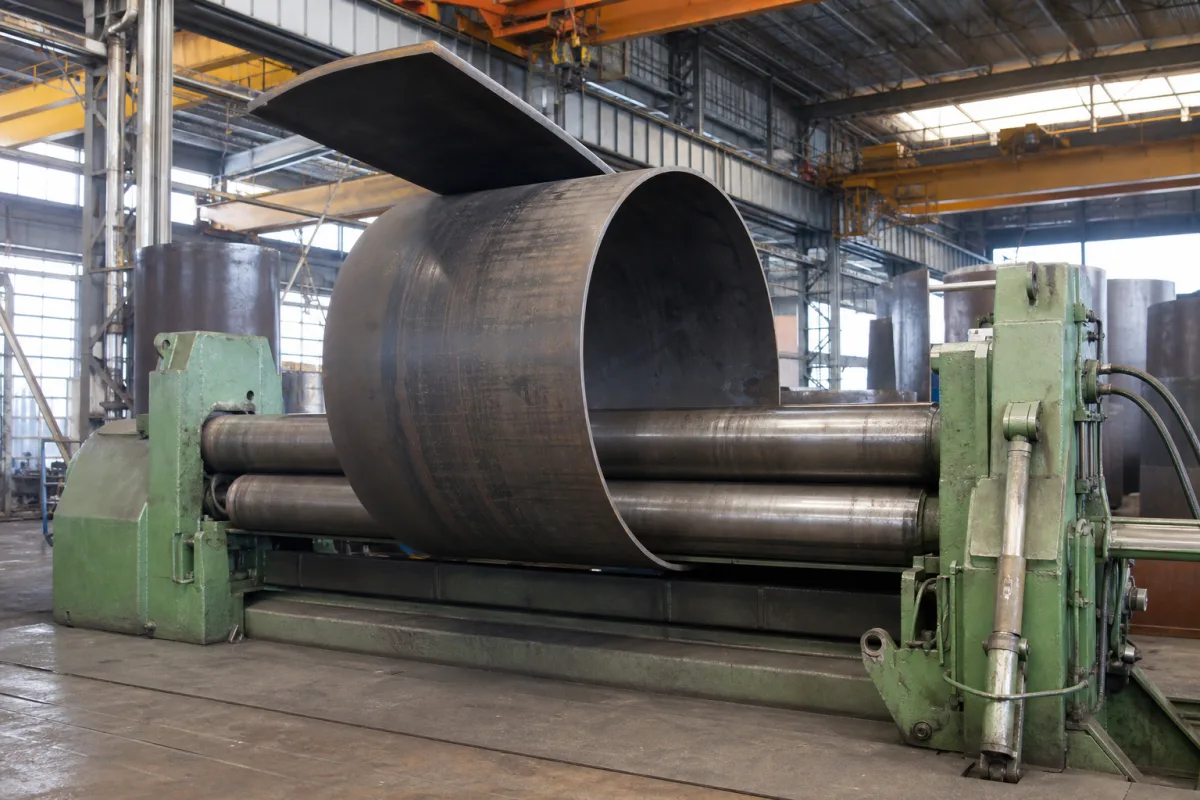
A plate roll bends flat plate into cylinders and cones between three or four rolls. Ask three things first: can it pre-bend both ends to minimise flats, what thickness can it roll and pre-bend in your material's strength, and how small a diameter can it make with its top roll.
Three-roll (initial pinch, double pinch, variable geometry), four-roll and vertical plate rolling machines for cylinders and cones. Section and profile benders, roll-forming lines and press brakes are outside this page.
CNFX editorial research · Sources checked October 12, 2026 · 4 sources
RMT, a plate roll supplier, describes the three-roll types: true pyramid rolls have fixed lower rolls and cannot pre-bend, leaving long flats; initial-pinch rolls suit lighter gauges and can pre-bend but need the sheet reloaded to do both ends; double-pinch rolls move the lower rolls and pre-bend both ends without removing the plate; four-roll machines are double-pinch machines with an extra roll under the top roll to keep the plate held. [1]
Variable-geometry three-roll machines move the lower rolls horizontally; RMT notes that wider spacing needs less force, like a wider V-die in a press brake, giving more capacity for heavy plate, and that lower rolls can be angled for cones. It also states that "almost without exception, the cost of a new three-roll machine is much lower when compared with a similar capacity 4-roll". [1]
Writing in The Fabricator, Paolo Seravesi of a three-roll maker argues that a variable-geometry three-roll machine leaves a shorter flat end than a traditional four-roll machine, whose leading edge must extend past the centre axis to stay clamped during pre-bending. Treat both makers' comparisons as their views and ask for trial rolls on your plate. [2]
Give the supplier the plate material and yield strength, thickness, width, smallest and largest diameters, cone geometry if any, how short the flat ends must be, and parts per shift.
02
Check capacity, pre-bend capacity and minimum diameter
Capacity is quoted for a stated material strength. Shenchong's W12 16×3100 four-roll machine, for example, is rated for 16 mm plate up to 3,200 mm wide at a yield limit of 245 MPa, but for 12 mm pre-bending, with a 360 mm top roll, 15 kW main motor and 4.5 m/min bending speed. [3]
Seravesi gives the minimum diameter as about 1.2 times the top-roll diameter on a four-roll machine and about 1.15 times or less on a variable-geometry three-roll machine. Editorial calculation: with a 360 mm top roll, 1.2 × 360 ≈ 430 mm minimum diameter. [2][3]
If your plate is stronger than the rated yield, or your diameter is near the minimum, ask the supplier for the derated capacity and a rolling trial.
03
Three-roll, four-roll and variable-geometry machines for plates, cones and profiles in the linked listings
KRRASS, Shenchong and Nantong Shengli list three-roll, four-roll and variable-geometry plate rolls, including machines for tanks and wind towers. [4][3]
KRRASS lists W11F, W11, W12, W11S and W24S rolling machines for plates, cones and profiles; Shenchong lists CNC four-roll machines such as the W12 16×3100; Nantong Shengli lists three- and four-roll machines and rolls for tanks and wind towers; Harting, CNHAWE, Prima and MetalWorkMaster list plate rolling machines among sheet-metal equipment. Capacities are suppliers' own figures at their stated yield strengths. [4][3]
04
Top roll, lower and side rolls, drives, hydraulics, frame and controls of a plate roll
Plate thickness and width, minimum diameter, roll speed and power values for a plate roll quotation
Published values in this table come from Shenchong's W12 16×3100 data and Paolo Seravesi's article in The Fabricator; where neither states a value, the row says what to obtain from the supplier.
Field
What it means and published values
Ask the supplier for
Maximum plate thickness (mm)
Rated at a stated yield, e.g. 16 mm at 245 MPa. [3]
Rolling and pre-bending thickness for your material.
Send the plate, parts and production data together
Paste it into your enquiry below or into an email to a maker, then replace every bracket.
Plate: [material; yield strength; thickness range; width; length]
Parts: [cylinders and cones; diameters; tolerances; flat-end limit]
Machine: [three-roll type, four-roll or variable geometry; horizontal or vertical]
Capacity: [rolling and pre-bending thickness at your yield; minimum diameter]
Handling: [side and overhead supports; feeding table; crane]
Controls: [NC or CNC; programs]
Documents: [capacity chart; trial roll on your plate; foundation drawing]
12 companies list this product among what they make. Company figures are quoted from each
company's own website; every card states where the relationship came from.
Wuxi Shenchong Forging Machine Co., Ltd.
Manufacturing site to be confirmed for the order
Lists CNC four-roll plate rolling machines such as the W12 16×3100.
Explore company information and manufacturing capabilities, then discuss the scope of your project with a relevant supplier.
Share this page
Compiled and source-reviewed by the CNFX editorial team.
Each manufacturer above links to the page on that company's own website where the product is listed, with the date we checked it. How we source and review
· Page last updated 13 October 2026
Buyer questions
Three-roll or four-roll plate roll?
Four-roll and double-pinch three-roll machines can pre-bend both ends without reloading; makers disagree on which leaves shorter flats, so ask for trial rolls. [1][2]
What is the smallest diameter a plate roll can make?
One maker gives about 1.2 times the top-roll diameter on four-roll machines and about 1.15 times on variable-geometry three-roll machines. [2]
Why is pre-bend capacity lower than rolling capacity?
Pre-bending the plate edge needs more force; one 16 mm machine is rated for 12 mm pre-bending at the same yield. [1][3]
Sources and what still needs a direct check
Sources checked 2026-10-12. RMT is a plate roll supplier explaining three-roll configurations. Paolo Seravesi of a variable-geometry plate roll maker wrote the Fabricator article. Both describe makers' views. Supplier pages describe their own offers.