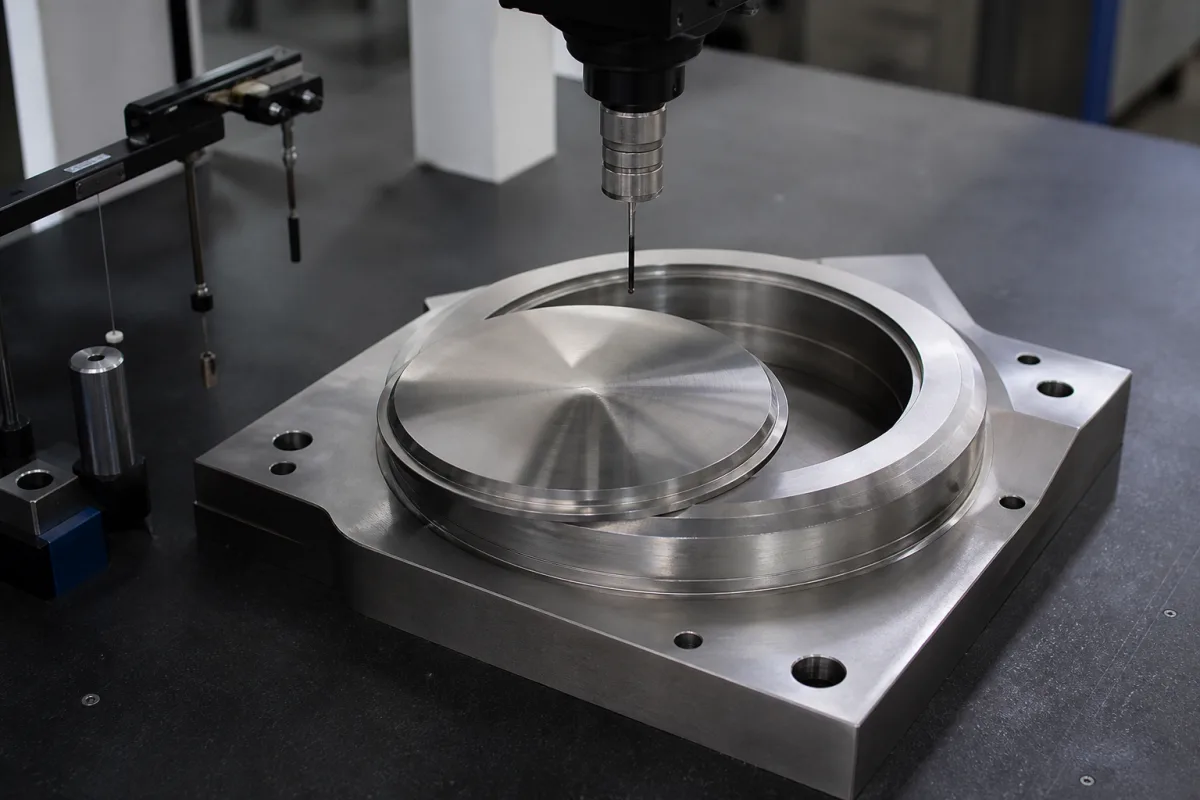
Pressure relief valve disc and seat assembly (trim) for replacement and repair
Relief valve trim · Seat tightness as a percentage of set pressure, metal and O-ring soft seats, seat geometry, repair rules for lapping and replacement
A disc and seat assembly is the pair of parts in a spring-loaded pressure relief valve that seal against each other until set pressure is reached: the disc (or disc insert in its holder) and the seat, which on full-nozzle valves is the top of the nozzle. Ask three things first: what seat tightness the trim holds as a percentage of set pressure, whether a metal or an O-ring soft seat suits the fluid and temperature, and who is authorised to lap or replace the parts.
Discs, disc inserts and holders, nozzles and seat bushings, and soft-seat O-rings supplied as replacement trim or machined and lapped in repair of spring-loaded pressure relief and safety valves. Complete relief valves, with their set pressure, overpressure, blowdown, back pressure and installation, are covered on the Pressure relief valve page. Seat assemblies for on-off or control valves and gauges for checking seats are outside this page.
CNFX editorial research · Sources checked October 12, 2026 · 3 sources
Read seat tightness as a percentage of set pressure
Dresser Industries' patent EP 0 753 117 B1 defines seat tightness as the ratio of the pressure at which a valve begins to leak or simmer to its opening pressure: a valve set at 500 psi that starts to leak at 480 psi has 96% seat tightness. It gives 94% as the seat tightness a prior-art valve with a 45° disc seat may have, and claims 97–98% for a disc with a flexible annular lip and seat surfaces at about 60°, illustrated at 1,200 psi and 1,000 °F. [1]
Emerson's Crosby J-Series data sheet states that its two-piece disc holder and disc insert give thermal balancing for seat tightness meeting API Standard 527, and that O-ring soft-seat valves are tightness tested at 95% of set pressure; in that design a flat metal-to-metal seat downstream of the O-ring controls its compression and acts as a secondary seal. [2]
Editorial calculation: for a valve set at 500 psi on a system running at 450 psi (90% of set), trim that starts to leak at 94% (470 psi) leaves 20 psi of margin, while 97% (485 psi) leaves 35 psi; ask the supplier for the tested leak point of the trim, not only for compliance with a leakage standard. Operating pressure is an assumed example. [1]
Give the supplier the valve maker, model, size, orifice letter and serial number, set pressure, fluid and temperature, operating pressure as a percentage of set, seat type (metal or soft), the leak history, and whether the work is a like-for-like replacement or a repair.
02
Choose metal or O-ring soft seats and the trim materials
In Emerson's Crosby J-Series data sheet, the conventional valve lists the nozzle and nozzle ring in 316 stainless steel, the disc holder in 316L and the disc insert in 316 stainless steel, with soft-seat O-rings offered in FKM, NBR, EPR, TFE, silicone rubber and FFKM and other materials on application. The series covers −450 to +1,000 °F overall. [2]
Dresser's patent explains that its flexible lip deflects under spring load and operating pressure so the disc keeps contact with the seat bushing as temperature and pressure change, which is the mechanism behind its stated rise from about 94% to 97–98% seat tightness. [1]
03
Treat lapping and part replacement as a repair
A National Board BULLETIN article on improper safety valve repairs (S. F. Harrison Jr., presented in May 1983) quotes NB-65, which defines a repair as replacement, remachining or cleaning of any critical part, lapping of seat and disk, or any other operation that may affect flow passage, capacity, function or pressure-retaining integrity; it notes the National Board approved its 'VR' repair stamp programme in 1977. [3]
The article lists, as improper repairs, altering special disks designed for high-pressure steam, and machining or lapping a seating surface flat when the manufacturer specifies a slight bevel such as 3 to 4 degrees; it also warns that springs suit a narrow set-pressure range and that bent spindles or galled guides can stop the valve reaching full lift. [3]
04
Disc insert, disc holder, nozzle seat, soft-seat O-ring, guide and spring
Explore company information and manufacturing capabilities, then discuss the scope of your project with a relevant supplier.
Share this page
Compiled and source-reviewed by the CNFX editorial team.
Each manufacturer above links to the page on that company's own website where the product is listed, with the date we checked it. How we source and review
· Page last updated 13 October 2026
Buyer questions
What does seat tightness mean?
Dresser's patent EP 0 753 117 B1 defines it as the leak or simmer pressure divided by the opening pressure, e.g. 480 psi over 500 psi = 96%. [1]
At what pressure are soft-seat relief valves leak tested?
Emerson's Crosby J-Series data sheet says O-ring soft-seat valves are tightness tested at 95% of set pressure. [2]
Is lapping a relief valve seat a repair?
Yes: a National Board article quotes NB-65, which counts lapping of seat and disk as a repair, and warns against lapping flat a seat specified with a 3–4° bevel. [3]
Sources and what still needs a direct check
Sources checked 2026-10-12. Dresser's patent and Emerson's Crosby data sheet describe their own valve designs. The National Board of Boiler and Pressure Vessel Inspectors' article explains repair rules.