Industry-Verified Manufacturing Data (2026)

High-Strength Aluminum Alloy Extrusion Billet

Based on aggregated insights from multiple verified factory profiles within the CNFX directory, the standard High-Strength Aluminum Alloy Extrusion Billet used in the Fabricated Metal Product Manufacturing sector typically supports operational capacities ranging from standard industrial configurations to heavy-duty production requirements.

Technical Definition & Core Assembly

A canonical High-Strength Aluminum Alloy Extrusion Billet is characterized by the integration of Aluminum Matrix and Grain Refiner. In industrial production environments, manufacturers listed on CNFX commonly emphasize Aluminum Alloy 6061 construction to support stable, high-cycle operation across diverse manufacturing scenarios.

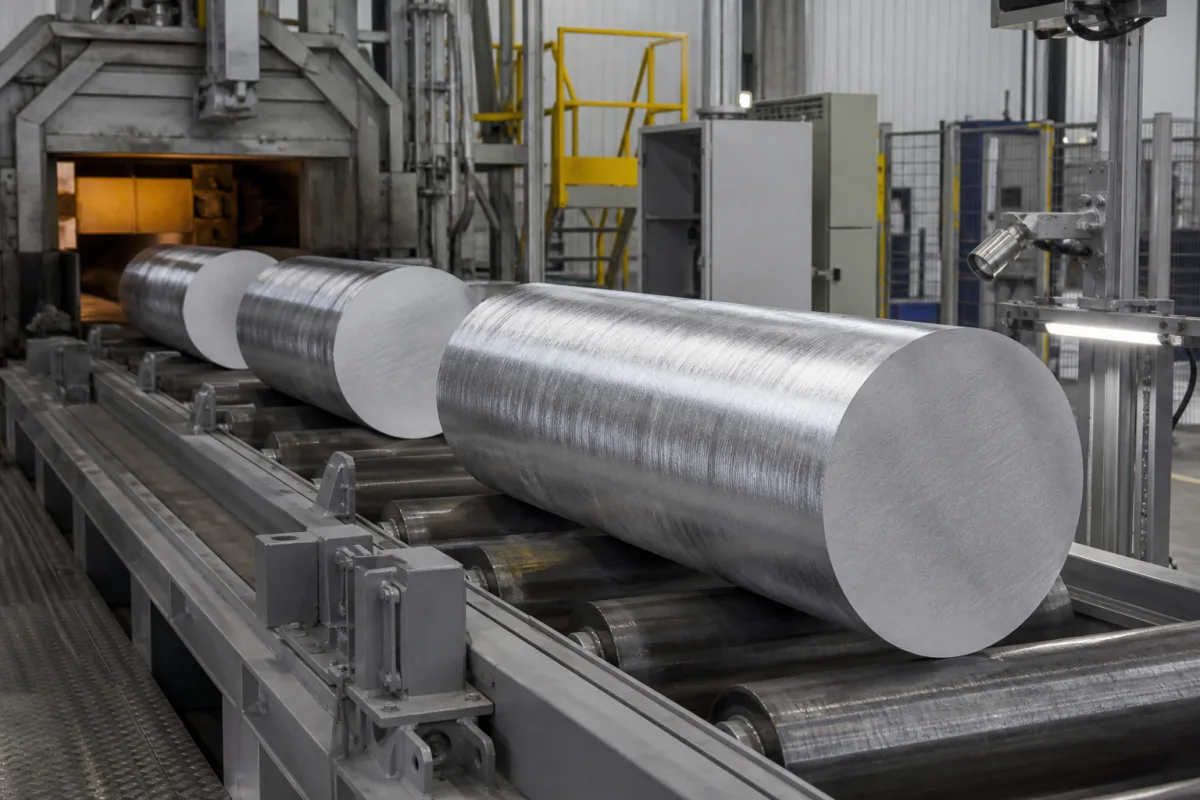
Semi-finished aluminum alloy stock for industrial extrusion processes.

Product Specifications

Technical details and manufacturing context for High-Strength Aluminum Alloy Extrusion Billet

Definition
A high-strength aluminum alloy extrusion billet is a semi-finished industrial material supplied as cylindrical or rectangular logs. It serves as the raw feedstock for hot extrusion presses to manufacture complex structural profiles, tubes, and custom shapes. In B2B supply chains, it is a critical upstream material for fabricators in construction, automotive, and aerospace sectors. Its consistent metallurgical properties ensure dimensional accuracy and mechanical performance in final fabricated components.
Working Principle
The billet is heated to a plastic state and forced through a die under high pressure, deforming it into a continuous profile matching the die's cross-section.
Common Materials
Aluminum Alloy 6061, Aluminum Alloy 7075
Technical Parameters
  • Standard billet diameter for extrusion press compatibility (mm) Per Request
  • Minimum tensile strength of the alloy temper (MPa) Per Request
Components / BOM
  • Aluminum Matrix
    Primary metallic base providing structural integrity
    Material: Aluminum with alloying elements
  • Grain Refiner
    Controls microstructure to prevent cracking during extrusion
    Material: Titanium Boride (TiB2)
Engineering Reasoning
350-550°C billet temperature, 10-40 MPa extrusion pressure, 0.5-5.0 m/min extrusion speed
Billet temperature below 300°C causes flow stress exceeding 100 MPa, billet temperature above 600°C initiates incipient melting at grain boundaries, extrusion pressure exceeding 60 MPa causes die deflection >0.5 mm
Design Rationale: Thermal softening coefficient of aluminum alloys (approximately 0.3-0.5 MPa/°C) governs flow stress; incipient melting occurs at eutectic phase boundaries (typically 520-580°C for 6xxx series alloys); die deflection follows Hooke's Law with Young's modulus of 200 GPa for tool steel
Risk Mitigation (FMEA)
Trigger Insufficient billet preheating to below 300°C
Mode: Extrusion pressure surge to >60 MPa causing die deflection and dimensional inaccuracy
Strategy: Closed-loop PID temperature control with 3-zone induction heating and infrared verification
Trigger Excessive billet heating above 600°C for >15 minutes
Mode: Grain boundary liquation and surface tearing during extrusion
Strategy: Multi-point thermocouple array with automatic quench system activation at 580°C

Industry Taxonomies & Aliases

Commonly used trade names and technical identifiers for High-Strength Aluminum Alloy Extrusion Billet.

Industrial Ecosystem & Supply Chain DNA

Complementary Systems
Downstream Applications
Specialized Tooling

Application Fit & Sizing Matrix

Operational Limits
pressure: Up to 10,000 psi (extrusion press capacity), 0-500 psi (post-extrusion service)
other spec: Flow rate: 0.5-5 m/min (extrusion speed), Slurry concentration: N/A (solid billet)
temperature: 400-500°C (extrusion process range), ambient to 200°C (post-extrusion service)
Media Compatibility
✓ Architectural structural components ✓ Automotive chassis/frame members ✓ Aerospace structural extrusions
Unsuitable: Marine/saltwater immersion environments without protective coating
Sizing Data Required
  • Required final cross-sectional area (mm²)
  • Extrusion ratio (billet area/final area)
  • Required billet length for production run

Reliability & Engineering Risk Analysis

Failure Mode & Root Cause
Stress corrosion cracking
Cause: Exposure to chloride-containing environments combined with residual stresses from extrusion or improper heat treatment, leading to crack initiation and propagation along grain boundaries.
Thermal fatigue cracking
Cause: Repeated thermal cycling during extrusion processes causing localized plastic deformation and microcrack formation at surface imperfections or inclusions.
Maintenance Indicators
  • Visible surface discoloration or white powdery deposits indicating active corrosion
  • Audible cracking or popping sounds during heating cycles suggesting internal stress relief or crack propagation
Engineering Tips
  • Implement controlled atmosphere heating with precise temperature uniformity (±5°C) to minimize thermal gradients and residual stresses
  • Apply protective ceramic-based coatings prior to extrusion and maintain strict chloride contamination control in cooling media

Compliance & Manufacturing Standards

Reference Standards
ISO 6362-2:2014 - Wrought aluminium and aluminium alloys - Extruded rods/bars, tubes and profiles - Part 2: Mechanical properties ASTM B221-21 - Standard Specification for Aluminum and Aluminum-Alloy Extruded Bars, Rods, Wire, Profiles, and Tubes DIN EN 755-2:2016 - Aluminium and aluminium alloys - Extruded rod/bar, tube and profiles - Part 2: Mechanical properties
Manufacturing Precision
  • Diameter tolerance: +/-0.05mm for diameters up to 50mm
  • Straightness tolerance: 0.5mm per meter length
Quality Inspection
  • Spectrographic Analysis for alloy composition verification
  • Ultrasonic Testing for internal defects detection

Factories Producing High-Strength Aluminum Alloy Extrusion Billet

Verified manufacturers with capability to produce this product in China

✓ 95% Supplier Capability Match Found

T Technical Director from Brazil Feb 16, 2026
★★★★★
"Standard OEM quality for Fabricated Metal Product Manufacturing applications. The High-Strength Aluminum Alloy Extrusion Billet arrived with full certification."
Technical Specifications Verified
P Project Engineer from Canada Feb 13, 2026
★★★★☆
"Great transparency on the High-Strength Aluminum Alloy Extrusion Billet components. Essential for our Fabricated Metal Product Manufacturing supply chain. (Delivery took slightly longer than expected, but technical support was excellent.)"
Technical Specifications Verified
S Sourcing Manager from United States Feb 10, 2026
★★★★★
"The High-Strength Aluminum Alloy Extrusion Billet we sourced perfectly fits our Fabricated Metal Product Manufacturing production line requirements."
Technical Specifications Verified
Verification Protocol

“Feedback is collected from verified sourcing managers during RFQ (Request for Quote) and factory evaluation processes on CNFX. These reports represent historical performance data and technical audit summaries from our B2B manufacturing network.”

5 sourcing managers are analyzing this specification now. Last inquiry for High-Strength Aluminum Alloy Extrusion Billet from Brazil (1h ago).

Supply Chain Commonly Integrated Components

Aluminum Shell

The outer protective casing component of a pharmaceutical vial aluminum seal

Explore Specs →
Material Handling Crane

Overhead lifting equipment for transporting aluminum profiles between processing stations in an anodizing line

Explore Specs →
Anodizing Tank Module

A modular tank unit designed for the electrochemical anodizing process of aluminum profiles, containing electrolyte solution and electrodes.

Explore Specs →
Rectifier Power Supply

A specialized power conversion device that converts alternating current (AC) to direct current (DC) for electrochemical processes.

Explore Specs →

Frequently Asked Questions

What are the key differences between 6061 and 7075 aluminum alloy billets?

6061 aluminum alloy offers excellent weldability and corrosion resistance with good strength, while 7075 provides superior strength-to-weight ratio and higher tensile strength, making it ideal for high-stress applications.

What industrial applications are suitable for T6/T651 tempered aluminum extrusion billets?

T6/T651 tempered billets are ideal for structural components, aerospace parts, automotive frames, machinery components, and architectural extrusions where high strength and dimensional stability are required.

Can you provide custom diameter and length specifications for aluminum extrusion billets?

Yes, we offer custom diameter and length specifications to meet specific extrusion press requirements. Standard diameters range from 100mm to 500mm, with lengths typically between 500mm and 7000mm, customizable per project needs.

Can I contact factories directly on CNFX?

CNFX is an open directory, not a transaction platform. Each factory profile provides direct contact information and production details to help you initiate direct inquiries with Chinese suppliers.

Get Quote for High-Strength Aluminum Alloy Extrusion Billet

Request technical pricing, lead times, or customized specifications for High-Strength Aluminum Alloy Extrusion Billet directly from verified manufacturing units.

Your business information is encrypted and only shared with verified High-Strength Aluminum Alloy Extrusion Billet suppliers.

Thank you! Your message has been sent. We'll respond within 1–3 business days.

Need to Manufacture High-Strength Aluminum Alloy Extrusion Billet?

Connect with verified factories specializing in this product category

Add Your Factory Contact Us
Previous Product
Heavy-Duty Aluminum Profile Multi-Axis CNC Machining Center
Next Product
High-Strength Low-Alloy Steel Plate