Industry-Verified Manufacturing Data (2026)

High-Strength Low-Alloy Steel Plate

Based on aggregated insights from multiple verified factory profiles within the CNFX directory, the standard High-Strength Low-Alloy Steel Plate used in the Fabricated Metal Product Manufacturing sector typically supports operational capacities ranging from standard industrial configurations to heavy-duty production requirements.

Technical Definition & Core Assembly

A canonical High-Strength Low-Alloy Steel Plate is characterized by the integration of Base Iron Matrix and Strengthening Alloy Elements. In industrial production environments, manufacturers listed on CNFX commonly emphasize Iron construction to support stable, high-cycle operation across diverse manufacturing scenarios.

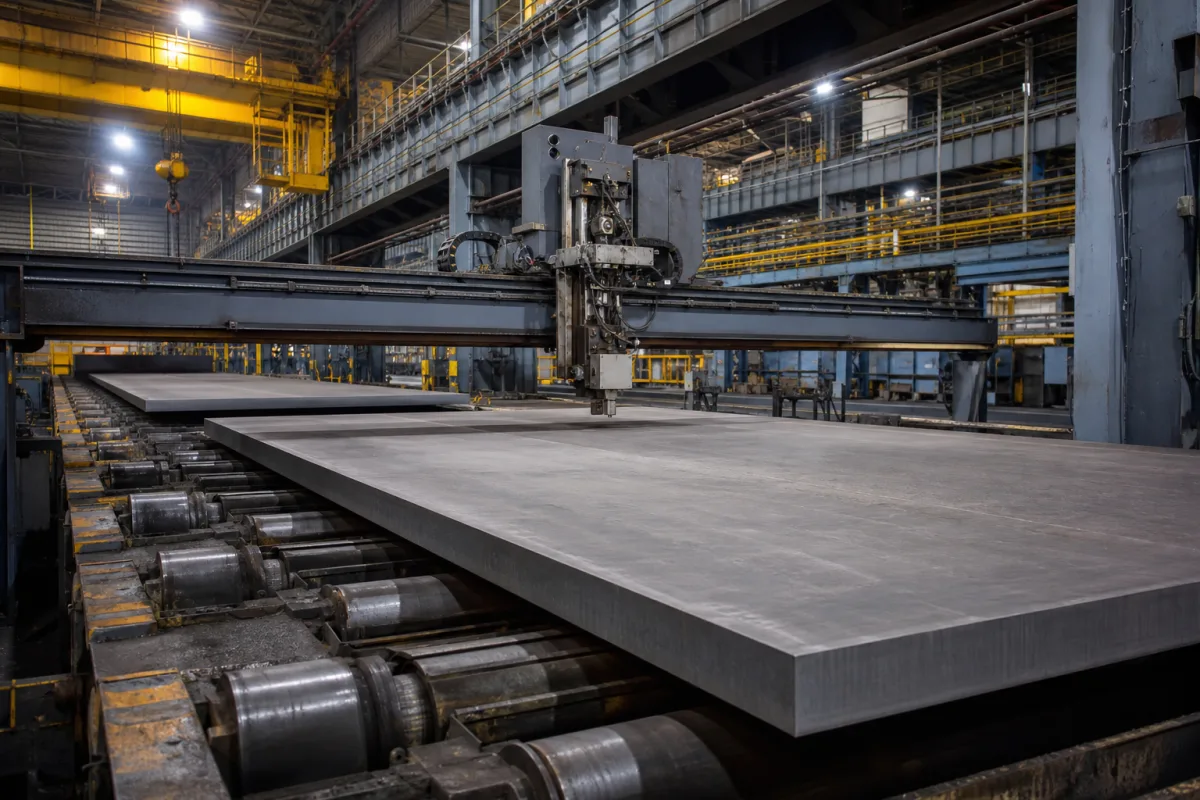
Structural steel plate with enhanced strength and weldability for industrial containers.
Product Specifications

Technical details and manufacturing context for High-Strength Low-Alloy Steel Plate

Definition
High-strength low-alloy (HSLA) steel plate is a semi-finished industrial material specifically engineered for manufacturing metal tanks, reservoirs, and pressure vessels. It provides superior mechanical properties compared to conventional carbon steels while maintaining excellent formability and weldability. This material is essential in B2B supply chains for fabricators who produce storage containers for chemicals, petroleum, water, and industrial gases. Its balanced composition reduces weight while increasing structural integrity, making it cost-effective for large-scale container production.
Working Principle
Achieves enhanced mechanical properties through precise alloying elements (like niobium, vanadium, or titanium) in small quantities, which refine grain structure and create precipitation hardening effects during controlled rolling processes.
Common Materials
Iron, Carbon, Manganese, Micro-alloying elements (Nb, V, Ti)
Technical Parameters
  • Minimum yield strength indicating structural load capacity (MPa) Per Request
  • Ultimate tensile strength before failure (MPa) Per Request
Components / BOM
  • Base Iron Matrix
    Primary structural framework providing bulk material properties
    Material: Iron with controlled carbon content
  • Strengthening Alloy Elements
    Precipitation hardening and grain refinement for enhanced strength
    Material: Niobium, Vanadium, or Titanium additions
Engineering Reasoning
Yield strength: 345-690 MPa, Tensile strength: 450-830 MPa, Operating temperature: -40°C to 400°C, Thickness: 6-150 mm
Fracture occurs at stress exceeding 0.9×UTS (Ultimate Tensile Strength) or below -50°C where Charpy V-notch impact energy drops below 27 J
Design Rationale: Cleavage fracture initiation at carbide precipitates along grain boundaries when stress exceeds cohesive strength of Fe3C interfaces, accelerated by hydrogen embrittlement at diffusion rates >1×10^-11 m²/s
Risk Mitigation (FMEA)
Trigger Hydrogen concentration exceeding 2 ppm at grain boundaries during welding with moisture-contaminated electrodes
Mode: Delayed cracking within 24-72 hours post-weld due to hydrogen-induced cold cracking (HICC)
Strategy: Pre-heat to 150°C minimum with interpass temperature control ≤250°C using low-hydrogen electrodes (AWS E7018) and post-weld heating at 250°C for 2 hours per 25 mm thickness
Trigger Cyclic loading at stress range Δσ ≥ 207 MPa with stress ratio R=0.1
Mode: Fatigue crack propagation from surface inclusions at rate da/dN = 6×10^-9×(ΔK)^3 m/cycle where ΔK=20 MPa√m
Strategy: Shot peening to induce 400-600 MPa compressive residual stress layer of 0.1-0.3 mm depth with surface roughness Ra≤3.2 μm

Industry Taxonomies & Aliases

Commonly used trade names and technical identifiers for High-Strength Low-Alloy Steel Plate.

Industrial Ecosystem & Supply Chain DNA

Complementary Systems
Downstream Applications
Specialized Tooling

Application Fit & Sizing Matrix

Operational Limits
pressure: Up to 100 MPa (depending on thickness and design)
other spec: Slurry concentration: Up to 60% solids by weight (depending on abrasiveness)
temperature: -40°C to 400°C
Media Compatibility
✓ Industrial water and wastewater ✓ Petroleum products (crude oil, diesel) ✓ Dry bulk solids (grains, minerals)
Unsuitable: Concentrated acids (e.g., hydrochloric acid, sulfuric acid) due to corrosion risk
Sizing Data Required
  • Required plate thickness (based on structural load calculations)
  • Container dimensions (length, width, height)
  • Design pressure and temperature conditions

Reliability & Engineering Risk Analysis

Failure Mode & Root Cause
Hydrogen-induced cracking (HIC)
Cause: Absorption of atomic hydrogen from corrosive environments (e.g., wet H2S service), leading to internal cracking and blistering due to high-strength microstructure susceptibility.
Stress corrosion cracking (SCC)
Cause: Combination of tensile stress (residual or applied) and corrosive environments (e.g., chlorides, caustics), exploiting microstructural inhomogeneities in the alloy.
Maintenance Indicators
  • Visible surface blistering or bulging indicating internal hydrogen damage
  • Sudden appearance of crack networks or audible 'crackling' sounds during thermal cycling
Engineering Tips
  • Implement strict control of environmental exposure (e.g., pH monitoring, H2S partial pressure limits) and use hydrogen diffusion barriers like coatings.
  • Apply post-weld heat treatment (PWHT) to relieve residual stresses and optimize microstructure, particularly in welded joints.

Compliance & Manufacturing Standards

Reference Standards
ASTM A572/A572M - Standard Specification for High-Strength Low-Alloy Columbium-Vanadium Structural Steel EN 10025-4 - Hot rolled products of structural steels - Part 4: Technical delivery conditions for thermomechanical rolled weldable fine grain structural steels ISO 630-2 - Structural steels - Part 2: Technical delivery conditions for structural steels for general purposes
Manufacturing Precision
  • Thickness: +/- 0.25mm for plates up to 10mm thick
  • Flatness: 5mm per meter of length
Quality Inspection
  • Ultrasonic Testing (UT) for internal defects
  • Tensile Testing for yield strength and ultimate tensile strength

Factories Producing High-Strength Low-Alloy Steel Plate

Verified manufacturers with capability to produce this product in China

✓ 95% Supplier Capability Match Found

P Procurement Specialist from Brazil Jan 08, 2026
★★★★★
"Found 13+ suppliers for High-Strength Low-Alloy Steel Plate on CNFX, but this spec remains the most cost-effective."
Technical Specifications Verified
T Technical Director from Canada Jan 05, 2026
★★★★★
"The technical documentation for this High-Strength Low-Alloy Steel Plate is very thorough, especially regarding Yield Strength (MPa)."
Technical Specifications Verified
P Project Engineer from United States Jan 02, 2026
★★★★★
"Reliable performance in harsh Fabricated Metal Product Manufacturing environments. No issues with the High-Strength Low-Alloy Steel Plate so far."
Technical Specifications Verified
Verification Protocol

“Feedback is collected from verified sourcing managers during RFQ (Request for Quote) and factory evaluation processes on CNFX. These reports represent historical performance data and technical audit summaries from our B2B manufacturing network.”

14 sourcing managers are analyzing this specification now. Last inquiry for High-Strength Low-Alloy Steel Plate from India (52m ago).

Supply Chain Commonly Integrated Components

Aluminum Shell

The outer protective casing component of a pharmaceutical vial aluminum seal

Explore Specs →
Material Handling Crane

Overhead lifting equipment for transporting aluminum profiles between processing stations in an anodizing line

Explore Specs →
Anodizing Tank Module

A modular tank unit designed for the electrochemical anodizing process of aluminum profiles, containing electrolyte solution and electrodes.

Explore Specs →
Rectifier Power Supply

A specialized power conversion device that converts alternating current (AC) to direct current (DC) for electrochemical processes.

Explore Specs →

Frequently Asked Questions

What makes this steel plate suitable for metal tank manufacturing?

This HSLA steel plate offers enhanced strength-to-weight ratio, excellent weldability, and superior impact resistance (Charpy Impact Value), ensuring durable and reliable construction for tanks, reservoirs, and containers that withstand industrial stresses.

How do micro-alloying elements improve the steel plate's performance?

Micro-alloying elements like Niobium (Nb), Vanadium (V), and Titanium (Ti) refine the grain structure during production, increasing tensile and yield strength while maintaining good elongation and weldability, crucial for fabricating large metal containers.

What specifications are critical for container applications?

Key specs include Charpy Impact Value for toughness, tensile and yield strength for load-bearing capacity, elongation for formability, and thickness/width dimensions for fabrication flexibility in constructing tanks and reservoirs.

Can I contact factories directly on CNFX?

CNFX is an open directory, not a transaction platform. Each factory profile provides direct contact information and production details to help you initiate direct inquiries with Chinese suppliers.

Get Quote for High-Strength Low-Alloy Steel Plate

Request technical pricing, lead times, or customized specifications for High-Strength Low-Alloy Steel Plate directly from verified manufacturing units.

Your business information is encrypted and only shared with verified High-Strength Low-Alloy Steel Plate suppliers.

Thank you! Your message has been sent. We'll respond within 1–3 business days.

Need to Manufacture High-Strength Low-Alloy Steel Plate?

Connect with verified factories specializing in this product category

Add Your Factory Contact Us
Previous Product
High-Strength Aluminum Alloy Extrusion Billet
Next Product
High-Strength Structural Steel Plate