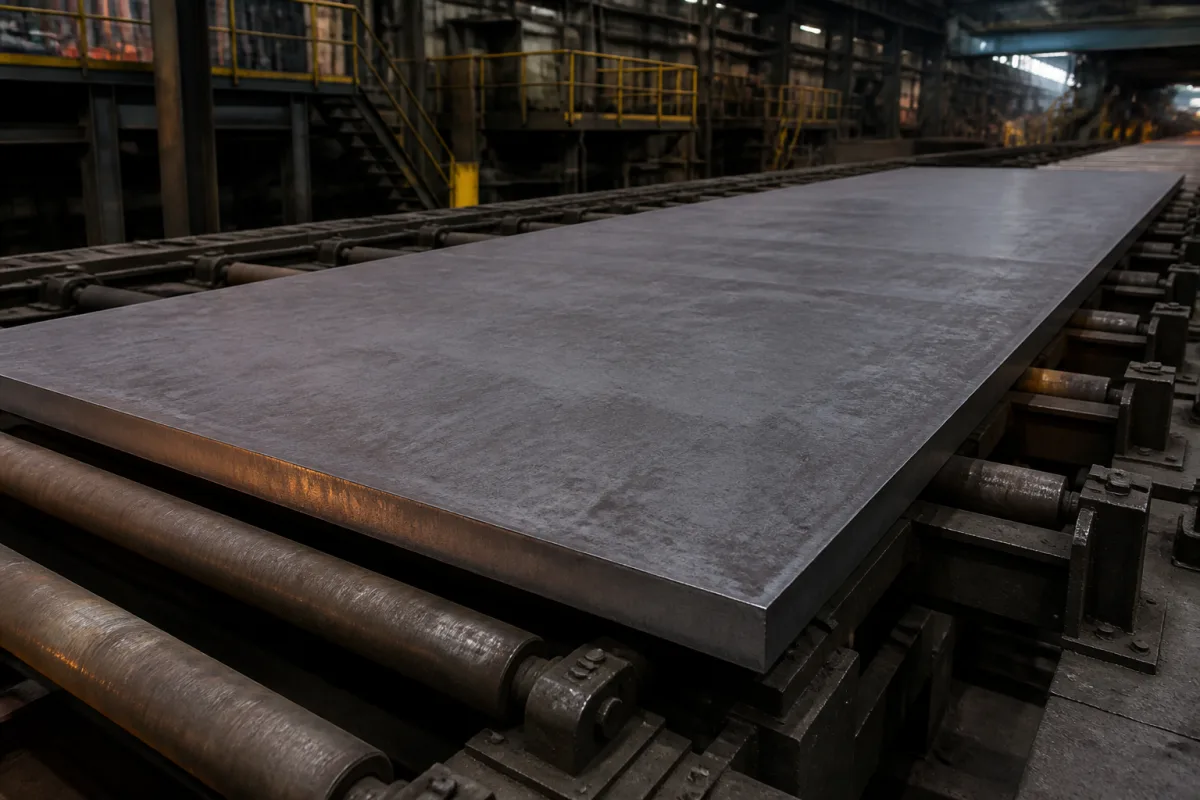
Ordinary-strength plate · A36, S235/S275, Q235 and SS400 classes, yield by thickness, impact subgrades and mill size windows
Hot-rolled carbon steel plate in ordinary-strength grades is flat steel rolled hot from slab and sold as discrete plates for tanks, containers, base plates, brackets and general fabrication, in the 235–275 MPa minimum-yield class: ASTM A36 and A283, EN 10025-2 S235 and S275, GB Q235 and JIS SS400. Ask three things first: which grade and thickness band sets the minimum yield, which impact subgrade the plate is tested to, and whether the mill can roll the thickness, width and length you need.
As-rolled carbon steel plate in ordinary structural and general-purpose grades with minimum yield around 235–275 MPa, including floor plate ordered to a plate grade. Higher-strength structural plate from S355 class to quenched-and-tempered grades around 700 MPa is covered on the High-strength structural steel plate page. Pressure-vessel, shipbuilding and wear-resistant plate, coil, sheet and sections are outside this page.
CNFX editorial research · Sources checked October 12, 2026 · 3 sources
Read the minimum yield by grade and thickness, and check what will be delivered
AISC's 2022 Modern Steel Construction article on specifying materials, written for the 16th edition Steel Construction Manual, gives ASTM A36 plate as Fy = 36 ksi and Fu = 58 ksi. It adds that if plate is specified as A36 it is "very likely" to arrive as A572 Grade 50 plate (Fy = 50 ksi, Fu = 65 ksi), because A572 Grade 50 meets the mechanical requirements of A36, and that the new Manual prefers A572 Grade 50 for connecting elements while keeping A36 as the preferred material for connecting elements 4 in. through 8 in. thick. [1]
Editorial calculation: 36 ksi × 6.895 = 248 MPa and 58 ksi × 6.895 = 400 MPa, which places A36 in the same minimum-yield class as S235–S275. Design to the grade ordered; a plate certified to a higher grade is a property of that delivery, not of the order.
For European grades, the Steel Construction Institute's steelconstruction.info table for BS EN 10025-2 gives S275 minimum yield of 275 N/mm² for t ≤ 16 mm, 265 for 16 < t ≤ 40 mm, 255 for 40 < t ≤ 63 mm and 245 for 63 < t ≤ 80 mm, with minimum tensile strength of 410 N/mm² for 3 < t ≤ 100 mm and 400 for 100 < t ≤ 150 mm. The UK National Annex to BS EN 1993-1-1 allows the minimum yield for the particular thickness to be used as the characteristic yield strength. [2]
Editorial calculation: a 50 mm S275 plate is designed at 255 N/mm², 7% below the 275 N/mm² of a 12 mm plate of the same grade ((275 − 255) / 275 = 7.3%). State the thickness on the order so the right row applies.
Give the supplier the grade and standard (A36, A283, S235/S275 with subgrade, Q235 with quality class, SS400), thickness, width and length with tolerances, impact test temperature, any ultrasonic testing, surface condition (as-rolled, shot-blasted, primed), cutting, the end use, and the inspection document required.
02
Choose the impact subgrade for the service temperature
SCI lists the specified minimum Charpy impact energy for the non-alloy subgrades of BS EN 10025-2: JR 27 J at 20 °C, J0 27 J at 0 °C, J2 27 J at −20 °C and K2 40 J at −20 °C. It notes that EN 10025 sets mandatory limits on the carbon equivalent value (CEV) for all structural steel products it covers, so welding procedures can be qualified for the grade and CEV. [2]
SCI also gives the elastic constants used in design: modulus of elasticity 210,000 N/mm², Poisson's ratio 0.3 and a coefficient of thermal expansion of 12 × 10⁻⁶ per °C in the ambient range. [2] Editorial calculation: a 12 m long plate warming by 40 °C grows 12,000 mm × 12 × 10⁻⁶ × 40 = 5.8 mm, which matters for long tank shells and base plates with fixed bolt holes.
AISC's article notes a case where no mechanical properties apply at all: ASTM A786 raised-pattern floor plate is supplied with 0.33% maximum carbon by heat analysis and without specified mechanical properties, unless it is ordered to a plate material specification such as A36, A572 or A588. [1] Editorial note: if floor plate carries load, name the plate grade on the order.
03
Check that the mill can roll your size
Nucor's plate division publishes capability windows by mill, for information and subject to confirmation with the mill. [3]
Editorial calculation: 14 in = 356 mm and 168 in = 4,267 mm; 4 in = 102 mm; 1,510 in = 38.4 m. Nucor lists CVN (Charpy) testing as available on request at Hertford and Tuscaloosa, so ask for it on the order when a subgrade or test temperature is required. [3]
Explore company information and manufacturing capabilities, then discuss the scope of your project with a relevant supplier.
Share this page
Compiled and source-reviewed by the CNFX editorial team.
Each manufacturer above links to the page on that company's own website where the product is listed, with the date we checked it. How we source and review
· Page last updated 13 October 2026
Buyer questions
What are the A36 plate strengths?
AISC's 2022 article gives Fy = 36 ksi and Fu = 58 ksi, and notes A36 orders may be filled with A572 Grade 50 plate. [1]
Does S275 yield change with thickness?
Yes. SCI's table gives 275 N/mm² up to 16 mm, 265 to 40 mm, 255 to 63 mm and 245 to 80 mm. [2]
How large can a plate be rolled?
Nucor's Brandenburg mill lists as-rolled plate 3/16–14 in thick, 60–168 in wide and 120–1,510 in long. [3]
Sources and what still needs a direct check
Sources checked 2026-10-12. AISC is the American Institute of Steel Construction; SCI's steelconstruction.info summarises the BS EN 10025 tables; Nucor is a plate producer publishing its mill capabilities. The ASTM, EN, GB and JIS standards themselves govern the grades.