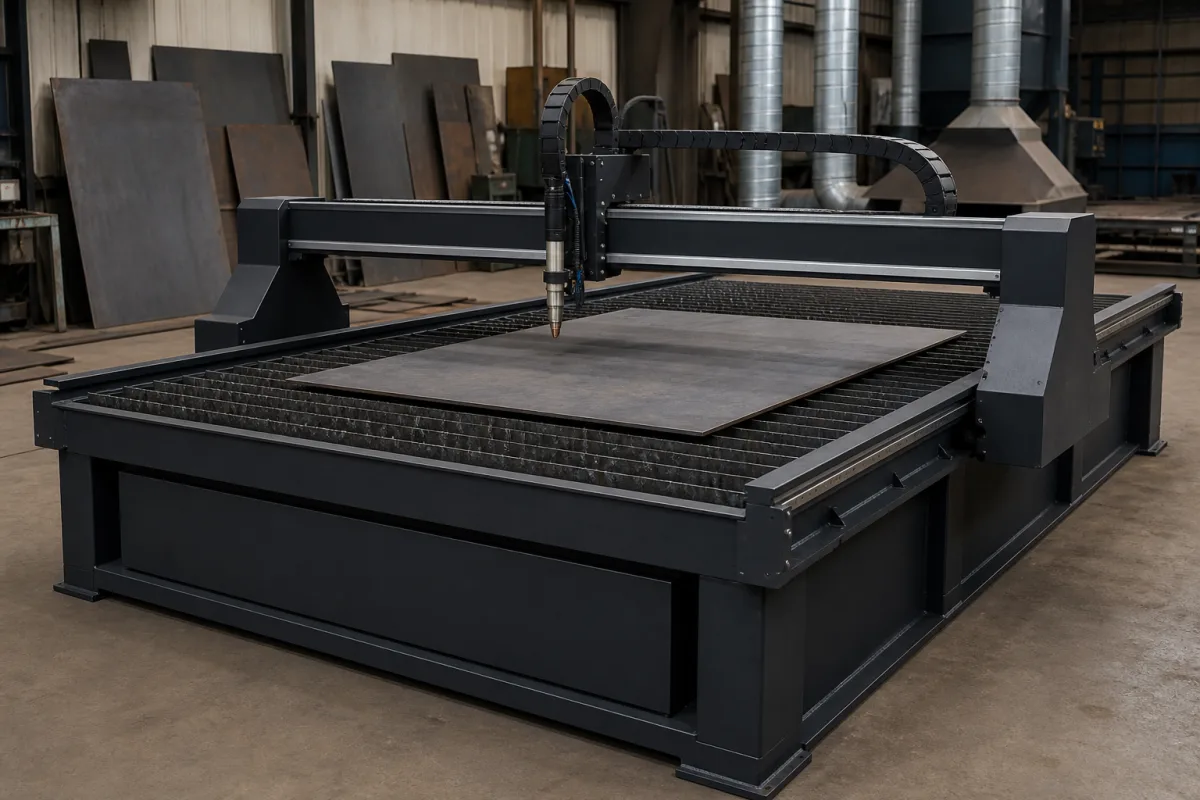
Plasma cutting table (the slat bed and the water or downdraft chamber under it)
The cutting bed of a CNC plasma table · water table or downdraft fume control, airflow for a 4 × 4 ft downdraft bed, zoned dampers and slag-clearing blades, slat wear and replacement, bed sizes from 4 × 4 to 6 × 12 ft
Under the gantry of a CNC plasma machine sits the table: a frame of steel slats that carries the plate, and a chamber below that either holds water or pulls air down through the slats to catch fume, sparks and dross. The choice between water and downdraft decides fume handling, rust and part temperature; the slats decide whether the plate lies flat enough for the torch height control to work.
Cutting tables for CNC plasma machines: slat beds, water tables and downdraft tables with their dampers, slag removal and slats, and bed sizes. The complete machine with gantry, drives and height control is covered on the CNC gantry plasma cutting machine page; the power source on the Plasma power supply page; torches and consumables on the Cutting torch for CNC plasma machines page; filters and collectors that a downdraft feeds on the Dust collector page.
CNFX editorial research · Sources checked October 12, 2026 · 4 sources
Hypertherm gives two ways to control fume on a CNC table. On a table smaller than 5 × 10 ft, a water system can be a tray "about 4 to 10 inches deep", with the water touching the bottom of the plate or a few inches below it; larger tables use deeper tanks, removable slat assemblies and pneumatically controlled water levels. A downdraft table closes the space under the slats into a chamber and a fan draws the fume out: "On an entry level 4 x 4 cutting machine, air flow of about 3,200 to 3,600 cubic feet per minute is required to effectively remove fumes from a 100 amp or smaller plasma system." Larger industrial tables use zoned dampers that draw only from the area being cut, and some have chain-driven blades that drag slag to one end. [1]
Editorial calculation: 3,200-3,600 cfm is about 5,440-6,120 m³/h (1 cfm ≈ 1.699 m³/h), or 200-225 cfm per square foot over a 4 × 4 ft (16 ft²) bed. Use these as the starting point for the fan and any filter the downdraft feeds. [1]
Water table
Downdraft
Source
Hypertherm, for
Very good fume control; less warpage and camber on thin plate; better edge metallurgy on some stainless parts
Better cut quality on steel; no rust; no water to freeze; easier to clean
State plate thickness and material, plasma current, shop climate, whether parts go straight to paint or welding, and whether fume goes outside or to a filter; these decide water or downdraft, and the airflow and zoning.
02
Slats that keep the plate flat
Hypertherm writes that "When slats are worn, bent, or covered in dross, the plate isn't level, so it’s impossible to get a good cut." Slag builds up along the slat tops, heavy plate bows the slats, and repeated cutting over the same slats removes their top edges. It recommends a visual check before loading, siphoning water off a water table to see the slats, removing slag and replacing bent or worn slats, varying the nest so cut paths move, and keeping "a full set of replacement slats on-hand". [2]
Tormach's 1300PL water table has 13 slats; it recommends changing all of them at once, combined with a full cleaning of the water table, and gives the replacement size as 1/8" × 3-1/2" × 49-3/16" CRS or HRS. [3] StyleCNC describes its plasma tables with "blade or sawtooth" beds on 4 × 4, 4 × 8, 5 × 10 and 6 × 12 ft workbenches. [4]
Editorial conversion: a 4 × 8 ft bed is about 1,219 × 2,438 mm. [4]
Ask the table maker for the slat size, steel grade, spacing and a spare set price, and how slats come out of a water tank or downdraft chamber.
03
Plasma table order details
Paste it into your enquiry below or into an email to a maker, then replace every bracket.
2 companies list this product among what they make. Company figures are quoted from each
company's own website; every card states where the relationship came from.
Jinan Style Machinery Co., Ltd. (STYLECNC)
Manufacturing site to be confirmed for the order
Publishes CNC plasma tables on 4 × 4, 4 × 8, 5 × 10 and 6 × 12 ft workbenches with blade or sawtooth beds and water or downdraft options discussed.
Explore company information and manufacturing capabilities, then discuss the scope of your project with a relevant supplier.
Share this page
Compiled and source-reviewed by the CNFX editorial team.
Each manufacturer above links to the page on that company's own website where the product is listed, with the date we checked it. How we source and review
· Page last updated 13 October 2026
Buyer questions
Water table or downdraft?
Hypertherm credits water with very good fume control and less warpage, and downdraft with better cut quality on steel, no rust and easier cleaning; downdraft pulls shop air out. [1]
How much airflow does a downdraft need?
About 3,200 to 3,600 cfm for an entry-level 4 × 4 ft machine with a plasma of 100 A or less, according to Hypertherm. [1]
Why do slats affect cut quality?
Worn, bent or dross-covered slats stop the plate lying level, which upsets torch height and cut angle. [2]
Replace slats one by one or all together?
Tormach recommends changing all the slats at the same time with a full table cleaning. [3]
Sources and what still needs a direct check
Sources checked 2026-10-12. Hypertherm publishes blog guidance on fume control and table slats; Tormach publishes 1300PL maintenance notes; StyleCNC publishes its plasma table listing.