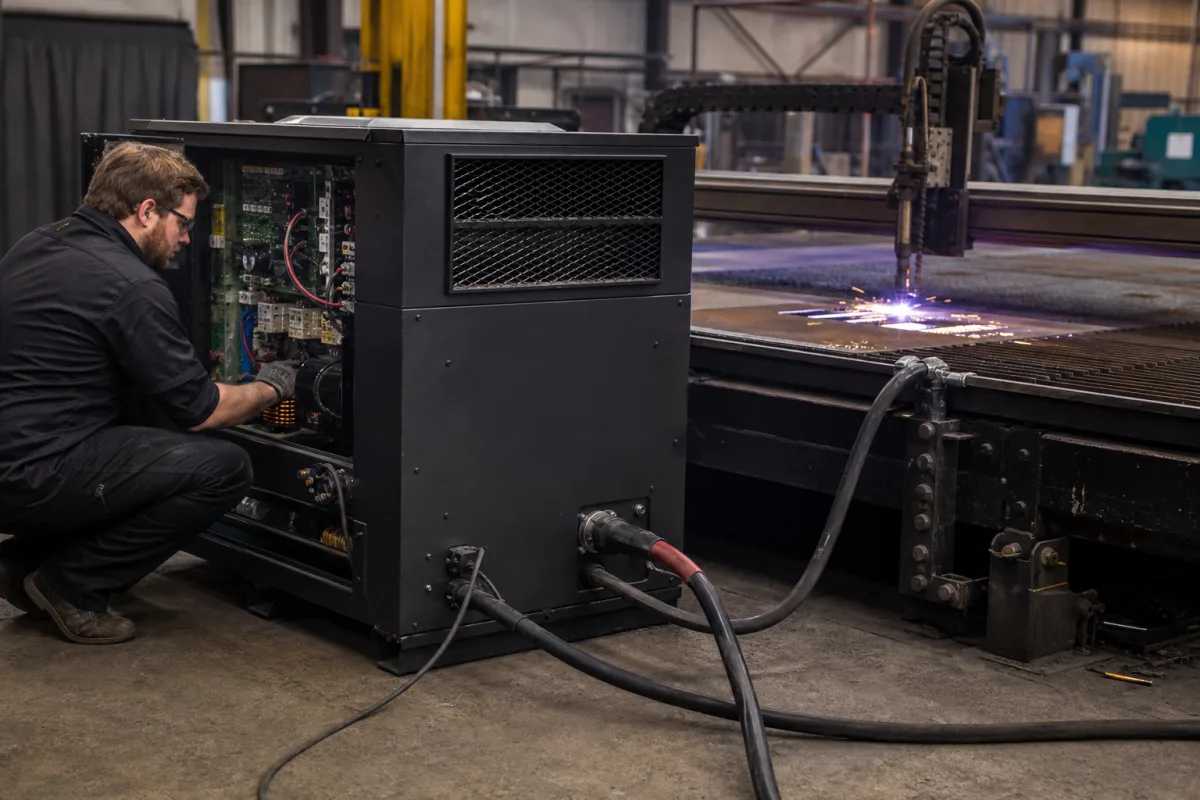
Plasma power supply: the power source unit of a mechanized plasma cutting system
Plasma power source units · output current, arc voltage, open-circuit voltage and duty cycle, chopper versus high-frequency inverter circuits, input power quality
A plasma power supply is the cabinet that turns three-phase mains into the regulated direct current a plasma torch needs: it starts the pilot arc, holds the cutting current constant as the arc voltage changes with torch height and plate thickness, and reports faults to the machine controller. On a mechanized system it stands beside the cutting table and is connected to the torch by leads, gas lines and a gas console. Ask three things first: what current and arc voltage the unit delivers at what duty cycle, which power circuit it uses and how it treats the mains supply, and what cutting and piercing capacity the maker states for that current.
Power source units for mechanized (CNC, robotic and pipe-cutting) plasma systems, including chopper and inverter designs, their pilot-arc circuits, cooling and controls. Complete gantry machines, with their beams, drives, height control and cutting tables, are covered on the CNC gantry plasma cutting machine page. Hand-held portable plasma cutters, torches and consumables as spare parts are outside this page.
CNFX editorial research · Sources checked October 12, 2026 · 5 sources
Read the output rating: current, arc voltage, open-circuit voltage and duty cycle
Hypertherm's specification table for the XPR300 lists a maximum output current of 300 A, maximum output power of 66.5 kW, output voltage of 50–210 VDC, a 100% duty arc voltage of 210 V and a maximum open-circuit voltage (U0) of 360 VDC. Its duty cycle rating is 100% at 66.5 kW and 40 °C (104 °F), over an operating ambient range of −10 °C to 40 °C. The same table lists a power factor of 0.98 at 66.5 kW, forced-air cooling (Class F), Class H insulation, CE EMC emissions Class A and a top lift eye rated 680 kg. [1]
Kjellberg states the cutting current of its HiFocus 280i neo power source as 280 A at 100% duty cycle on 3x 400 V, 50 Hz mains, with other voltages and frequencies available on request, and a separate marking current of 5–50 A. [2] For its Smart Focus 300 it gives a cutting current range of 35–300 A and a marking current of 10–50 A on the same mains. [3]
Editorial note: a current figure without the duty cycle and the ambient temperature at which it was rated does not tell you whether the unit can cut continuously at that current; ask for the duty-cycle statement in the form Hypertherm gives (percentage, power and temperature). The open-circuit voltage matters for the torch leads and for operator safety, so obtain it together with the output voltage range.
Give the supplier the materials and thickness range, cutting and marking currents needed, required duty cycle and shop ambient, mains voltage and frequency, cable run from power supply to torch, gas console and gases, the CNC or robot interface, and the documents needed (rating plate data, conformity declarations).
02
Choose the power circuit: interleaved chopper or high-frequency inverter
A Hypertherm patent application describes a mechanized plasma power supply built around a multi-pulse (six- or twelve-pulse) transformer feeding series-connected three-phase diode bridges, a bank of four DC bus capacitors, and two IGBT choppers each wired to its own output inductor and switched in an interleaved mode. It states that interleaving can reduce arc ripple current to a peak of about 3 A at about 200 A, cites a power factor of 0.98 and input-current THD of about 13% at 33 kW in some embodiments, and gives a load range of about 3 kW to 120 kW. [4]
The same document compares an earlier circuit of four IGBTs, eight DC bus capacitors, six power resistors, four fans, two heat sinks and four circuit-board assemblies with a liquid-cooled design using two IGBTs, four capacitors, three resistors, no circuit fans, one cold plate and one board, and targets an average semiconductor case temperature of about 100 °C during cutting. It notes that the pilot arc between electrode and nozzle can be started by a high-frequency, high-voltage signal coupled to the DC supply or by contact starting. [4]
A South China University of Technology patent application on a SiC inverter plasma cutting power supply states that compact MOSFET or IGBT inverters were in use for low-power cutting sources, while medium and high-power sources were still mainly rectifier or chopper types because of the high voltage and power the process needs. Its design rectifies the mains, switches it with SiC devices into a high-frequency square wave above 200 kHz, which it describes as more than ten times the frequency of existing IGBT inverter cutting supplies, isolates it through a power transformer and rectifies it again; it claims energy efficiency that can exceed 96% and adds a non-contact arc-striking module. [5] Kjellberg describes the HiFocus 280i neo as using soft-switch inverter technology. [2]
Editorial calculation: a ripple peak of about 3 A at about 200 A is 1.5% of the cutting current (3 ÷ 200). [4] Patent figures describe embodiments, not a tested product; ask the supplier which circuit the offered unit uses and for its measured power factor and current ripple.
03
Compare the cutting and piercing capacity makers state for each current
Makers state capacity as a cutting range, a pierce capacity and sometimes a separate severance capacity; the table keeps each figure with its source and current.
Editorial note: severance capacity is the thickness a unit can part, not the thickness it cuts to production quality; Kjellberg's split between an 80 mm maximum and a 1–60 mm recommended range for the Smart Focus 300 shows the same distinction. [3] Ask for the cut chart (current, gas, speed and thickness) for your materials rather than one headline thickness.
Unit and current
Published capacity
Source
Hypertherm XPR300, 300 A
Pierce: mild steel 50 mm (argon-assist), 45 mm (standard O₂); stainless 38 mm; aluminium 38 mm. Severance: mild steel 80 mm, stainless 75 mm, aluminium 50 mm. [1]
Maker specification
Kjellberg HiFocus 280i neo, 280 A
Cutting range 0.5–70 mm; piercing up to 40 mm. [2]
Maker technical data
Kjellberg Smart Focus 300, 35–300 A
Cutting range 80 mm maximum, 1–60 mm recommended; piercing 40 mm. [3]
Maker technical data
04
Inside the cabinet: from mains transformer to pilot-arc circuit
Component
Role
Fix in the order
Input transformer and rectifier
Converts three-phase mains to a DC bus; multi-pulse designs reduce input-current harmonics. [4]
Mains voltage, frequency, power factor, THD.
DC bus capacitors
Store and smooth the bus; four 450 V, 2,200 µF capacitors in one embodiment. [4]
Rating and ripple current.
Chopper or inverter switches (IGBT, MOSFET or SiC)
Regulate the arc current; SiC inverter switching above 200 kHz in one design. [4][5]
Starts the arc between electrode and nozzle by high-frequency or contact start. [4][5]
Start method and interference limits.
Cooling
Forced air on the XPR300; cold plate with liquid loop in one patent design. [1][4]
Cooling type and rated ambient.
Control and interface
CNC control of all functions, diagnostics, Ethernet LAN and Wi-Fi on the XPR300. [1]
Protocol to your CNC or robot.
05
Duty cycle, open-circuit voltage and mains data that decide the unit
Editorial calculation: 1.03 m × 0.68 m × 1.45 m is about 1.02 m³ of enclosure volume for the Kjellberg units. [2] A weight-to-power ratio of about 22.4 lb per kilowatt, given in the Hypertherm patent, is about 10.2 kg per kW (22.4 × 0.4536). [4]
Explore company information and manufacturing capabilities, then discuss the scope of your project with a relevant supplier.
Share this page
Compiled and source-reviewed by the CNFX editorial team.
Each manufacturer above links to the page on that company's own website where the product is listed, with the date we checked it. How we source and review
· Page last updated 13 October 2026
Buyer questions
What duty cycle should a mechanized plasma power supply have?
Ask for the rating with power and temperature; Hypertherm rates the XPR300 at 100% duty at 66.5 kW and 40 °C, and Kjellberg rates the HiFocus 280i neo at 280 A at 100% duty. [1][2]
What is the open-circuit voltage of a plasma power supply?
Hypertherm lists a maximum open-circuit voltage of 360 VDC for the XPR300, with output voltage of 50–210 VDC. [1]
How do chopper and inverter plasma power supplies differ?
A Hypertherm patent describes interleaved IGBT choppers fed from a multi-pulse transformer; a SCUT patent describes a SiC inverter switching above 200 kHz with claimed efficiency above 96%. [4][5]
Sources and what still needs a direct check
Sources checked 2026-10-12. Hypertherm and Kjellberg publish data for their own power sources; the two patent applications (Hypertherm and South China University of Technology) describe circuit designs. Patents describe inventions, not tested products.