Industry-Verified Manufacturing Data (2026)

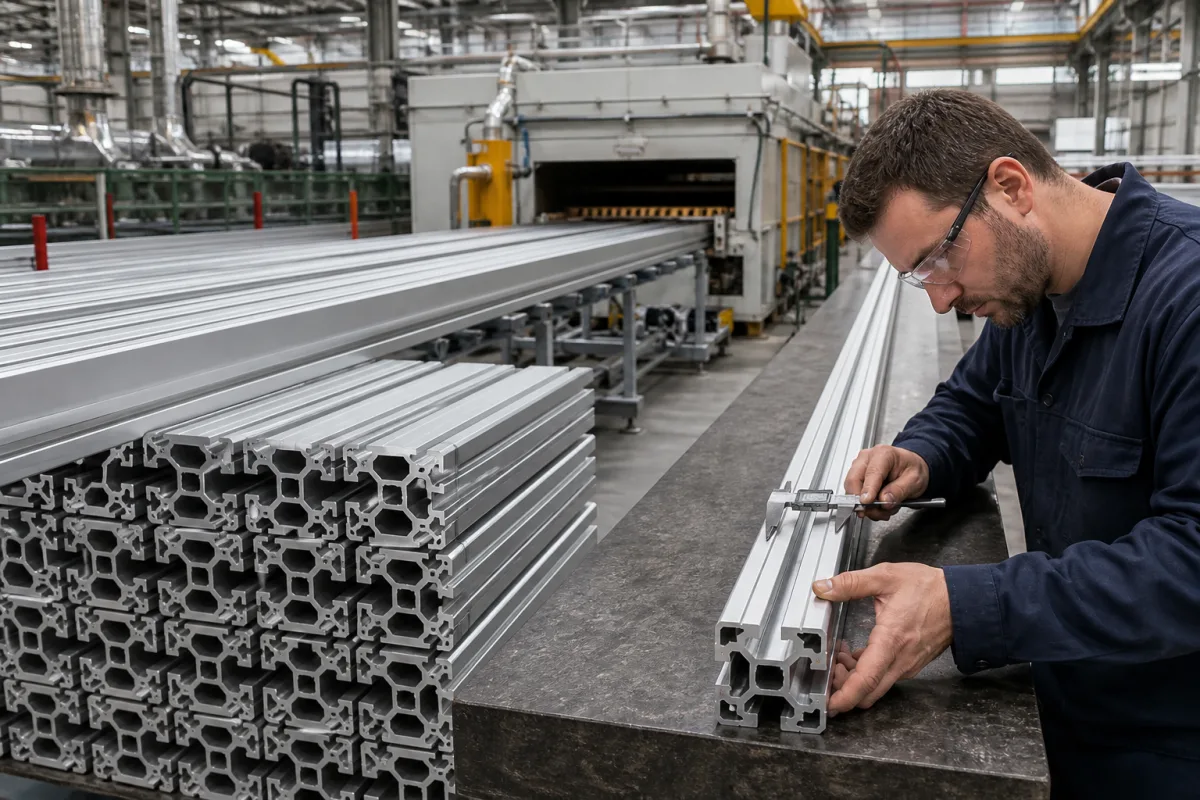
Precision Aluminum Extrusion Profile

Based on aggregated insights from multiple verified factory profiles within the CNFX directory, the standard Precision Aluminum Extrusion Profile used in the Fabricated Metal Product Manufacturing sector typically supports operational capacities ranging from standard industrial configurations to heavy-duty production requirements.

Technical Definition & Core Assembly

A canonical Precision Aluminum Extrusion Profile is characterized by the integration of Extrusion Die and Anodized Coating. In industrial production environments, manufacturers listed on CNFX commonly emphasize Aluminum Alloy 6063-T5 construction to support stable, high-cycle operation across diverse manufacturing scenarios.

Custom-shaped aluminum profiles manufactured through extrusion processes

Product Specifications

Technical details and manufacturing context for Precision Aluminum Extrusion Profile

Definition
Precision aluminum extrusion profiles are semi-finished structural components produced by forcing heated aluminum alloy through a shaped die. These profiles serve as foundational building blocks across multiple industries due to their excellent strength-to-weight ratio, corrosion resistance, and dimensional accuracy. They enable modular construction systems while reducing assembly time and material waste. Common applications include framing systems, heat sinks, and structural supports where consistent cross-sectional geometry is critical.
Working Principle
Aluminum billets are heated and forced through a die under high pressure to create continuous lengths with specific cross-sectional shapes
Common Materials
Aluminum Alloy 6063-T5, Aluminum Alloy 6061-T6
Technical Parameters
  • Maximum bow or twist over length (mm/m) Customizable
  • Maximum deviation from nominal dimensions (mm) Customizable
Components / BOM
  • Extrusion Die
    Defines cross-sectional shape during manufacturing
    Material: Tool Steel H13
  • Anodized Coating Optional
    Provides corrosion resistance and surface hardness
    Material: Aluminum Oxide Layer
  • Thermal Break Insert Optional
    Reduces thermal conductivity in insulated profiles
    Material: Polyamide 66
Engineering Reasoning
0-250 MPa compressive stress, 0-200°C temperature, 0.1-2.0 mm/min extrusion speed
280 MPa yield strength (6061-T6 aluminum), 250°C recrystallization temperature, 2.5 mm/min critical extrusion speed causing tearing
Design Rationale: Grain boundary sliding at 250°C (Hall-Petch relationship breakdown), localized necking at 280 MPa (Lüders band propagation), surface tearing at 2.5 mm/min (critical strain rate exceeding material flow stress)
Risk Mitigation (FMEA)
Trigger Die deflection exceeding 0.05 mm under 50 MPa extrusion pressure
Mode: Profile dimensional deviation beyond ±0.1 mm tolerance
Strategy: Tungsten carbide die inserts with 500 GPa elastic modulus, 4-point support die housing
Trigger Billet preheat temperature gradient >15°C/cm across cross-section
Mode: Internal cracking along 45° shear planes (Cockcroft-Latham criterion >150 MPa·s)
Strategy: Multi-zone induction heating with ±3°C uniformity, 120-second homogenization soak at 480°C

Industry Taxonomies & Aliases

Commonly used trade names and technical identifiers for Precision Aluminum Extrusion Profile.

Industrial Ecosystem & Supply Chain DNA

Complementary Systems
Downstream Applications
Specialized Tooling

Application Fit & Sizing Matrix

Operational Limits
pressure: Up to 10 MPa (100 bar) for standard profiles, up to 20 MPa (200 bar) for reinforced designs
flow rate: Dependent on cross-sectional area and surface finish; typically 0.1-5 m/s for fluid applications
temperature: -50°C to 150°C (continuous), up to 200°C (short-term)
slurry concentration: Up to 30% solids by weight for abrasive slurries, depending on alloy hardness and surface treatment
Media Compatibility
✓ Industrial cooling fluids (water-glycol mixtures) ✓ Compressed air/dry gases ✓ Food-grade materials (with appropriate surface finish)
Unsuitable: Concentrated acids (pH <4) or strong alkaline solutions (pH >10) without protective coating
Sizing Data Required
  • Required cross-sectional dimensions and tolerances (mm)
  • Maximum expected mechanical load (N/m or MPa)
  • Environmental exposure conditions (temperature, humidity, chemical contact)

Reliability & Engineering Risk Analysis

Failure Mode & Root Cause
Dimensional distortion
Cause: Thermal stress from uneven heating/cooling during extrusion or in-service temperature fluctuations, leading to warping, twisting, or shrinkage beyond tolerances.
Surface degradation
Cause: Corrosion from environmental exposure (e.g., moisture, chemicals) or mechanical wear from abrasive contact during handling or operation, resulting in pitting, scoring, or loss of protective coating.
Maintenance Indicators
  • Visible cracks, fractures, or excessive bending along the profile length, indicating structural failure.
  • Abnormal noises (e.g., grinding, squeaking) during operation, suggesting misalignment, excessive friction, or loose components.
Engineering Tips
  • Implement regular cleaning and application of corrosion-resistant coatings or anodizing to protect against environmental damage and maintain surface integrity.
  • Ensure proper installation with correct alignment and torque specifications, and conduct periodic inspections for thermal expansion/contraction effects to prevent stress-related failures.

Compliance & Manufacturing Standards

Reference Standards
ISO 9001:2015 - Quality Management Systems ASTM B221 - Standard Specification for Aluminum-Alloy Extruded Bars, Rods, Wire, Profiles, and Tubes DIN EN 755-9 - Aluminum and aluminum alloys - Extruded rod/bar, tube and profiles - Part 9: Profiles, tolerances on dimensions and form
Manufacturing Precision
  • Wall Thickness: +/-0.15mm
  • Straightness: 0.5mm per meter
Quality Inspection
  • Dimensional Verification with CMM (Coordinate Measuring Machine)
  • Spectrographic Analysis for Alloy Composition

Factories Producing Precision Aluminum Extrusion Profile

Verified manufacturers with capability to produce this product in China

✓ 98% Supplier Capability Match Found

T Technical Director from Singapore Jan 18, 2026
★★★★★
"Reliable performance in harsh Fabricated Metal Product Manufacturing environments. No issues with the Precision Aluminum Extrusion Profile so far."
Technical Specifications Verified
P Project Engineer from Germany Jan 15, 2026
★★★★☆
"Testing the Precision Aluminum Extrusion Profile now; the Alloy Temper (designation) results are within 1% of the laboratory datasheet. (Delivery took slightly longer than expected, but technical support was excellent.)"
Technical Specifications Verified
S Sourcing Manager from Brazil Jan 12, 2026
★★★★★
"Impressive build quality. Especially the Alloy Temper (designation) is very stable during long-term operation."
Technical Specifications Verified
Verification Protocol

“Feedback is collected from verified sourcing managers during RFQ (Request for Quote) and factory evaluation processes on CNFX. These reports represent historical performance data and technical audit summaries from our B2B manufacturing network.”

5 sourcing managers are analyzing this specification now. Last inquiry for Precision Aluminum Extrusion Profile from Germany (18m ago).

Supply Chain Commonly Integrated Components

Upper Blade

The stationary cutting blade in a guillotine shear that works in conjunction with the lower blade to shear sheet metal.

Explore Specs →
Lower Blade

The stationary cutting blade in a sheet metal guillotine shear that works in conjunction with the upper blade to shear metal sheets.

Explore Specs →
Aluminum Shell

The outer protective casing component of a pharmaceutical vial aluminum seal

Explore Specs →
Material Handling Crane

Overhead lifting equipment for transporting aluminum profiles between processing stations in an anodizing line

Explore Specs →

Frequently Asked Questions

What are the main differences between Aluminum Alloy 6063-T5 and 6061-T6 for extrusion profiles?

6063-T5 offers excellent extrudability and surface finish for architectural applications, while 6061-T6 provides higher tensile strength and better structural performance for demanding industrial uses.

How does the thermal break insert improve aluminum extrusion performance?

Thermal break inserts create a barrier that reduces heat transfer through the aluminum profile, improving energy efficiency and preventing condensation in building and refrigeration applications.

What tolerances can be achieved with precision aluminum extrusion profiles?

Our extrusion processes maintain tight tolerances with minimum wall thickness as low as 1mm, cross-sectional accuracy within ±0.1mm, and surface roughness (Ra) down to 0.8μm for high-precision applications.

Can I contact factories directly on CNFX?

CNFX is an open directory, not a transaction platform. Each factory profile provides direct contact information and production details to help you initiate direct inquiries with Chinese suppliers.

Get Quote for Precision Aluminum Extrusion Profile

Request technical pricing, lead times, or customized specifications for Precision Aluminum Extrusion Profile directly from verified manufacturing units.

Your business information is encrypted and only shared with verified Precision Aluminum Extrusion Profile suppliers.

Thank you! Your message has been sent. We'll respond within 1–3 business days.

Need to Manufacture Precision Aluminum Extrusion Profile?

Connect with verified factories specializing in this product category

Add Your Factory Contact Us
Previous Product
Power Source Unit
Next Product
Precision Cartridge Case Annealing Machine