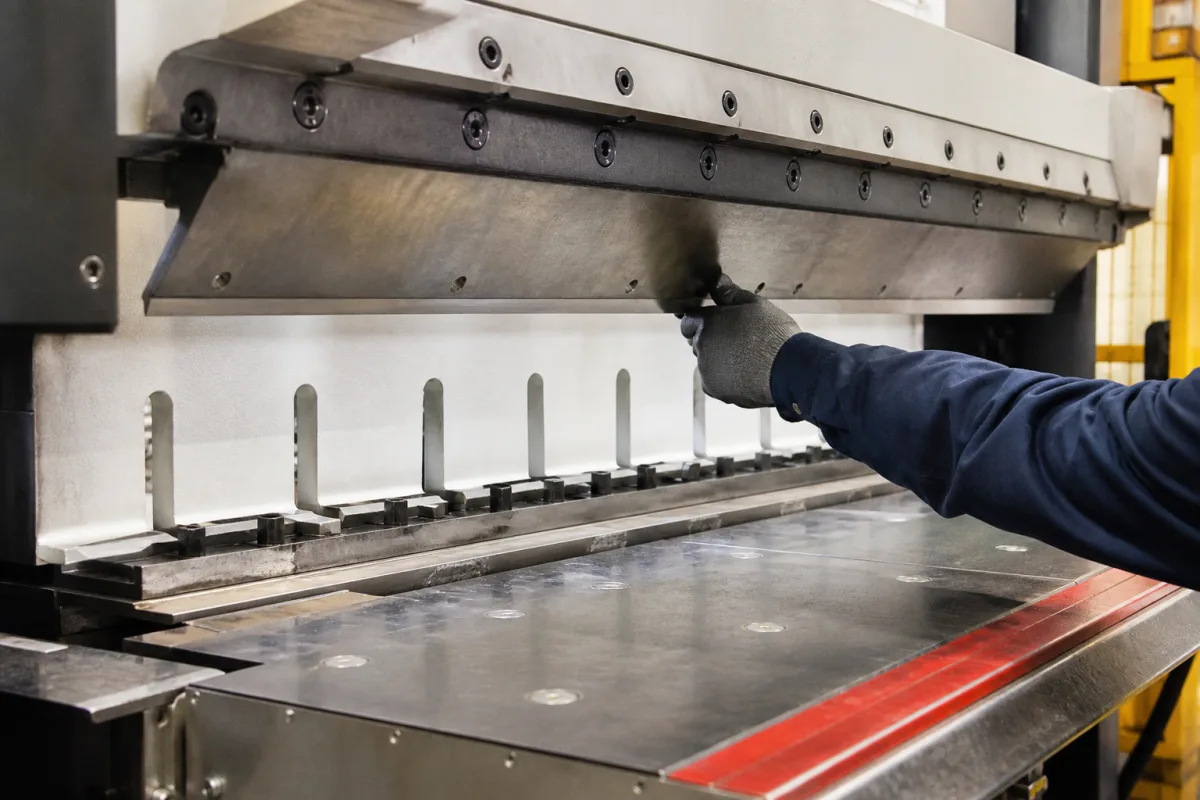
Upper blade for a guillotine shear: the replaceable top knife bolted to the ram, turned to fresh edges, reground and reset to the right clearance
Upper blades for guillotine shears, sold as replacement parts · Usable edges and turning, blade clearance as a share of plate thickness, regrinding at 0.25 mm edge radius with 0.5 mm per grind, and refitting to the ram
This page covers upper blades for guillotine shears bought as replacement parts: the long tool-steel knife bolted to the ram, with two or four cutting edges that are used in turn, then reground or replaced. Ask three things first: how many usable edges the blade has and how it is turned, what clearance to the lower blade your materials and thicknesses need, and when and by how much the blade can be reground before it is scrapped.
Upper blades for guillotine and swing-beam shears supplied as replacement parts, including edge configuration, clearance setting against the lower blade, regrinding and refitting. Complete hydraulic and mechanical shears are covered on the Sheet metal guillotine shear page. Lower blades sold alone, slitting knives, rotary shear blades and paper guillotine knives are outside this page.
CNFX editorial research · Sources checked October 12, 2026 · 3 sources
Usable edges: a top blade turned end for end, or four edges on each blade
Baileigh's maintenance manuals for its SH-5208HD and SH-5203HD hydraulic shears state that the top blade has two cutting edges and is rotated end for end to expose a sharp one, that the bottom blade has four usable edges, and that once all edges are used a blade can be reground or replaced; the blades are high-carbon, high-chrome alloy tool steel. They ask that the blades never rub each other and that the lower blade be brushed with light oil when shearing stainless steel or galvanised material. [1][2] A shear operation guide from MachineMFG, for a CNC hydraulic shear, states instead that its upper and lower blades each have four cutting edges. [3]
Give the supplier the shear make and model, blade length and section, number and position of mounting holes, the existing edge configuration, the materials and maximum thicknesses cut, and whether upper and lower blades are to be replaced or reground as a pair.
02
Clearance to the lower blade as a share of plate thickness
Baileigh gives blade gap as a general guideline of 6.5–7% of material thickness, with a table by gauge, and a setting method in which the clearance is checked with a feeler gauge at the point where the blades cross: 0.8 mm at each end and 0.6 mm at the centre. [1] MachineMFG's guide takes low-carbon steel of 370–400 MPa tensile strength and 35% elongation as the benchmark at 8% of plate thickness, with larger clearance for medium and high-carbon steel of low elongation, clearance for stainless set by its elongation, slightly smaller gaps for plastic (ductile) and slightly larger for brittle materials, and a trial cut after every adjustment. [3]
Editorial calculation: for 6 mm mild steel, 6.5–7% gives 0.39–0.42 mm and 8% gives 0.48 mm, while Baileigh's own table for 6.073 mm lists 0.25–0.45 mm; the two sources differ, so confirm the clearance with the shear maker for your material. [1][3] MachineMFG adds that raising the shear angle deforms the workpiece more and lowering it gives more burr, and that strips narrower than three times the plate thickness risk damaging the blade. [3]
Regrind at 0.25 mm edge radius, 0.5 mm a side, and refit to 35 N·m
MachineMFG's guide says blades must be ground regularly because a blunt edge damages the blade's outer grain structure and the cut: grind when the edge radius exceeds 0.25 mm, remove 0.5 mm per side each time, within a total allowance of 4 mm per blade (2 mm per side). To refit, the upper blade is held up against the tool holder with wooden blocks and its screws tightened from the knife joint outward to 35 N·m; after grinding or changing blades, clearance uniformity is rechecked with the shear angle at 0° and the blades parallel, at no more than 0.64 mm. [3]
Baileigh's procedure sets the blade gap arm to 4.76 mm, lowers the top blade until it overlaps the bottom blade along its full length and checks a gap of 0.6 mm with the blades parallel; it asks for leather gloves whenever a blade is handled. [1] Editorial calculation: at 2 mm allowance per side and 0.5 mm per grind, each face can be reground four times before the blade is replaced. [3]
04
Send the shear, blade drawing and materials together
Paste it into your enquiry below or into an email to a maker, then replace every bracket.
Shear: [make; model; capacity]
Blade: [length; section; holes; edges]
Materials: [steel; stainless; aluminium; maximum thickness]
Pair: [upper only or upper and lower]
Regrind: [allowance; edge radius limit]
Delivery: [new or reground; packing]
Explore company information and manufacturing capabilities, then discuss the scope of your project with a relevant supplier.
Share this page
Compiled and source-reviewed by the CNFX editorial team.
Each manufacturer above links to the page on that company's own website where the product is listed, with the date we checked it. How we source and review
· Page last updated 13 October 2026
Buyer questions
How many cutting edges does a shear upper blade have?
It depends on the shear: Baileigh's top blades have two edges turned end for end and bottom blades four, while another CNC shear guide gives four edges on both upper and lower blades. [1][3]
What blade clearance should a guillotine shear use?
Baileigh gives a general guideline of 6.5–7% of material thickness; a MachineMFG guide uses 8% for low-carbon steel, more for harder steels, with a trial cut after each change. [1][3]
When should a shear blade be reground?
The MachineMFG guide says when the edge radius exceeds 0.25 mm, removing 0.5 mm per side within a 4 mm total allowance per blade. [3]
Sources and what still needs a direct check
Sources checked 2026-10-12. Baileigh's maintenance manuals describe its own shears' blades; MachineMFG's guide describes operating and adjusting a CNC hydraulic shear.