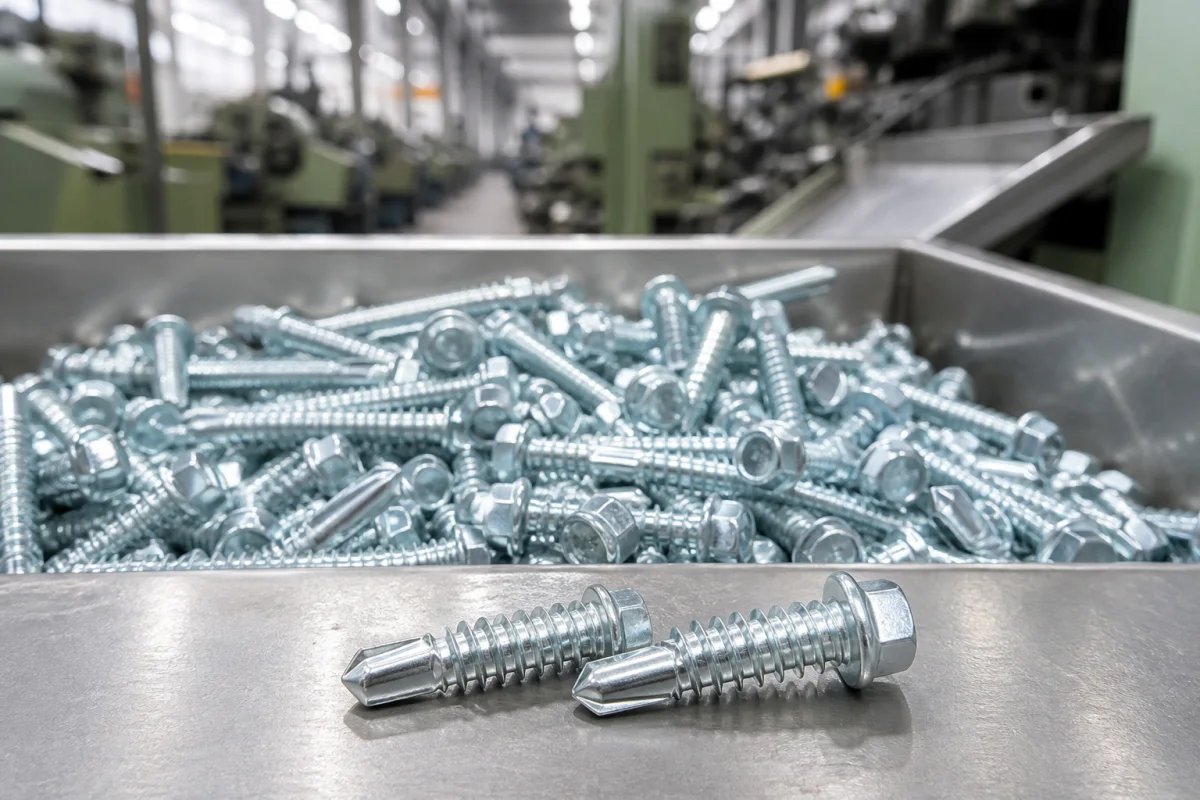
Self-drilling screws for sheet steel and cold-formed framing · Drill point size by steel thickness, length and protrusion, ASTM C1513 material and corrosion test, head styles, spacing and edge distance, installation
A self-drilling screw has a drill point that cuts its own hole and a tapping thread that forms the mating thread, so it can fasten sheet steel without pre-drilling. Ask three things first: how thick the steel is at the point, since the drill point must suit it; how thick the whole joint is, since the screw must be long enough to leave threads protruding; and what coating and head the environment and application need.
Self-drilling (drill-point) tapping screws and self-piercing screws for sheet steel, roofing and cladding, cold-formed steel framing and steel-to-steel connections, in carbon or hardened steel with plated or proprietary coatings. Thread-forming and thread-cutting self-tapping screws, drywall and wood screws, machine screws and screw-making machines are outside this page except where compared.
CNFX editorial research · Sources checked October 11, 2026 · 4 sources
ICC-ES report ESR-1976 for ITW Buildex TEKS self-drilling fasteners says screw length must be chosen from the thickness of the fastened steel plus the minimum required protrusion past the back of the supporting steel, and point selection from the drilling capacity of the screw; TEKS points are designated TEKS/1 to TEKS/5 on No. 10 (0.190 in), No. 12 (0.216 in) and 1/4 in (0.250 in) screws from 1/2 to 4 in long. [2] ESR-2196 for Hilti self-drilling and self-piercing screws gives the same rule — thread length by the fastened material and point style by the supporting steel, within a maximum total thickness. Its Table 1 lists, for example, #8-18 and #10-16 screws with a #2 point drilling 0.035 to 0.100–0.110 in and #10-16 screws with a #3 point drilling 0.110 to 0.175 in, with minimum protrusion lengths of about 0.375–0.5 in. [1]
Editorial calculation: 0.035–0.100 in is about 0.9–2.5 mm of steel for a #2 point, and 0.110–0.175 in about 2.8–4.4 mm for a #3 point; a #10 screw is 0.190 in (4.8 mm) in diameter. [1][2]
Give the supplier the steel thickness at the point and total joint thickness, steel grade, screw size and thread pitch, drill point, length, head style (hex washer, pan, truss, wafer, countersunk) and drive, sealing washer (EPDM) if roofing, coating or material and corrosion requirement, standard (ASTM C1513, SAE J78 or ISO), evaluation report or approval needed, packaging (loose or collated) and quantity.
02
Meet material, corrosion and installation rules
ITW Buildex TEKS screws are case-hardened from ASTM A510 grade 1018–1022 carbon steel and heat-treated to give a hard surface that can cut threads; they comply with ASTM C1513, with threads to ASME B18.6.4, and are coated with Climaseal or electro-zinc meeting ASTM F1941. [2] Hilti's hex washer and high hex washer self-drilling screws comply with ASTM C1513 and SAE J78; tested to ASTM B117, screws with the listed coatings showed no white corrosion after 3 hours and no red rust after 12 hours, the ASTM F1941 minimum required by ASTM C1513. [1]
ESR-2196 requires installation perpendicular to the work surface with a variable-speed screw-driving tool, with at least three threads protruding past the back of the supporting steel and the maker's installation instructions on site. Engineered connections are designed to Section J4 of AISI S100 using the report's pull-out, pull-over, shear and fastener strength tables; under the 2024 and 2021 IBC, framing screws are fully effective at a minimum spacing of 3 times and edge distance of 1.5 times the nominal screw diameter, and allowable loads may not be increased for wind or seismic loads. [1]
Editorial calculation: for a #10 screw (4.8 mm), 3 diameters is about 14.5 mm spacing and 1.5 diameters about 7.2 mm edge distance. [1]
03
Compare what suppliers offer
Suppliers linked to this page list self-drilling screws; each card links to the page reviewed.
Listings include hex washer head screws with EPDM or PVC washers for roofing, pan, countersunk and hex-with-washer head self-drilling screws, through-hardened and Ruspert-coated screws, and screws for equipment assembly; ask each for drilling capacity by point, standard compliance, coating test results and approval reports.
04
Ask for ASTM C1513-24 test results, not only a compliance claim
ASTM International's abstract for C1513-24, the active edition of the specification named in the ICC-ES reports above, says it covers steel self-drilling and self-piercing tapping screws for connecting cold-formed steel members made to ASTM C645 or AISI S220 and to C955 or AISI S240. It also sets test methods for performance requirements such as dimension and total case depth, and for physical properties: hardness, ductility, torsional strength, drill drive performance and self-drilling tapping screw drill capacity. [4]
ASTM lists earlier editions from C1513-01 to C1513-18 and marks C1513-24 as active. Values in inch-pound units are the standard; SI values in parentheses are conversions for information only. [4]
Editorial note: ask the supplier which C1513 edition its test report follows, and for the measured result of each listed property (case depth, hardness, ductility, torsional strength, drill drive performance and drill capacity) for the exact size and drill point quoted, stated in inch-pound units.
05
Convert gauge to steel thickness and protect the drill point
Grabber's Self-Drilling Screw Selection Guide states that gauge numbers are a reference only and "should not be used to order, design or specify steel studs or joists". [3] Its table, as noted in ICBO AC 46, gives uncoated minimum delivered thickness and maximum design thickness, where design thickness equals minimum thickness divided by 0.95. Its drilling-capacity chart counts the total thickness of all steel, including any spacing between layers, and is noted as meeting or exceeding SAE J78 Table 9. [3]
Grabber explains the failure mode behind point selection: the drill flute length sets the metal thickness that can be drilled, and if the flute is completely embedded, chips are trapped, cutting stops and the point burns up or breaks. Because screw threads advance up to ten times faster than the flute removes metal, the unthreaded point length must let drilling finish before the first thread engages. For wood over 1/2" thick on steel, it calls for a screw with break-away wings that ream a clearance hole and snap off on metal of at least .090". [3]
Editorial calculation (using the guide's 1 inch = 25.4mm): 18 gauge at 0.0428 in is about 1.09 mm, 12 gauge at 0.0966 in about 2.45 mm, and the .090" wing minimum about 2.29 mm. Give suppliers the steel thickness in inches or millimetres, not only the gauge. [3]
Fill the specification fields with values for your joint
A self-drilling screw quotation needs values for your joint. The table explains each field, gives published values where a reviewed source states them, and says what to obtain from the supplier.
Explore company information and manufacturing capabilities, then discuss the scope of your project with a relevant supplier.
Share this page
Compiled and source-reviewed by the CNFX editorial team.
Published product pages show what a company offers, not tested performance. Confirm the legal seller, factory and scope for your order. How we source and review
· Page last updated 13 October 2026
Buyer questions
How do I choose a self-drilling screw point?
By the thickness of the supporting steel: in ESR-2196, a #2 point drills about 0.035–0.100 in and a #3 point 0.110–0.175 in. [1]
How long should a self-drilling screw be?
Total thickness of the steel members plus the minimum protrusion; ESR-2196 requires at least three threads past the back of the supporting steel. [1][2]
What corrosion test do self-drilling screws pass?
Under ASTM C1513 and F1941, no white corrosion after 3 hours and no red rust after 12 hours in ASTM B117 salt spray. [1][2]
Why does a self-drilling screw point burn up or break?
Grabber's selection guide says that if the drill flute becomes completely embedded in the material, chips are trapped, cutting stops and the point burns up or breaks, so the flute length must suit the total steel thickness. [3]
Which ASTM standard covers self-drilling screws for steel framing?
ASTM International's C1513-24, the active edition, covers self-drilling and self-piercing tapping screws for cold-formed steel framing and sets tests for case depth, hardness, ductility, torsional strength, drill drive performance and drill capacity. [4]
Sources and what still needs a direct check
Sources checked 2026-10-11. Both sources are ICC-ES evaluation reports on specific brands' screws under US building codes; they are not endorsements. Other markets use ISO 15480-series or national standards.