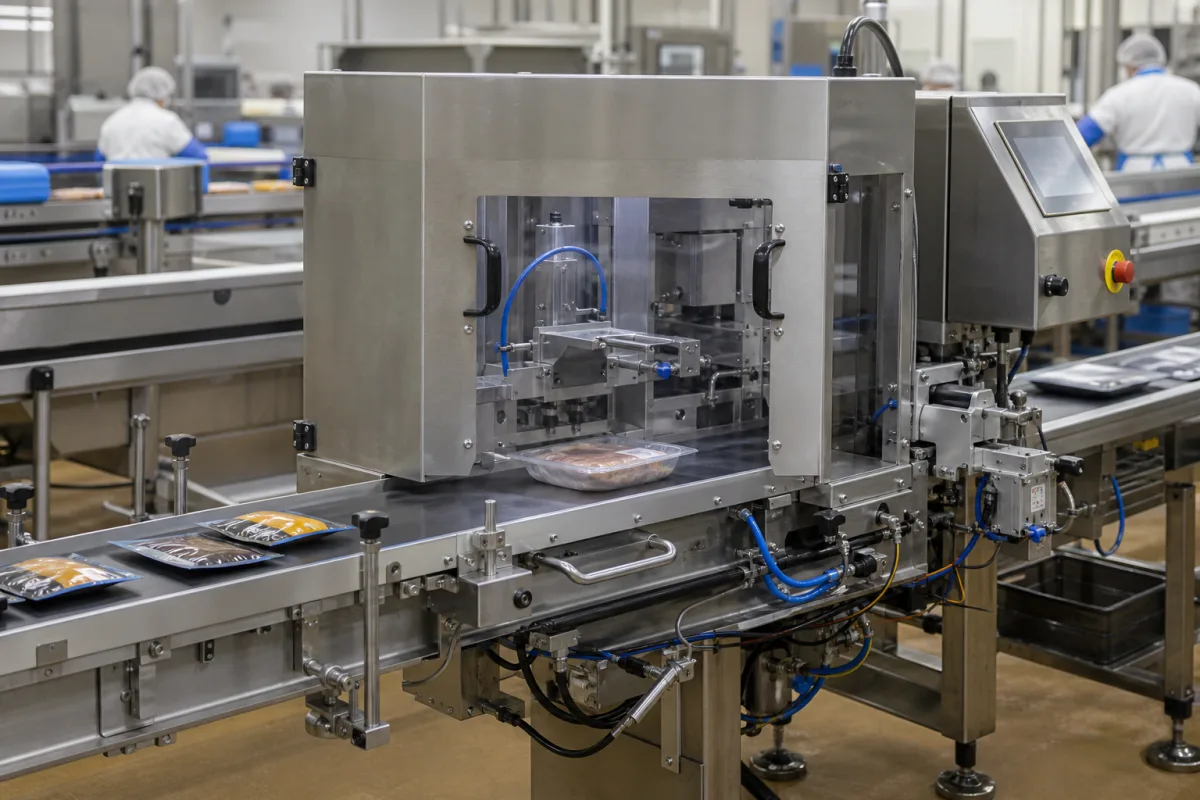
Package leak testers · Vacuum decay to ASTM F2338 versus bubble emission to ASTM D3078, detectable hole sizes and sensitivity
A food packaging integrity tester checks sealed packs — pouches, trays, cups and bottles — for leaks that would let in oxygen, microorganisms or contaminants. Ask three things first: which test method it uses and whether that method destroys the pack, what hole or leak size it is shown to detect on packages like yours, and whether it is designed for 100% online testing or laboratory sampling.
Vacuum decay, pressure decay and bubble emission leak testers for food packages, laboratory or in-line. Seal strength testers, gas analysers for headspace composition, metal detectors and X-ray inspection are outside this page.
CNFX editorial research · Sources checked October 11, 2026 · 4 sources
ASTM F2338 describes vacuum decay as non-destructive detection of leaks that are not visibly detectable, needing no dyes or tracer gases: the package sits in an evacuated test chamber and leakage of headspace gas, or vaporising liquid at the leak, raises the chamber pressure. Being rapid, non-invasive and non-destructive, it is suited to 100% online testing or statistical sampling; porous lidding must be masked to stop gas migration through it. Results are accept/reject against baselines from non-leaking controls and calibrated simulated leaks. [1]
ASTM D3078 covers gross leaks in flexible packaging with a headspace by bubble emission: the pack is immersed in a fluid in a transparent vacuum chamber and bubbles show leaks. It warns that small leaks may be missed, because viscous products or entrapped air block small openings and pressure inside the pouch can force the product to plug them. [2]
Cell Instruments' bubble-emission tester, built to ASTM D3078, ASTM E515 and GB/T 15171, draws vacuum to –90 kPa in a 270 × 210 mm chamber. [4] Labthink's C690H uses vacuum decay and pressure decay to ASTM F2338 and USP <1207> for vials, ampoules, cartridges, infusion bottles and prefilled syringes, with stated repeatability of ±1 µm and a 0.5–0.7 MPa air supply. [3]
Give the supplier the package types (pouch, tray, cup, bottle), materials and any porous lidding, headspace volume and product (dry, liquid, viscous), the smallest leak to detect, required throughput and whether 100% inline or sampled, reject handling, data integrity needs, and air and power supply.
02
Match detectable hole size and sensitivity
ASTM F2338's precision studies found that vacuum decay detected hole or crack defects of at least 50 µm in unlidded trays or cups at –400 mbar; holes of at least 100 µm, seal channels made with 125 µm wires and severe seal-bonding defects in trays with porous lidding at –400 mbar, with sensitivity of about 10⁻² Pa·m³/s; and holes of at least 5 µm in rigid non-porous packages, with sensitivity of about 10⁻³·⁴ Pa·m³/s for capped plastic bottles and 10⁻⁴·¹ Pa·m³/s for air-filled glass syringes. Flexible non-porous packages can also be tested, though not covered by the precision studies. [1]
ASTM D3078 states that bubble-emission sensitivity is limited to about 1 × 10⁻⁵ atm·cm³/s (1 × 10⁻⁶ Pa·m³/s), or even less sensitive as an interlaboratory test showed, and that detectable leak size depends on the product, packaging material and test parameters; because small leaks can be plugged by product, the standard is framed for gross leaks. [2]
Editorial calculation: dividing by atmospheric pressure (101,325 Pa) converts leak rates to flow at atmospheric conditions: 10⁻² Pa·m³/s is about 5.9 mL/min, 10⁻³·⁴ Pa·m³/s about 0.24 mL/min, and 10⁻⁴·¹ Pa·m³/s about 0.05 mL/min. These help compare suppliers who quote sensitivity in mL/min. [1]
03
Bench bubble testers and decay detectors on the listed pages
Listings include bench bubble-emission testers to ASTM D3078 and non-destructive vacuum and pressure decay detectors to ASTM F2338; ask whether an in-line version exists for your line speed.
04
Chamber, vacuum, transducers and the calibrated leak
In a vacuum decay tester the transducers and the calibrated leak decide where the accept/reject line sits; a bubble tester relies on the immersion tank and what the operator can see in it. [1][2]
Explore company information and manufacturing capabilities, then discuss the scope of your project with a relevant supplier.
Share this page
Compiled and source-reviewed by the CNFX editorial team.
Each manufacturer above links to the page on that company's own website where the product is listed, with the date we checked it. How we source and review
· Page last updated 13 October 2026
Buyer questions
Which package leak test is non-destructive?
Vacuum decay to ASTM F2338, which needs no dyes or tracer gases and suits 100% online testing. [1]
What hole size can vacuum decay detect?
In ASTM F2338 studies, 50 µm in unlidded trays, 100 µm in porous-lidded trays and 5 µm in rigid non-porous packs. [1]
Is the bubble test sensitive?
ASTM D3078 is framed for gross leaks: its stated limit is about 1 × 10⁻⁶ Pa·m³/s or less sensitive, and small leaks can be plugged by product. [2]
Why might a bubble test miss leaks?
Viscous product or entrapped air can block small openings, and internal pressure can plug them. [2]
Sources and what still needs a direct check
Sources checked 2026-10-11. ASTM F2338 and D3078 are the test standards (scope and significance text published by ASTM); Labthink and Cell Instruments are linked makers describing their instruments.