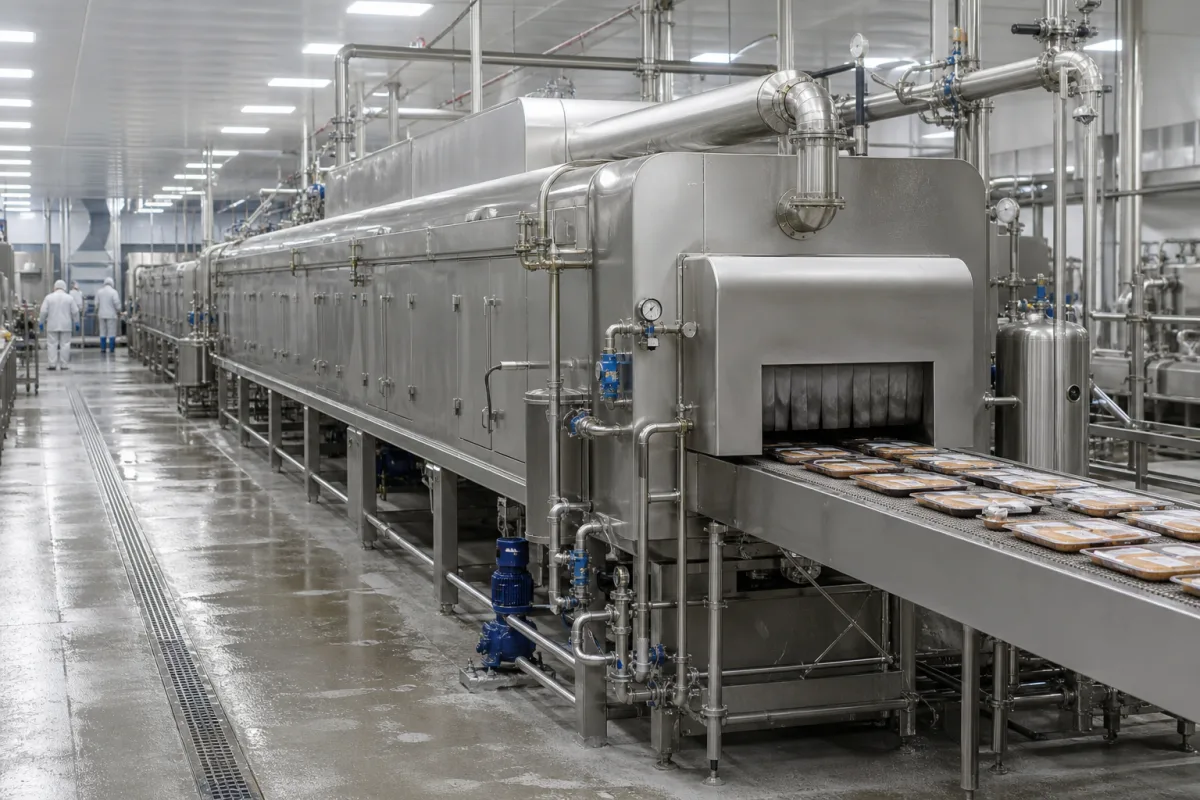
Automated food sterilization tunnel for sealed trays and pouches of chilled foods
In-pack heat treatment of sealed food trays and pouches · chilled shelf-life targets, zone layout, belt and dwell time
An automated food sterilization tunnel, in the sense used on this page, is a continuous conveyor tunnel that heats sealed trays, pouches and other packs of solid or semi-solid food with steam or hot water, holds them until the slowest-heating point reaches a target, and cools them before they go into chilled storage. Ask three things first: which time and temperature the coldest point of each pack must reach for the shelf life you want, how the zones and belt deliver that across the full belt width, and how the pack keeps its orientation and seal through heating and cooling.
Continuous in-pack heat-treatment tunnels for sealed trays, pouches and similar packs of chilled foods such as ready meals, soups, sauces and cooked meats, working at atmospheric pressure. Tunnel pasteurizers for filled beverage bottles and cans, dosed in pasteurization units, are covered on the Tunnel sterilizer (tunnel pasteurizer) for filled bottles and cans page. Pressure retorts for shelf-stable low-acid canned foods, surface pasteurizers for unpacked products and depyrogenation tunnels for empty vials are outside this page.
CNFX editorial research · Sources checked October 12, 2026 · 4 sources
Set the time and temperature from the chilled shelf life you need
Campden BRI describes industry heat processes for pasteurised chilled foods such as soups, sauces, ready meals and cooked meats in two groups by shelf life. Short shelf-life products are pasteurised at 70 °C for 2 minutes and long shelf-life products, over 10 days, at 90 °C for 10 minutes, each aimed at a 6-log reduction of Listeria monocytogenes or Clostridium botulinum respectively. [1]
Campden BRI states that 70 °C for 2 minutes, or a time and temperature with equivalent lethality, is the minimum process recommended against Listeria monocytogenes in pasteurised chilled foods with a shelf life of more than 5 days. [1]
The UK Food Standards Agency explains that non-proteolytic Clostridium botulinum can grow and produce toxin at 3 °C and above in vacuum and modified-atmosphere packed chilled foods, and that a shelf life of more than 10 days needs additional controlling factors, set out in its guidance and decision tree. [2] Campden BRI lists 90 °C for 10 minutes as the heat treatment used for products sold beyond 10 days. [1]
Editorial note: the tunnel's job is to bring the slowest-heating point of the densest pack on the belt to the chosen target; ask the supplier for heat-penetration data on your own pack, filling and orientation rather than an air or water set-point.
Give the supplier the product and its pieces, pack type and material, pack dimensions and fill weight, target time and temperature at the coldest point, shelf life and storage temperature, packs per minute, steam, water and power available, and the records you need for each batch.
02
Lay out the zones, belt and dwell time
Wanying, a Chinese maker listing a spray tunnel pasteurizer for glass, PET, cans and stand-up pouches, publishes a standard 5-zone model (two preheat, one pasteurization, two cooling) with a temperature range from ambient +5 °C to 98 °C, belt widths of 1,000 to 2,400 mm, belt speed of 0.5 to 5.0 m/min, dwell time of 5 to 40 minutes, steam or thermal-oil heating and machine lengths of 8,000 to 18,000 mm. [3]
For pouches, Wanying writes that it adds a support platform and reduces conveyor speed to prevent the packs shifting, and that changeover between container families takes about 30 to 45 minutes. [3] Editorial calculation: at 0.5 m/min, a 40-minute dwell needs 20 m of belt travel, more than the 18 m maximum machine length listed, so ask which belt speed and tunnel length together deliver your dwell.
Marlen, a US maker, describes two continuous post-package routes: a water pasteurizer that carries packs on a flighted conveyor through a recipe-driven heating and chilling process using steam injection, water agitation and recirculation, and a spiral pasteurizer that distributes steam, dry heat or superheated vapour with a forward-reversing fan for products in trays and pouches where orientation must be kept. [4]
Marlen contrasts these with surface pasteurizers used before packing, which hold product for 30 to 90 seconds in flame at over 400 °C, or 60 seconds in infrared, while the core stays at 4 °C. [4] Editorial note: those surface systems treat the outside of unpacked product; a sealed-pack tunnel has to heat through the pack to the centre.
03
Water spray, steam or immersion, and has it run your pouch?
The supplier linked to this page lists a spray tunnel pasteurizer that it says handles pouches as well as bottles and cans; the card links to the page reviewed.
Ask each supplier whether the tunnel has run your pack format, which heating medium it uses (water spray, steam or hot water immersion), the maximum water or steam temperature, and heat-penetration results at the coldest point of a full belt.
04
From infeed belt through heating, holding and cooling zones of a sterilization tunnel
Part
Role
Fix in the order
Infeed conveyor
Spaces packs and sets orientation; support platform for pouches. [3]
Pack spacing and lanes.
Heating zones
Bring pack to target with spray, steam or water. [3][4]
Number and set-points.
Holding section
Holds coldest point at target, such as 90 °C for 10 minutes. [1]
Explore company information and manufacturing capabilities, then discuss the scope of your project with a relevant supplier.
Share this page
Compiled and source-reviewed by the CNFX editorial team.
Each manufacturer above links to the page on that company's own website where the product is listed, with the date we checked it. How we source and review
· Page last updated 13 October 2026
Buyer questions
What temperature does a chilled-food tunnel need to reach?
Campden BRI cites 70 °C for 2 minutes for short shelf-life chilled foods and 90 °C for 10 minutes for products kept over 10 days. [1]
Why does a 10-day shelf life matter?
The UK FSA says non-proteolytic C. botulinum can grow at 3 °C and above in VP/MAP chilled foods, and shelf lives over 10 days need extra controlling factors. [2]
How wide and long are these tunnels?
One maker lists belt widths of 1,000–2,400 mm, dwell of 5–40 minutes and lengths of 8–18 m. [3]
Can trays and pouches be heated without a tunnel belt?
Marlen lists a spiral pasteurizer with steam for trays and pouches and a water pasteurizer with a flighted conveyor. [4]
Sources and what still needs a direct check
Sources checked 2026-10-12. Campden BRI is a food research organisation and the UK Food Standards Agency is the regulator; both set out heat-treatment and shelf-life targets. Wanying and Marlen are makers describing their own equipment.