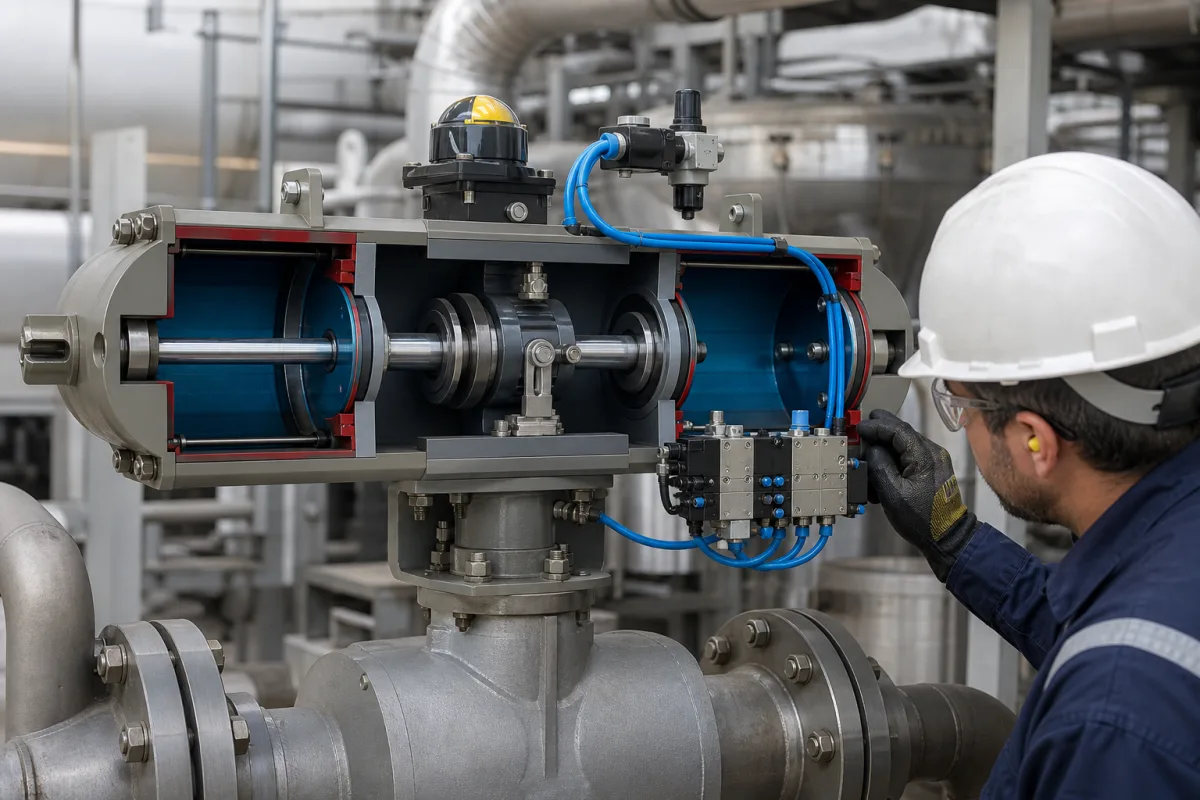
Valve automation · Torque at the worst point of the stroke
A pneumatic actuator turns compressed air into the torque that opens and closes a valve. Sizing mistakes cause failures: enough torque to open but not to close, a valve stuck mid-stroke, or so much torque the valve stem is damaged. Start from the valve's torque signature in your service and the air pressure actually available at the valve.
Quarter-turn pneumatic actuators for ball, butterfly and plug valves (rack-and-pinion and scotch-yoke, double-acting and spring-return), with a note on linear actuators. Electric actuators and control positioners are separate products.
CNFX editorial research · Sources checked October 10, 2026 · 4 sources
Cross Company lists the valve torques to collect: break (opening) torque to start a closed valve moving, running torque mid-stroke, seating (closing) torque, and the maximum allowable stem torque (MAST) beyond which the stem may deform. It notes that different valve types have different signatures: a metal-seated butterfly needs high torque to break and seat but little in between, while a metal-seated ball valve also needs elevated torque while travelling. [1]
A valve maker may publish only a minimum opening torque in water service, or only the torque at maximum conditions, without the running torque. Some media increase torque. Ask the valve supplier for the torques in your service: pressure, temperature, media and seat material. [1]
Modulating (throttling) valves need more torque than on-off valves, and stop repeatedly mid-stroke. State which service the actuator is for. [1]
Cross Company gives a 25% safety factor as an example: a valve needing 100 in-lb to open would get an actuator sized for 125 in-lb break torque. Use the factor your project specifies, and keep actuator output below the valve's maximum allowable stem torque. [1]
02
Check the operating envelope and seal options on the data sheet
A rack-and-pinion data sheet states the limits the actuator is rated for, and these should match your plant air and site. FNW's AD-Series brochure, for an aluminium-bodied rack-and-pinion range offered double-acting or spring-return, sets a minimum supply pressure of 30 psi and a maximum of 115 psi, and accepts dry or lubricated air or non-corrosive gas. [3] It ties the temperature rating to the O-ring material: standard NBR seals cover -20 °C to +80 °C, low-temperature NBR -40 °C to +80 °C, and Viton seals -15 °C to 150 °C. [3] State your lowest and highest ambient and media temperatures so the supplier quotes the right seal set rather than the standard one.
The same brochure gives a standard 90-degree rotation with external travel-stop bolts adjustable by ±5° at both the 0° and 90° positions. [3] It tabulates the air volume for opening and closing each body size in litres, and notes that air consumption depends on air supply, so ask for air volume per stroke and stroke times at your own supply pressure and with your solenoid and tubing. [3]
For maintenance, FNW ships the actuator lubricated with EP-1 grease, recommends periodic checks that fasteners remain tight, and warns that spring fatigue may set in on spring-return units, with springs always to be replaced in new full sets. [3] Ask the supplier for seal and spring kits by part number.
03
Read the spring-return torque chart at your lowest air pressure
Ramén's Wirematic torque chart for its WM/TT rack-and-pinion actuators lists, for each size, the double-acting torque at 2–7 bar and, for each spring set, the spring start and end torque and the air-stroke start and end torque at each pressure. For the WM/TT8 size, double-acting torque is 60.0 Nm at 4 bar, 82.5 Nm at 5.5 bar and 90.0 Nm at 6 bar. [4]
The chart shows the trade-off: each added spring raises the fail-safe torque and lowers the air torque left to turn the valve. With eight springs the air-stroke end torque is 2.4 Nm at 4 bar, and at 2 bar the chart prints negative values (−1.7 / −27.6 Nm). [4]
Editorial calculation: a valve needing 40 Nm to break open, with Cross Company's 25% example factor, needs 50 Nm of air start torque. The three-spring WM/TT8SR gives 66.7 Nm at 5.5 bar but 44.2 Nm at 4 bar, so it falls short if the supply can drop to 4 bar; its spring end torque of 15.8 Nm limits the seating torque it can cover to 15.8 ÷ 1.25 ≈ 12.6 Nm. [4][1]
WM/TT8SR spring set (outer + inner)
Spring start / end (Nm)
Air start / end at 4 bar | at 5.5 bar (Nm)
1 + 0
9.6 / 5.3
54.7 / 50.4 | 77.2 / 72.9
2 + 0
19.2 / 10.6
49.4 / 40.8 | 71.9 / 63.3
3 + 0
28.8 / 15.8
44.2 / 31.2 | 66.7 / 53.7
4 + 0
38.4 / 21.1
38.9 / 21.6 | 61.4 / 44.1
4 + 4
57.6 / 31.7
28.3 / 2.4 | 50.8 / 24.9
04
Choose rack-and-pinion or scotch yoke, double-acting or spring-return
Cross Company notes that rack-and-pinion actuators give constant torque through the stroke, while scotch-yoke actuators give reduced torque mid-stroke. Compare the actuator's published torque curve with your valve's torque signature, not one figure. [1]
Function
Behaviour
Use when
Double-acting
Air opens and air closes; on loss of air the valve stays where it is. [1]
No fail-safe position is required.
Spring-return, fail closed
Air opens; internal springs close on loss of air. Air torque falls as the springs compress. [1]
The process must stay open, for example cooling flow.
DONJOY's actuator page lists horizontal rack-and-pinion and vertical stainless-steel actuators in SS304, SS316L or aluminium alloy for sanitary butterfly and ball valves. Specify body material and coating for the environment, especially washdown or corrosive atmospheres. [2]
05
Size against every point of the stroke at minimum air pressure
For spring-return actuators Cross Company defines four torque points: start of air (air torque from the normal position), end of air (air torque at full travel), start of spring (spring torque at full travel when air is removed) and end of spring (spring torque back at the normal position). Each must exceed the valve torque needed at that position; MAST must exceed every actuator output. [1]
Stroke point (fail-closed example)
Actuator torque
Must exceed
Valve closed, air applied
Start of air
Break torque × safety factor
Valve open, air held
End of air
Running/end torque × safety factor
Valve open, air removed
Start of spring
Torque to start closing × safety factor
Valve closing onto seat
End of spring
Seating torque × safety factor
Read the actuator's torque tables at the lowest air pressure that will reach the valve, not the compressor set-point; Cross Company warns these can differ. As a calculation example only, a butterfly valve with 80 N·m break torque and a 25% factor needs at least 100 N·m start-of-air torque at minimum supply pressure; if the valve's MAST is 300 N·m, no actuator output may exceed 300 N·m. [1]
06
Define mounting, accessories and air quality
The actuator must fit the valve's mounting pad and stem, and carry the accessories the control system needs.
Ask for the mounting flange pattern and stem drive (square or flats) matched to the valve, and whether a bracket and coupling are needed. If your plant standardises on a mounting or accessory interface (for example ISO 5211 flanges or NAMUR solenoid mounting), name it and confirm the pattern on the drawing.
List accessories: solenoid valve, limit-switch box, positioner for modulating duty, manual override, speed controls and filter-regulator. Give the air supply pressure range, quality and the ambient temperature.
07
Body, pistons and rack or yoke, pinion, springs, seals, travel stops and accessory interfaces
The body and mechanism rows carry published facts (DONJOY's aluminium or stainless bodies; Cross Company's constant versus mid-stroke-reduced torque); seal and travel-stop details are model-specific, as FNW's seal-temperature table above shows. [2][1][3]
Part
Role
Fix in the order
Body (cylinder barrel)
Contains the pistons and air chambers; aluminium alloy or stainless steel offered. [2]
Body material, coating and size.
Pistons and rack, or yoke
Convert air pressure into rotation; rack-and-pinion gives constant torque, scotch yoke peaks at the ends. [1]
Mechanism type and torque curve.
Pinion / output shaft
Delivers torque to the valve stem.
Shaft drive and material.
End caps and springs
Close the body; springs give fail-safe return in spring-return units. [1]
Number of springs and spring torque.
Seals
Seal pistons and shaft against air leakage.
Seal material for temperature and air quality.
Travel stops
Set the open and closed positions.
Stop adjustment range.
Accessory interfaces
Mount solenoids, switches and positioners.
Interface patterns and accessories included.
08
Air pressure, torque at each stroke point, seals, materials and mounting for a quarter-turn actuator
Pressure and torque rows are sized from Cross Company's four stroke points at your lowest air pressure; temperature, air volume and seal data belong to the model quoted, as FNW's brochure shows. [1][3]
Field
What it means
Ask the supplier for
Operating pressure (MPa)
Minimum air pressure at the valve sets available torque. [1]
Torque tables at your minimum and maximum pressure.
Torque output (N·m)
Must exceed valve torque × safety factor at each stroke point. [1]
Paste it into your enquiry below or into an email to a maker, then replace every bracket.
Valve: [type; size; seat material; manufacturer and model; MAST]
Torques: [break; running; seating; at your pressure, temperature and media]
Service: [on-off or modulating; cycles per day]
Function: [double-acting, spring-return fail-closed or fail-open]
Air supply: [minimum and maximum pressure at the valve; air quality]
Safety factor: [percentage required by your project]
Mounting: [flange pattern; stem drive; bracket and coupling]
Accessories: [solenoid valve; limit switches; positioner; manual override; speed control]
Environment: [ambient temperature; washdown; corrosive or hazardous area]
Documents: [torque tables; sizing sheet; dimension drawing; certification]
These companies make pneumatic actuators or valves supplied with them, for industrial and sanitary service, and some also offer linear air cylinders.
Donjoy Technology
Location not checked for this product
Lists horizontal rack-and-pinion and vertical stainless-steel pneumatic actuators in SS304, SS316L or aluminium alloy for sanitary butterfly and ball valves, and valve control units.
Explore company information and manufacturing capabilities, then discuss the scope of your project with a relevant supplier.
Share this page
Compiled and source-reviewed by the CNFX editorial team.
Each manufacturer above links to the page on that company's own website where the product is listed, with the date we checked it. How we source and review
· Page last updated 13 October 2026
Buyer questions
What safety factor should I add to valve torque?
Cross Company gives 25% as an example safety factor: a valve needing 100 in-lb to open would get an actuator sized for 125 in-lb. Use the factor your project specifies and stay below the valve's maximum allowable stem torque. [1]
Why does a spring-return actuator need more checking?
Its air torque falls as it compresses the springs, and its spring torque falls as the springs extend. Each of start of air, end of air, start of spring and end of spring must exceed the valve torque at that point. [1]
Can I size from the compressor pressure?
No. Cross Company warns the pressure at the valve can be lower than the compressor setting; size from the minimum pressure that will reach the actuator. [1]
What air pressure range should a rack-and-pinion actuator accept?
Check the data sheet of the model you order: FNW's AD-Series brochure, for example, sets a minimum supply pressure of 30 psi and a maximum of 115 psi, and its temperature limits depend on the O-ring material chosen. [3]
Why does a spring-return actuator lose torque at low air pressure?
The air must compress the springs as well as turn the valve. Ramén's Wirematic torque chart shows a WM/TT8 with three outer springs giving 66.7 Nm air start torque at 5.5 bar but 44.2 Nm at 4 bar. [4]
Sources and what still needs a direct check
Sources checked 2026-10-10. Cross Company's technical article (a valve and automation distributor) is the main sizing source; calculations are editorial examples. Supplier pages describe their own offers. ISO 5211 and NAMUR documents were not read for this page.