Industry-Verified Manufacturing Data (2026)

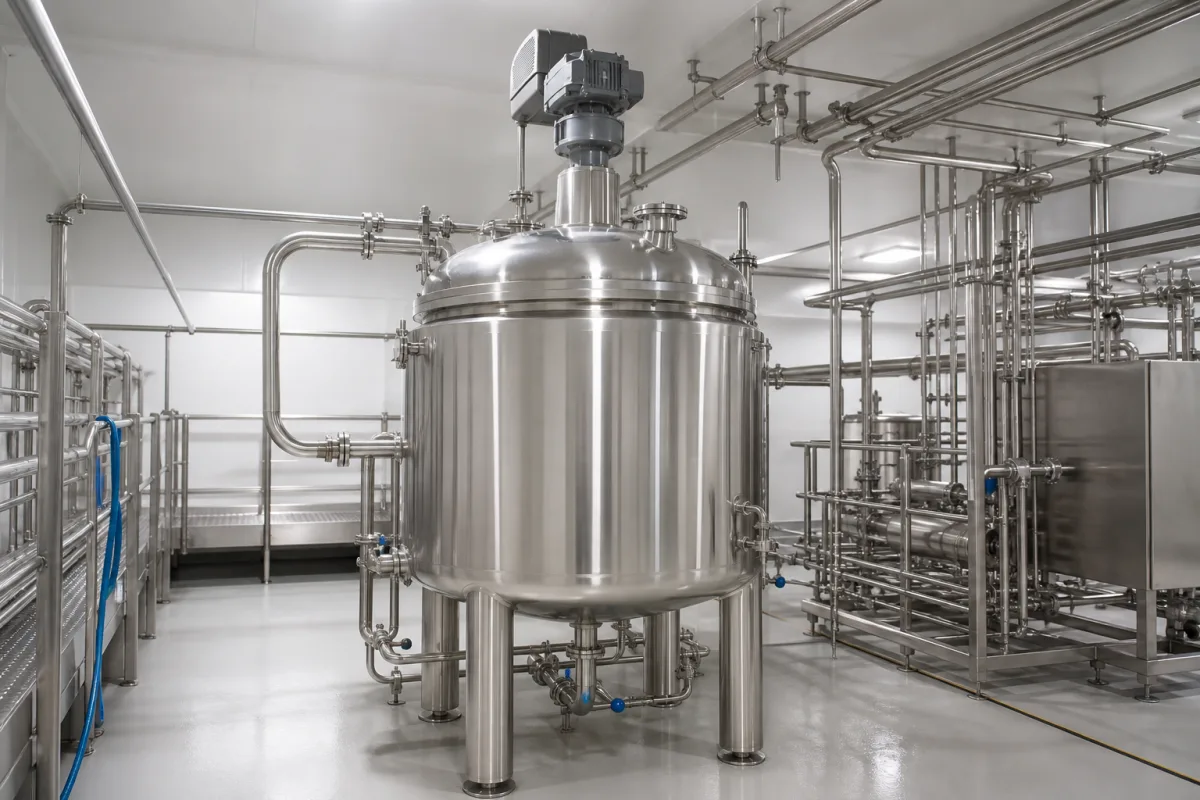
Central Mixing Vessel

Based on aggregated insights from multiple verified factory profiles within the CNFX directory, the standard Central Mixing Vessel used in the Food Manufacturing sector typically supports operational capacities ranging from standard industrial configurations to heavy-duty production requirements.

Technical Definition & Core Assembly

A canonical Central Mixing Vessel is characterized by the integration of Agitator Assembly and Vessel Body/Cylinder. In industrial production environments, manufacturers listed on CNFX commonly emphasize Stainless Steel (e.g., 304, 316L) construction to support stable, high-cycle operation across diverse manufacturing scenarios.

The primary container within an automated food blending system where ingredients are combined and homogenized.
Product Specifications

Technical details and manufacturing context for Central Mixing Vessel

Definition
The Central Mixing Vessel serves as the core component of the Automated Food Ingredient Blending and Mixing System, designed to receive, contain, and facilitate the thorough mixing of various food ingredients according to precise recipes. It ensures uniform distribution and consistency of the final blended product.
Working Principle
Ingredients are fed into the vessel via automated systems. Internal agitators (e.g., paddles, blades) rotate to create shear and convective forces, blending the contents. The process is controlled by a central system managing speed, duration, and sometimes temperature to achieve the desired homogeneity and texture.
Common Materials
Stainless Steel (e.g., 304, 316L)
Technical Parameters
  • Working volume capacity of the vessel. (L) Per Request
Components / BOM
  • Agitator Assembly
    Provides mechanical mixing action to blend ingredients.
    Material: Stainless Steel
  • Vessel Body/Cylinder
    Primary containment structure for ingredients during mixing.
    Material: Stainless Steel
  • Inlet Port(s)
    Entry point(s) for automated ingredient feeding.
    Material: Stainless Steel
  • Outlet Valve
    Controlled discharge point for the blended product.
    Material: Stainless Steel
Engineering Reasoning
0.1-2.0 bar absolute pressure, 5-85°C temperature, 30-70% fill level
3.5 bar internal pressure (burst disc rating), 120°C thermal limit (PTFE seal degradation), 95% fill level (overflow risk)
Design Rationale: Yield strength exceedance of 316L stainless steel (205 MPa at 100°C), polymer seal thermal degradation above glass transition temperature, turbulent flow-induced vibration at Reynolds numbers >4000
Risk Mitigation (FMEA)
Trigger Incomplete cleaning cycle leaving 0.5% residual solids
Mode: Bacterial biofilm formation reaching 10⁶ CFU/cm²
Strategy: CIP system with 2% NaOH at 80°C for 30 minutes, followed by 0.5% nitric acid passivation
Trigger Agitator imbalance exceeding 15 μm vibration amplitude at 1200 RPM
Mode: Bearing fatigue failure after 10⁷ cycles at 450 MPa contact stress
Strategy: Dynamic balancing to ISO 1940 G2.5 standard, SKF CARB toroidal roller bearings with 100,000 hour L10 life

Industry Taxonomies & Aliases

Commonly used trade names and technical identifiers for Central Mixing Vessel.

Industrial Ecosystem & Supply Chain DNA

Complementary Systems
Downstream Applications
Specialized Tooling

Application Fit & Sizing Matrix

Operational Limits
pressure: 0 to 10 bar (gauge)
flow rate: Up to 500 m³/h
temperature: -10°C to 150°C
slurry concentration: Up to 60% solids by weight
Media Compatibility
✓ Food-grade slurries (e.g., sauces, batters) ✓ High-viscosity pastes (e.g., dough, confectionery mixes) ✓ Liquid blends with particulates (e.g., soups, fruit preparations)
Unsuitable: Highly abrasive or corrosive media (e.g., acidic cleaning solutions with chlorides)
Sizing Data Required
  • Batch volume requirement (m³)
  • Viscosity range of media (cP)
  • Required mixing time per batch (minutes)

Reliability & Engineering Risk Analysis

Failure Mode & Root Cause
Impeller blade fatigue cracking
Cause: Cyclic loading from turbulent flow and material stress concentrations at weld joints or sharp edges
Shaft seal leakage
Cause: Wear from abrasive slurry particles, improper seal alignment, or thermal expansion mismatches
Maintenance Indicators
  • Unusual vibration patterns or audible knocking during operation
  • Visible slurry leakage around shaft seals or discoloration indicating corrosion
Engineering Tips
  • Implement predictive maintenance with vibration analysis and thermography to detect early-stage component degradation
  • Use wear-resistant coatings on impeller surfaces and optimize slurry rheology to reduce abrasive wear

Compliance & Manufacturing Standards

Reference Standards
ISO 9001:2015 Quality Management Systems ASME BPE-2019 Bioprocessing Equipment DIN EN 13445-5:2014 Unfired pressure vessels - Part 5: Inspection and testing
Manufacturing Precision
  • Vessel inner diameter: +/- 0.5 mm
  • Impeller shaft runout: 0.05 mm maximum
Quality Inspection
  • Hydrostatic pressure test at 1.5x design pressure
  • Surface finish verification per ASME BPE Ra ≤ 0.8 μm

Factories Producing Central Mixing Vessel

Verified manufacturers with capability to produce this product in China

✓ 93% Supplier Capability Match Found

P Project Engineer from Germany Jan 25, 2026
★★★★★
"Testing the Central Mixing Vessel now; the technical reliability results are within 1% of the laboratory datasheet."
Technical Specifications Verified
S Sourcing Manager from Brazil Jan 22, 2026
★★★★★
"Impressive build quality. Especially the technical reliability is very stable during long-term operation."
Technical Specifications Verified
P Procurement Specialist from Canada Jan 19, 2026
★★★★★
"As a professional in the Food Manufacturing sector, I confirm this Central Mixing Vessel meets all ISO standards."
Technical Specifications Verified
Verification Protocol

“Feedback is collected from verified sourcing managers during RFQ (Request for Quote) and factory evaluation processes on CNFX. These reports represent historical performance data and technical audit summaries from our B2B manufacturing network.”

15 sourcing managers are analyzing this specification now. Last inquiry for Central Mixing Vessel from Brazil (25m ago).

Supply Chain Compatible Machinery & Devices

Automated Food Moisture Analyzer

Automated system for precise moisture content measurement in food products

Explore Specs →
Automated Food Color Consistency Analyzer

Automated inline system for real-time color measurement and consistency control in food processing.

Explore Specs →
Control Panel

A centralized interface for monitoring and controlling industrial equipment and processes

Explore Specs →
Industrial Vacuum Tumbler

Industrial machine for massaging and marinating meat under vacuum to enhance texture and flavor.

Explore Specs →

Frequently Asked Questions

What are the benefits of using stainless steel in food mixing vessels?

Stainless steel (304/316L) offers corrosion resistance, easy cleaning, compliance with food safety standards, durability for industrial use, and prevents contamination in food manufacturing.

How does the agitator assembly improve mixing efficiency?

The agitator assembly ensures thorough homogenization by creating consistent shear and flow patterns, reducing blending time, preventing ingredient stratification, and maintaining product consistency in automated systems.

What maintenance is required for central mixing vessels?

Regular cleaning between batches, inspection of seals and valves, lubrication of agitator components, checking for corrosion or wear, and following manufacturer's sanitation protocols to ensure food safety compliance.

Can I contact factories directly on CNFX?

CNFX is an open directory, not a transaction platform. Each factory profile provides direct contact information and production details to help you initiate direct inquiries with Chinese suppliers.

Get Quote for Central Mixing Vessel

Request technical pricing, lead times, or customized specifications for Central Mixing Vessel directly from verified manufacturing units.

Your business information is encrypted and only shared with verified Central Mixing Vessel suppliers.

Thank you! Your message has been sent. We'll respond within 1–3 business days.

Need to Manufacture Central Mixing Vessel?

Connect with verified factories specializing in this product category

Add Your Factory Contact Us
Previous Product
Cap Sorter/Orienter
Next Product
CIP (Clean-in-Place) System