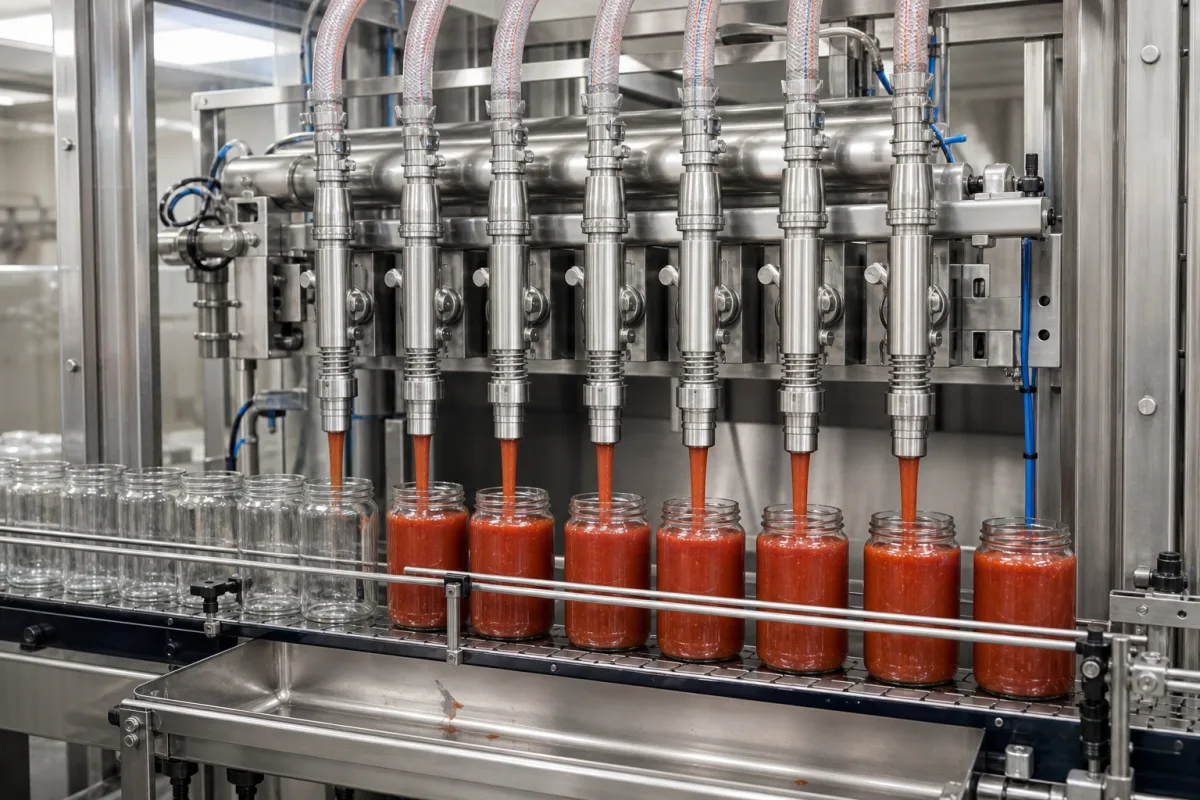
Filling nozzles for ketchup, tomato sauce and soup: positive shut-off tips that stop the stream of a paste with a yield stress
Shut-off nozzles on multi-head jar fillers for ketchup, tomato sauce and soups with pieces · a product that will not flow until 25–65 Pa is applied, a tapered seat or a 90° non-drip tip to cut the stream, and suck-back through one capillary to clear the last drop
A paste such as ketchup does not run like juice: it sits still until the stress on it passes a threshold, then thins as it moves. That helps and hurts at a filling nozzle. A thread of product can hang from the tip after the valve closes and land on the jar rim or seal area, yet the same yield stress can hold a short column of product in a narrow channel without any valve at all. This page is about the nozzle tip and its shut-off on fillers that put sauces, ketchup and soups with solids into jars, cartons or pouches.
Positive shut-off filling nozzles and nozzle tips for viscous, yield-stress foods such as ketchup, tomato sauce, pastes and soups with pieces, filled into jars, cartons or pouches on multi-head piston or valve fillers: tip geometry, channel or capillary inserts, seat design and suck-back. Filling heads, lances and anti-drip valves for drums and chemical containers are covered on the Filling head for drum and container filling of chemical liquids page; counter-pressure and flowmeter valves for drinks on the Beverage filling nozzle assembly for bottle and can fillers page; pulpy-juice and fruit-piece dosing valves on the Hot-fill valve for pulpy juices page; and load-cell controlled heads on the Net-weight filling head for rotary bottle fillers page.
CNFX editorial research · Sources checked October 13, 2026 · 5 sources
Ketchup that will not move below 25–65 Pa: what the yield stress means for nozzle bore and drips
Panovská and co-workers measured 20 tomato ketchups bought in Prague supermarkets on a RheoStress 300 rheometer at 23 °C and 45 °C, with the static yield stress taken on a vane rotor at 0.5 s⁻¹; they describe ketchup as viscoplastic and fit it with the Herschel-Bulkley equation. [1]
Editorial calculation: in an idealised open vertical tube with no wall slip, a plug of paste stays put when the yield stress on the wall can carry its weight, which gives a critical bore of 4τ/(ρg). Assuming a density of 1,100 kg/m³ (an assumption, not a value from the sources), 25 Pa gives about 9 mm and 65 Pa about 24 mm. Below that bore the product in the tip holds by itself; above it, product in the tip can slump out after the valve closes unless the tip is closed or split into narrower channels. Real pastes slip at steel walls and are vibrated by the machine, so treat this only as a reason to ask for drip trials with the actual product. [1]
The spread matters as much as the mean: one ketchup in the set had more than 80 times the plastic viscosity of another, and thixotropy ranged over more than four orders of magnitude, so a nozzle set up on one recipe can string or drip on another. [1] The US standard of identity puts a ceiling on runniness: catsup must flow not more than 14 cm in 30 seconds at 20 °C in a Bostwick consistometer. [2]
The same regulation sets the fill of container for catsup at not less than 90 % of the total capacity, with exceptions for frozen product and single-serve packs of 56.7 g (2 oz) or less. [2] Editorial calculation: for a 500 mL jar that is at least 450 mL of product, so the nozzle has to place the dose without leaving a mound or splash that disturbs a level surface close to the rim.
Send a sample or the yield stress, viscosity at fill temperature, particle size, fill temperature, container neck or opening and the fill volume; ask the supplier to show drip and stringing at the end of the dose on that sample.
02
Three patented ways to stop the last drop: a tapered seat over channels, a 90° concave tip and a capillary bundle with suck-back
The three patents below come from a can-machine builder, an individual inventor and a carton-packaging company; each attacks the drip at the end of a dose from a different side.
The Angelus patent contrasts its design with earlier valve types: it says piston-type valves had been used for high-viscosity liquids and solids suspended in them, and that plug-rod or reversed plug-rod valves suited liquids but not liquids with suspended solids. Its nozzle keeps enough internal clearance for particles while staying narrow enough to enter the gap of a pouch opening. [3]
In the Munoz Navarro valve the number and size of the nozzle channels are chosen from the viscosity of the product; for low-density, high-viscosity liquids the patent switches to a single large opening with the seat moved to the top of the outlet. A leak detection port between two seals shows which seal has failed before drive air can reach the product, and a flange at the nozzle end allows the valve to be cleaned in place by back-flowing cleaning solution through the channels. [4]
Elopak states the problem it solves directly: viscous product left hanging from the nozzle can drip onto the inner and outer surfaces of the carton, causing food hygiene and sealing problems. Splitting the closing between a plate and a separate sealing component is also meant to reduce wear compared with one part sealing every capillary. [5]
Design
How the tip closes
Product named
Numbers given
Pouch filler nozzle and valve, US 4,363,429 (Angelus Sanitary Can Machine Co., 1982)
A valve piston reciprocates in a vertical bore and seats on a downward-converging tapered seat at its lower end; below the seat is a concave conoidal non-drip tip, and residue on it is pulled upward by surface tension [3]
Low or high viscosity liquids, with or without suspended solid particles, filled into pouches [3]
Side inlet port at about 60° to the bore; tip surface at about 45° to its axis, a total included angle of about 90° [3]
Fill valve assembly, US 6,484,745 (R. Munoz Navarro, 2002)
A pneumatically driven piston with a cylindrical sealing head seats in a tapered outlet just above a nozzle drilled with a set of channels; product trapped in the channels is held in the way liquid is held in a straw [4]
Yogurt, milk, water, ice cream and other flowable foods, and pharmaceutical products [4]
Product dispensing piston operated at about 2 to 60 psi (Editorial calculation: about 0.14 to 4.1 bar) [4]
Filling device, US 11,597,542 (Elopak AS, 2023)
A filler nozzle made of a bundle of capillaries, angled to make one stream; a sealing plate closes all but a central main capillary, then a flexible sealing component closes and compresses it, pushing out a last pulse and reversing to suck back product hanging on the nozzle [5]
Viscous products such as soup containing solid food matter and bases for sauces, filled into partly formed cartons [5]
No dimensions given; the sequence is open main capillary, open all, close outer capillaries, close and compress main, release for suck-back [5]
Ask which closing principle the nozzle uses, the smallest internal clearance against your largest particle, how the tip is cleaned in place, and whether a suck-back or tip-wipe step is included in the cycle.
03
What to send for sauce and paste filling nozzles
Paste it into your enquiry below or into an email to a maker, then replace every bracket.
Product: [ketchup, sauce, paste or soup; yield stress or Bostwick value; viscosity; particle size; fill temperature]
Container: [jar, carton or pouch; opening size; fill volume; headspace]
Filler: [piston or valve; number of heads; speed]
Nozzle: [shut-off type; bore or channel layout; suck-back; diving or fixed]
Hygiene: [CIP route; seal materials; surface finish]
Trials: [drip and stringing test on your sample]
Explore company information and manufacturing capabilities, then discuss the scope of your project with a relevant supplier.
Share this page
Compiled and source-reviewed by the CNFX editorial team.
Each manufacturer above links to the page on that company's own website where the product is listed, with the date we checked it. How we source and review
· Page last updated 13 October 2026
Buyer questions
Why does ketchup drip or string from a filling nozzle?
Ketchup is viscoplastic: Panovská et al. measured static yield stresses of 25 to 65 Pa across 20 retail ketchups, with apparent viscosity from 0.17 to 1.42 Pa·s, so product left on the tip after shut-off may hang and fall later. [1]
How thick must US catsup be?
21 CFR 155.194 sets a flow of not more than 14 cm in 30 seconds at 20 °C in a Bostwick consistometer, and a fill of not less than 90 % of container capacity. [2]
How does a suck-back nozzle remove the last drop?
In Elopak's US 11,597,542 a central capillary is closed and compressed to push out a last pulse, then released so that suction draws product on the nozzle back inside. [5]
Can a shut-off nozzle handle sauces with pieces?
Angelus's US 4,363,429 was designed for low or high viscosity liquids with or without suspended solids, keeping internal clearance for particles and a 90° concave tip against drips. [3]
Sources and what still needs a direct check
Sources checked 2026-10-13. Ketchup rheology is from Panovská et al., Czech Journal of Food Sciences (2009); the catsup consistency and fill rules are the US FDA standard of identity in 21 CFR 155.194; the shut-off designs are three granted US patents read on Google Patents.