Industry-Verified Manufacturing Data (2026)

Homogenizing Valve

Based on aggregated insights from multiple verified factory profiles within the CNFX directory, the standard Homogenizing Valve used in the Food Manufacturing sector typically supports operational capacities ranging from standard industrial configurations to heavy-duty production requirements.

Technical Definition & Core Assembly

A canonical Homogenizing Valve is characterized by the integration of Valve Seat and Valve Stem. In industrial production environments, manufacturers listed on CNFX commonly emphasize Stainless Steel 316L construction to support stable, high-cycle operation across diverse manufacturing scenarios.

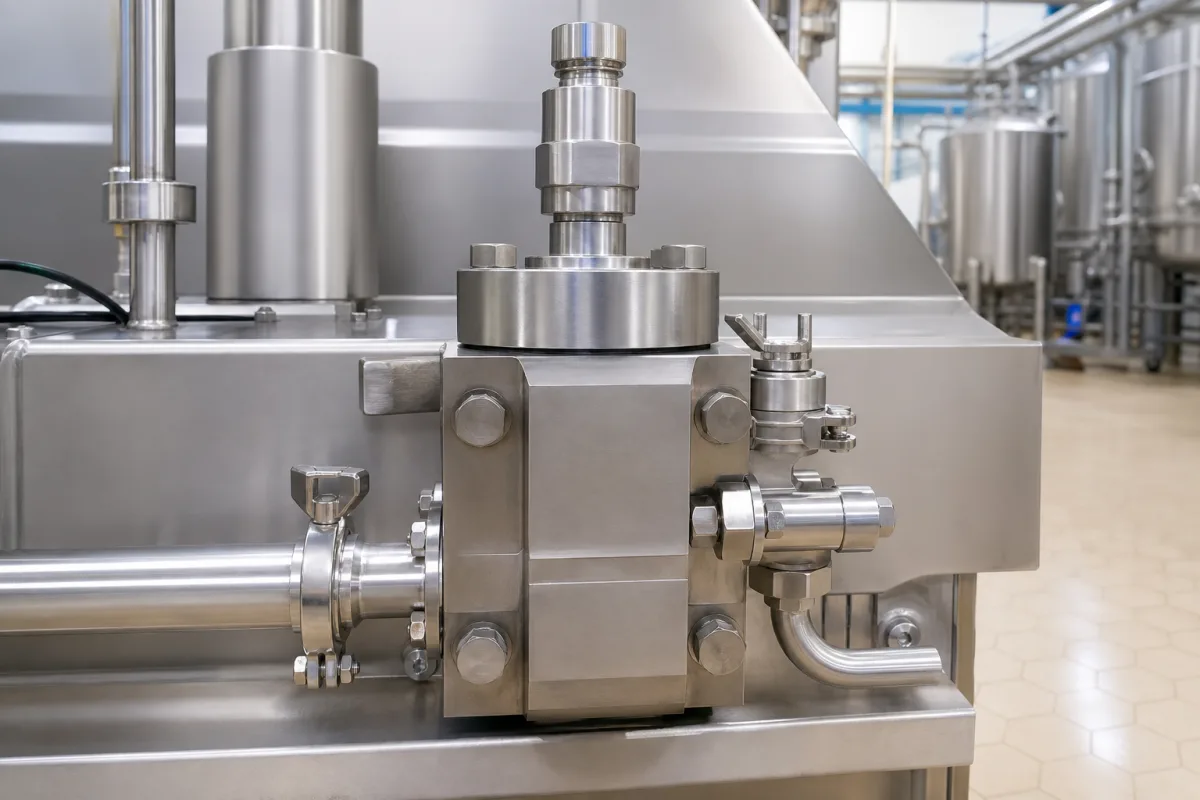
A precision valve component within a homogenizer that controls the flow and pressure of materials during the homogenization process.
Product Specifications

Technical details and manufacturing context for Homogenizing Valve

Definition
The homogenizing valve is a critical component of a homogenizer unit that regulates the passage of fluid or semi-fluid materials through a narrow gap under high pressure, creating shear forces that break down particles and droplets to achieve uniform consistency and stability in the final product.
Working Principle
The valve operates by forcing material through a narrow gap between a valve seat and a valve stem under high pressure (typically 100-1000 bar). This creates intense shear, turbulence, and cavitation forces that disrupt and reduce particle sizes, resulting in homogeneous mixtures with improved stability and texture.
Common Materials
Stainless Steel 316L, Tungsten Carbide, Ceramic
Technical Parameters
  • Gap clearance between valve seat and stem, typically ranging from 0.01-0.5mm depending on application requirements (mm) Standard Spec
Components / BOM
  • Valve Seat
    Stationary component that forms one side of the homogenization gap
    Material: Stainless Steel 316L
  • Valve Stem
    Movable component that adjusts gap clearance and applies pressure
    Material: Tungsten Carbide
  • Spring Mechanism
    Provides controlled pressure adjustment and shock absorption
    Material: Spring Steel
Engineering Reasoning
15-250 bar
275 bar sustained pressure or 300 bar instantaneous pressure
Design Rationale: Cavitation-induced erosion at the valve seat interface when local pressure drops below 0.5 bar absolute, causing vapor bubble collapse with microjet impacts exceeding 1000 MPa
Risk Mitigation (FMEA)
Trigger Particulate contamination exceeding 25 μm in homogenization fluid
Mode: Valve seat scoring leading to pressure regulation failure
Strategy: Install 10 μm absolute filtration upstream with differential pressure monitoring at 0.3 bar threshold
Trigger Cyclic pressure loading at 50 Hz frequency matching valve natural frequency
Mode: High-cycle fatigue crack initiation at valve stem radius (stress concentration factor Kt=2.8)
Strategy: Design pressure pulsation dampener with 85% attenuation at 50 Hz using Helmholtz resonator principle

Industry Taxonomies & Aliases

Commonly used trade names and technical identifiers for Homogenizing Valve.

Applied To / Applications

This component is essential for the following industrial systems and equipment:

Industrial Ecosystem & Supply Chain DNA

Complementary Systems
Downstream Applications
Specialized Tooling

Application Fit & Sizing Matrix

Operational Limits
pressure: Up to 250 MPa
flow rate: 0.5 to 5000 L/h
temperature: -20°C to 150°C
slurry concentration: Up to 45% solids by volume
Media Compatibility
✓ Food emulsions (dairy, sauces) ✓ Pharmaceutical suspensions ✓ Chemical slurries (pigments, catalysts)
Unsuitable: Highly abrasive media with >60% solids or corrosive acids (e.g., hydrofluoric acid)
Sizing Data Required
  • Required homogenization pressure (MPa)
  • Maximum flow rate (L/h)
  • Material viscosity and particle size distribution

Reliability & Engineering Risk Analysis

Failure Mode & Root Cause
Abrasive erosion
Cause: High-velocity flow of abrasive particles in the fluid stream wearing down valve components, particularly seats and seals, leading to leakage and reduced pressure control.
Cavitation
Cause: Rapid pressure drops across the valve creating vapor bubbles that implode violently, causing pitting, vibration, and material fatigue in valve internals.
Maintenance Indicators
  • Unusual high-frequency vibration or audible hammering noise during operation
  • Visible external leakage or significant pressure drop deviation from setpoints
Engineering Tips
  • Implement real-time particle monitoring upstream and install protective hard-faced trim materials to combat abrasive wear
  • Optimize valve sizing and operating parameters to maintain pressure above vapor pressure, preventing cavitation conditions

Compliance & Manufacturing Standards

Reference Standards
ISO 5208:2015 (Industrial valves - Pressure testing of valves) ASME B16.34 (Valves - Flanged, Threaded, and Welding End) DIN EN 12266-1 (Industrial valves - Testing of metallic valves)
Manufacturing Precision
  • Bore diameter: +/-0.025 mm
  • Surface flatness: 0.05 mm across sealing face
Quality Inspection
  • Hydrostatic pressure test (leakage verification)
  • Material composition verification via X-ray fluorescence (XRF) analysis

Factories Producing Homogenizing Valve

Verified manufacturers with capability to produce this product in China

✓ 94% Supplier Capability Match Found

P Procurement Specialist from United Arab Emirates Feb 16, 2026
★★★★★
"Impressive build quality. Especially the technical reliability is very stable during long-term operation."
Technical Specifications Verified
T Technical Director from Australia Feb 13, 2026
★★★★★
"As a professional in the Food Manufacturing sector, I confirm this Homogenizing Valve meets all ISO standards."
Technical Specifications Verified
P Project Engineer from Singapore Feb 10, 2026
★★★★★
"Standard OEM quality for Food Manufacturing applications. The Homogenizing Valve arrived with full certification."
Technical Specifications Verified
Verification Protocol

“Feedback is collected from verified sourcing managers during RFQ (Request for Quote) and factory evaluation processes on CNFX. These reports represent historical performance data and technical audit summaries from our B2B manufacturing network.”

6 sourcing managers are analyzing this specification now. Last inquiry for Homogenizing Valve from UAE (1h ago).

Supply Chain Compatible Machinery & Devices

Automated Food Packaging Integrity Tester

Automated system for non-destructive testing of food package seals and integrity.

Explore Specs →
Automated Food Moisture Analyzer

Automated system for precise moisture content measurement in food products

Explore Specs →
Automated Food Color Consistency Analyzer

Automated inline system for real-time color measurement and consistency control in food processing.

Explore Specs →
Control Panel

A centralized interface for monitoring and controlling industrial equipment and processes

Explore Specs →

Frequently Asked Questions

What materials are used in food manufacturing homogenizing valves?

Our homogenizing valves are constructed from food-grade materials including Stainless Steel 316L for corrosion resistance, Tungsten Carbide for extreme wear resistance, and Ceramic for chemical inertness and durability in demanding applications.

How does a homogenizing valve control pressure in food processing?

The homogenizing valve precisely regulates material flow through its spring mechanism, valve seat, and valve stem components, creating controlled pressure drops that break down particles and emulsify ingredients for consistent product quality.

What maintenance is required for homogenizer valves?

Regular inspection of the valve seat and stem for wear, cleaning to prevent contamination, and replacement of spring mechanisms as needed. Material selection (316L stainless, tungsten carbide, or ceramic) determines specific maintenance intervals based on application demands.

Can I contact factories directly on CNFX?

CNFX is an open directory, not a transaction platform. Each factory profile provides direct contact information and production details to help you initiate direct inquiries with Chinese suppliers.

Get Quote for Homogenizing Valve

Request technical pricing, lead times, or customized specifications for Homogenizing Valve directly from verified manufacturing units.

Your business information is encrypted and only shared with verified Homogenizing Valve suppliers.

Thank you! Your message has been sent. We'll respond within 1–3 business days.

Need to Manufacture Homogenizing Valve?

Connect with verified factories specializing in this product category

Add Your Factory Contact Us
Previous Product
Homogenizer Unit
Next Product
Humidity Exhaust System