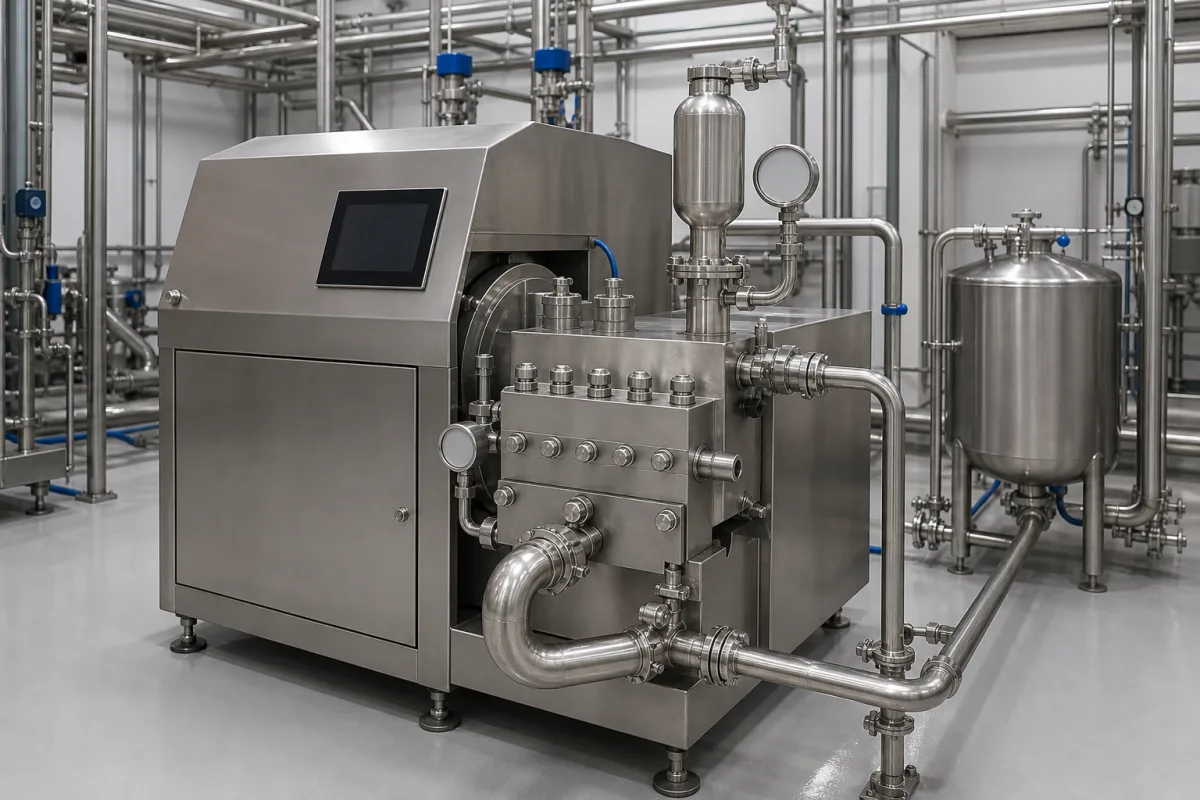
Liquid processing · Homogenizing pressure, two-stage valves, capacity, power and wetted materials
A high-pressure homogenizer is a piston pump that forces liquid through a narrow valve gap to break up droplets or particles. Ask three things first: what product and droplet size you need, what homogenizing pressure and capacity, and how the machine will be cleaned and kept sanitary.
Industrial and laboratory high-pressure homogenizers with piston pumps and homogenizing valves for dairy, beverage, food, pharmaceutical and chemical liquids. Rotor-stator mixers, ultrasonic homogenizers and complete processing lines are outside this page.
CNFX editorial research · Sources checked October 12, 2026 · 4 sources
Tetra Pak's Dairy Processing Handbook describes the homogenizer as a large piston pump with a homogenizing device: the pump raises milk from about 0.3 MPa at the inlet to the homogenizing pressure, which the handbook puts at 10 – 25 MPa (100 – 250 bar) while adding that it can also be lower or higher, set hydraulically by the gap between forcer and seat. [1]
Homogenization takes place in the first stage. A second stage supplies controlled back-pressure to the first, suppressing cavitation, and breaks up clusters formed just after homogenization; the handbook gives best results with about 3 MPa back-pressure using modern devices, and notes that the second stage also cuts outlet noise and vibration. [1]
Pressures differ by application: Donghua's GYB series for emulsions and dispersions runs to 100–180 MPa maximum, with tungsten carbide, silicon nitride or ceramic wear parts and ceramic plungers. [2]
Give the supplier the product and its viscosity, solids and temperature, target droplet or particle size, homogenizing and second-stage pressure, capacity, sanitary or aseptic requirements, cleaning method and utilities.
02
Check capacity, power and temperature rise
The handbook explains that capacity of the positive-displacement piston pump changes only with motor speed or pulleys, that smaller pistons are fitted for higher pressure at the cost of capacity, that the pump block it describes has three to five pistons with water-flushed double seals, and that dampers on suction and outlet reduce pulsation. Because it is a positive pump, a safety device must open before the pipe bursts if flow can be stopped downstream. [1]
The handbook says the part of the pressure energy not recovered as pressure is released as heat: every 4 MPa of pressure drop raises the product about 1 °C, and less than 1% of the energy goes into homogenization. [1] Editorial calculation: at 20 MPa that is about 20 ÷ 4 = 5 °C; at 90 MPa about 22 °C, so plan cooling for high-pressure duties.
Editorial calculation: hydraulic power is flow × pressure. Donghua's GYB5000-10D lists 5,000 L/h at 90 MPa rated pressure with a 160 kW motor; 5,000 L/h ≈ 0.00139 m³/s, and 0.00139 × 90,000,000 Pa ≈ 125 kW, so the motor allows for drive and pump losses. [2]
A 2026 review in Comprehensive Reviews in Food Science and Food Safety (Li et al., 25(5):e70594) gives first-order figures for water-like products. The hydraulic energy of one pass is about 100 kJ/kg, or 0.028 kWh per litre, per 100 MPa before pump losses, and 0.035–0.056 kWh/L per 100 MPa at an assumed 50–80% pump efficiency. The adiabatic temperature rise is about 24 °C per 100 MPa, so a feed at 20 °C can briefly approach about 92 °C at 300 MPa before post-valve cooling. The review treats about 200 MPa and above as ultra-high-pressure homogenization, citing 100–150 MPa in food emulsion and dispersion studies and 200–400 MPa for UHPH, and lists pressure-equivalent valve velocities of about 450, 630, 775 and 895 m/s at 100–400 MPa. [3]
Editorial calculation: the review's 24 °C per 100 MPa equals about 4.2 MPa per °C, consistent with the handbook's 4 MPa per 1 °C; at 0.028 kWh/L per 100 MPa, a 5,000 L/h machine at 90 MPa delivers about 5,000 × 0.028 × 0.9 ≈ 126 kW of hydraulic power, close to the 125 kW worked out above. [3][1]
03
Dairy, juice and laboratory homogenizer makers
Donghua lists GYB-series homogenizers from 180 to 5,000 L/h; Chaoli lists high-pressure and laboratory homogenizers; Weishu, Kinding, Easyreal and ZenoPack list homogenizers for dairy, juice and beverage lines; the Homogenizer Machine site lists dairy and milk homogenizers; Scientz and Yocell list laboratory and microfluidizing homogenizers; Drawell and Xiangyi list homogenizers among laboratory instruments. [2]
04
Match capacity to pressure: flow falls as pressure rises
GEA's page for its Ariete Homogenizer 3160 lists the maximum flow rate at each pressure from 180 to 1,500 bar and states that each line refers to a different machine, designed for that maximum pressure and maximum capacity. The listed maximum flow drops from 22,000 l/h at 180 bar to 12,000 l/h at 400 bar, 4,100 l/h at 1,000 bar and 2,100 l/h at 1,500 bar (GEA prints these as 22.000, 12.000, 4.100 and 2.100). [4]
GEA states that the 3160 can be customized with more than 300 options and that Ariete homogenizers comply with USDA, FDA, 3-A, ATEX, EHEDG and cGMP certifications and guidelines. [4]
Editorial calculation: hydraulic power is flow × pressure. 22,000 l/h (0.00611 m³/s) at 180 bar (18 MPa) is about 110 kW, while 2,100 l/h (0.000583 m³/s) at 1,500 bar (150 MPa) is about 88 kW, so one frame size trades flow for pressure at a similar power. With the handbook's 1 °C per 4 MPa, 150 MPa adds about 150 ÷ 4 ≈ 37 °C, close to the review's 24 °C per 100 MPa (about 36 °C). [4][1][3] Editorial note: state your required flow at your working pressure, not a maximum of either alone.
Pressure, temperature rise and specific energy rows draw on Tetra Pak, Donghua and the 2026 review; connection size, duty and pH depend on your line and product.
Field
What it means and published values
Ask the supplier for
Maximum operating pressure (bar)
E.g. 100–250 bar for milk; up to 1,800 bar on some machines; UHPH from about 2,000 bar. [1][2][3]
Donghua lists GYB-series machines from 180 to 5,000 L/h; Weishu, Kinding, Easyreal, ZenoPack and the Homogenizer Machine site list dairy, juice and process homogenizers; Chaoli, Scientz, Yocell, Drawell and Xiangyi list high-pressure, laboratory or microfluidizing models.
Shanghai Donghua Homogenizer
Manufacturing site to be confirmed for the order
Lists GYB-series high-pressure homogenizers from 180 to 5,000 L/h.
Explore company information and manufacturing capabilities, then discuss the scope of your project with a relevant supplier.
Share this page
Compiled and source-reviewed by the CNFX editorial team.
Each manufacturer above links to the page on that company's own website where the product is listed, with the date we checked it. How we source and review
· Page last updated 13 October 2026
Buyer questions
Why use two-stage homogenization?
The first stage does the homogenizing; the second supplies back-pressure that suppresses cavitation and breaks up clusters, with best results at about 3 MPa back-pressure. [1]
How much does homogenizing heat the product?
About 1 °C for every 4 MPa of pressure drop, so 20 MPa adds about 5 °C. [1]
How do I change homogenizer capacity?
It is a positive-displacement pump, so capacity changes with motor speed or pulleys; smaller pistons allow higher pressure but less flow. [1]
How much does a homogenizer heat the product?
About 1 °C per 4 MPa according to Tetra Pak, or about 24 °C per 100 MPa in a 2026 review; at 300 MPa a 20 °C feed can briefly approach 92 °C. [1][3]
How much capacity does a homogenizer lose at higher pressure?
GEA's Ariete 3160 table lists 22,000 l/h at 180 bar but 2,100 l/h at 1,500 bar, with each line being a different machine design. [4]
Sources and what still needs a direct check
Sources checked 2026-10-12. Tetra Pak's Dairy Processing Handbook is an equipment maker's reference on dairy processing. Donghua is a supplier listed on this page; its values are catalogue figures.