Structured Manufacturing Data (2026)

Manifold/Piping

Based on aggregated insights from structured factory profiles within the CNFX directory, the standard Manifold/Piping used in the Food Manufacturing sector typically supports operational capacities ranging from standard industrial configurations to heavy-duty production requirements.

Technical Definition & Core Assembly

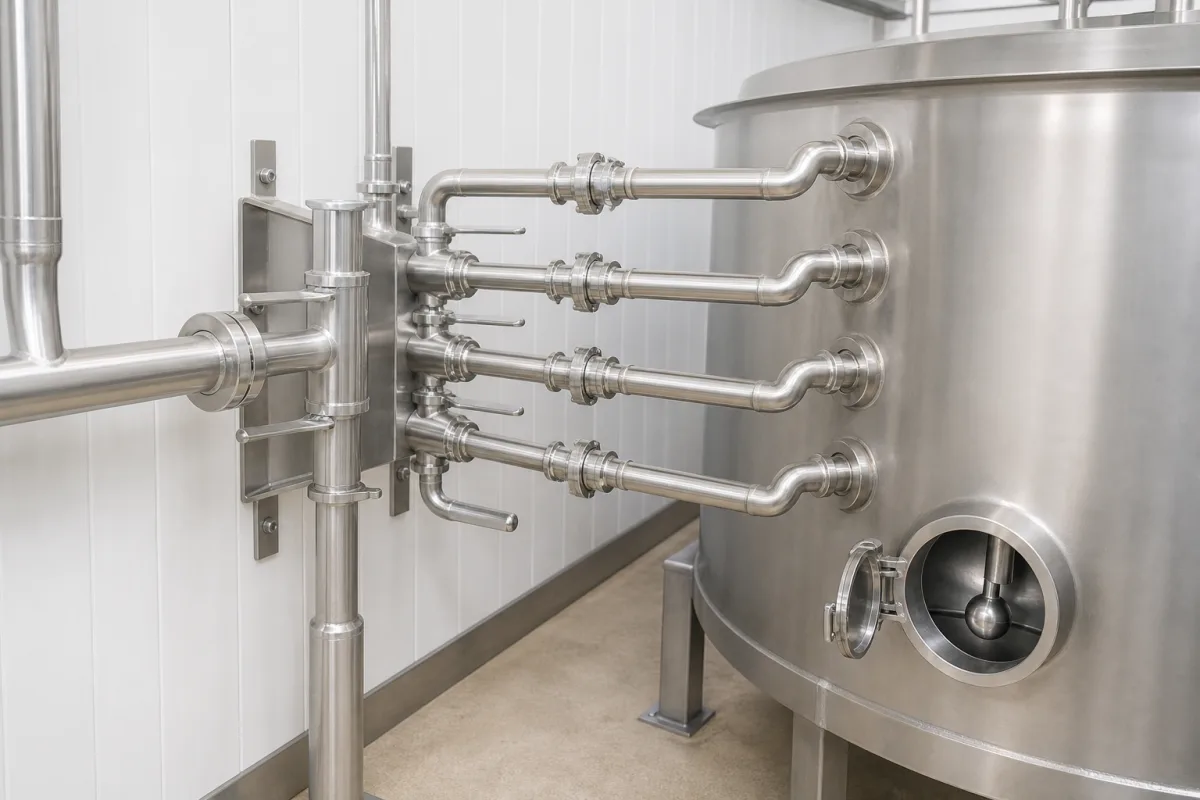
A canonical Manifold/Piping is characterized by the integration of Manifold Header and Distribution Pipes. In industrial production environments, manufacturers listed on CNFX commonly emphasize Stainless Steel 316L construction to support stable, high-cycle operation across diverse manufacturing scenarios.

Distribution network for cleaning fluids in CIP systems

Product Specifications

Technical details and manufacturing context for Manifold/Piping

Definition
A manifold and piping assembly that distributes cleaning, sanitizing, and rinsing solutions to spray devices within a Clean-in-Place (CIP) spray system, ensuring complete coverage of equipment surfaces.
Working Principle
Receives pressurized cleaning fluids from the CIP unit and distributes them through strategically placed spray balls, nozzles, or jets to create turbulent flow and impingement for effective soil removal.
Common Materials
Stainless Steel 316L
Technical Parameters
  • Pipe diameter and manifold dimensions (mm) Standard Spec
Components / BOM
  • Manifold Header
    Central distribution point connecting multiple spray lines
    Material: Stainless Steel
  • Distribution Pipes Part
    Transport cleaning fluids to spray devices
    Material: Stainless Steel
  • Connection Fittings
    Secure pipe joints and connections to spray devices
    Material: Stainless Steel

Industry Taxonomies & Aliases

Commonly used trade names and technical identifiers for Manifold/Piping.

Applied To / Applications

This component is essential for the following industrial systems and equipment:

Industrial Ecosystem & Supply Chain Structure

Complementary Systems
Downstream Applications
Specialized Tooling

Application Fit & Sizing Matrix

Operational Limits
pressure: Up to 10 bar (150 psi)
flow rate: 0.5 to 50 m³/h
temperature: -20°C to 120°C
slurry concentration: Up to 15% solids by weight
Media Compatibility
✓ Caustic soda solutions ✓ Acidic cleaning agents (e.g., nitric acid) ✓ Hot water/steam condensate
Unsuitable: Hydrofluoric acid or highly oxidizing media
Sizing Data Required
  • Maximum system flow rate (m³/h)
  • Required pressure drop across the manifold (bar)
  • Number of distribution branches/outlets

Reliability & Engineering Risk Analysis

Failure Mode & Root Cause
Corrosion-induced wall thinning
Cause: Chemical attack from process fluids or external environment, accelerated by improper material selection, inadequate protective coatings, or exposure to corrosive contaminants.
Fatigue cracking at weld joints or stress concentrations
Cause: Cyclic thermal expansion/contraction, vibration from connected equipment, or pressure fluctuations leading to stress concentration at welds, bends, or supports.
Maintenance Indicators
  • Visible leaks, weeping, or dampness at joints, welds, or connections indicating seal failure or material degradation
  • Abnormal audible vibrations, hammering noises, or whistling sounds suggesting flow turbulence, cavitation, or loose components
Engineering Tips
  • Implement regular thickness monitoring via ultrasonic testing at high-risk areas (bends, welds, supports) to detect wall thinning before failure
  • Use expansion loops, proper supports, and flexible connectors to absorb thermal movement and vibration, reducing stress on fixed connections

Compliance & Manufacturing Standards

Reference Standards
ISO 9001:2015 - Quality Management Systems ASME B31.3 - Process Piping EN 10204:2004 - Metallic Products - Types of Inspection Documents
Manufacturing Precision
  • Wall Thickness: +/-10% of nominal thickness
  • Flange Flatness: 0.1mm across sealing surface
Quality Inspection
  • Hydrostatic Pressure Test
  • Dimensional Verification with CMM

Factories Producing Manifold/Piping

Manufacturer profiles with relevant production capability in China

Manufacturer listings support early research and capability understanding. They are not certification, ranking, or transaction guarantees.

Technical documentation
4/5
Manufacturing capability
4/5
Inspection readiness
5/5
Supplier transparency
3/5

These scores are example evaluation dimensions, not real customer ratings, country-specific buyer feedback, or live inquiry activity.

Supply Chain Compatible Machinery & Devices

Automated Food Packaging Integrity Tester

Automated system for non-destructive testing of food package seals and integrity.

Explore Specs →
Automated Food Moisture Analyzer

Automated system for precise moisture content measurement in food products

Explore Specs →
Automated Food Color Consistency Analyzer

Automated inline system for real-time color measurement and consistency control in food processing.

Explore Specs →
Control Panel

A centralized interface for monitoring and controlling industrial equipment and processes

Explore Specs →

Frequently Asked Questions

Why is Stainless Steel 316L recommended for CIP manifolds in food manufacturing?

Stainless Steel 316L offers superior corrosion resistance against cleaning chemicals, maintains hygiene with smooth surfaces, and meets food safety standards for direct contact applications.

What components are included in a typical CIP distribution manifold BOM?

A complete BOM includes the manifold header (main distribution point), distribution pipes (branch lines to equipment), and connection fittings (valves, tees, elbows) for a fully integrated cleaning fluid network.

How does a CIP manifold system improve cleaning efficiency in food plants?

Centralized manifolds enable simultaneous, controlled cleaning of multiple processing lines, reduce chemical and water usage through optimized routing, and minimize downtime with automated valve sequencing.

Can I contact factories directly on CNFX?

CNFX is an open directory, not a transaction platform. Each factory profile provides direct contact information and production details to help you initiate direct inquiries with Chinese suppliers.

Data Basis

CNFX manufacturer profiles, technical classification, publicly available product information, and ongoing plausibility checks.

Preliminary Technical Classification
This page supports structured research, RFQ preparation, and supplier evaluation. It does not replace buyer-led supplier qualification, standards review, or technical approval.

Request Manufacturing Insight for Manifold/Piping

Ask for use case, specification boundaries, supplier type, and RFQ preparation information for Manifold/Piping.

Your business information is used only to process this request.

Thank you! Your message has been sent. We'll respond within 1–3 business days.

Need to Manufacture Manifold/Piping?

Compare manufacturer profiles with relevant product and process capability.

Create Manufacturer Profile Contact Us
Previous Product
Main Roller Assembly
Next Product
Meat Processing Vacuum Pump Seal Assembly