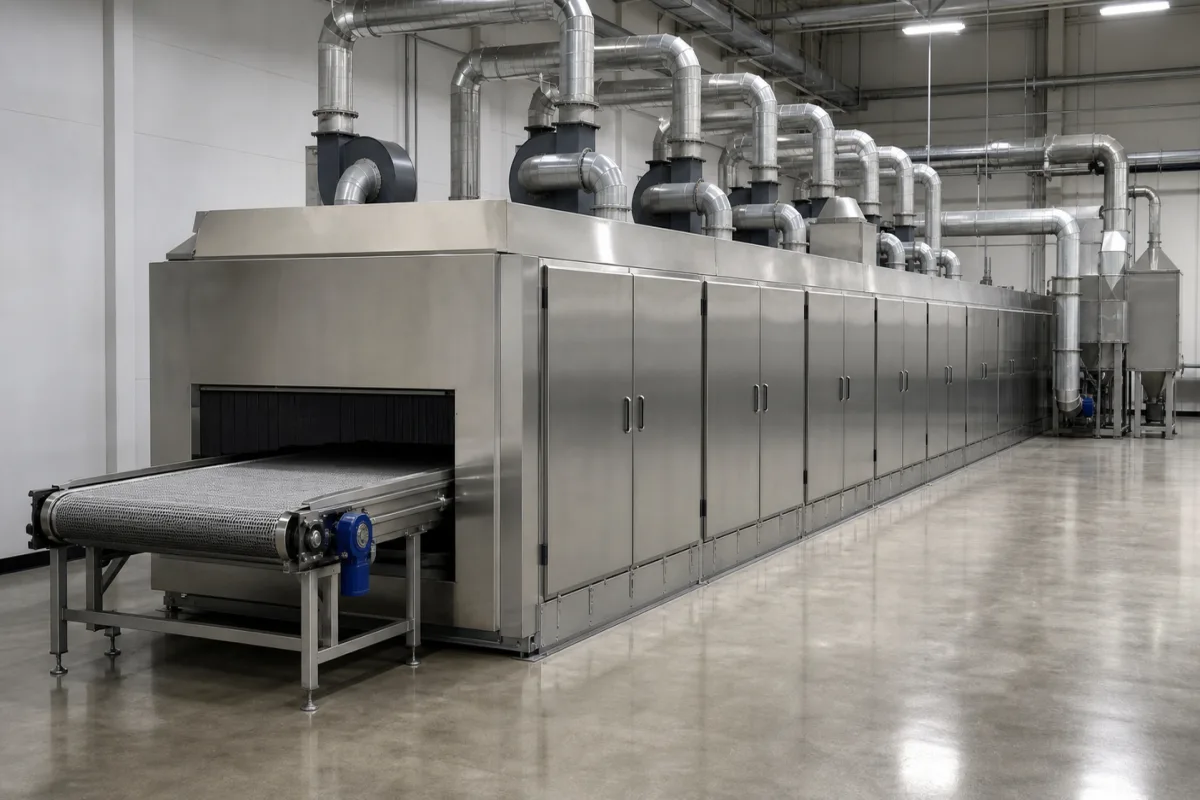
Drying tunnel (heated-air tunnel that dries tanned leather after the wet end)
Drying tunnels for tanned leather after the wet end · overhead-chain hang-drying tunnels with heated air at set temperature and humidity, how they sit beside vacuum dryers, toggling frames and conditioning systems, and what each method does to area yield and resiliency
After the drums, wet leather has to lose water without losing area, softness or strength. A drying tunnel does this with heated, humidity-controlled air while the leathers travel through hanging on rods or carried on frames. Choose it against the other drying routes for the leather being made, then specify the conveying method, the air conditions, the space it takes and how the leather is conditioned afterwards.
Drying tunnels and related air-drying equipment for tanned leather after the wet end: overhead-chain hang-drying tunnels, tunnel toggling frame dryers, dry chambers and conditioning systems, compared with vacuum drying. Wet-end drums are covered on the Tanning drum system page; drying tunnels inside spray finishing lines on the Leather spray finishing line page; moisture measurement on the Leather moisture analyzer for hides and crust on tannery lines page; wet-end lines on the Integrated leather wet-end processing line page.
CNFX editorial research · Sources checked October 12, 2026 · 3 sources
Assomac, the Italian tannery machinery association, writes that after tanning the skin "should be dried to an optimum internal moisture content" under "controlled and reproducible environmental conditions", either "by hanging the tanned leather for a few hours in the appropriate tunnels, or through vacuum driers, or by drying with toggling systems, or other dry methods, according to the type of product and of the finishing type of leather that must be obtained." [1]
Assomac category
How it works
Source
A02.04 Drying tunnel with overhead chain
Metal boxes suspended from the roof; leathers on metal rods carried by a chain; heated air at adjusted temperature and humidity; the chain also moves product between production areas
Leathers stretched with toggle clips on frames; frames run on chain conveyors from inside to outside the drying chamber, on rails, or as a continuous metal conveyor
State the leather type and thickness, hides per hour, the moisture content wanted at the exit, available floor and roof space, and the heat source; ask the maker for air temperature, humidity and residence time for that leather.
02
What the drying route does to area yield and resiliency
C-K Liu, N. Latona and Peter Cooke of the USDA Eastern Regional Research Center list air, hang, toggle, radiation, paste and vacuum drying, note that "Very often, a combination of drying methods is used", and give the example of toggle drying right after vacuum drying "as practiced in many tanneries to increase area yield". In their tests on chrome-free leather, "toggle drying may impair the resiliency of leather, while vacuum drying produced the best resilient leather in this study"; samples were equilibrated at 23 °C and 50% RH for one week before testing. [2]
A thesis at Addis Ababa University on garment leather compared normal, toggle and vacuum drying and found moisture content, softness, tensile strength and elongation at break "steadily decrease with increase in drying period and area yield"; it judged toggle drying preferable "because of the better area yield of 14.5% with good tensile strength and more porous leather", and observed some grain surface damage with vacuum drying. [3]
The two studies point in different directions on toggle drying (better area yield in one, lower resiliency in the other) and used different leathers; test the tunnel or toggle route on the leather actually being made. [2][3]
Agree the exit moisture, area yield and softness targets with the tannery's technologist before fixing tunnel length and air conditions.
03
Leather drying tunnel details
Paste it into your enquiry below or into an email to a maker, then replace every bracket.
Explore company information and manufacturing capabilities, then discuss the scope of your project with a relevant supplier.
Share this page
Compiled and source-reviewed by the CNFX editorial team.
Each manufacturer above links to the page on that company's own website where the product is listed, with the date we checked it. How we source and review
· Page last updated 13 October 2026
Buyer questions
How does an overhead-chain drying tunnel work?
Assomac describes metal boxes suspended from the roof, with leathers hung on rods carried by a chain through heated air at adjusted temperature and humidity. [1]
Is a tunnel used alone?
Not always: USDA researchers write that "Very often, a combination of drying methods is used", such as toggle drying after vacuum drying. [2]
Does toggle drying help area yield?
An AAU study on garment leather found 14.5% better area yield with toggle drying; USDA researchers found toggling may impair resiliency. [3][2]
What is a conditioning system?
A climatic-chamber-like system with heated air at balanced temperature and humidity, used to season leather on rods carried by a chain. [1]
Sources and what still needs a direct check
Sources checked 2026-10-12. Assomac publishes a technological guide to tanning machinery; the Journal of the American Leather Chemists Association published the USDA resiliency study; Addis Ababa University holds the drying-technique thesis.