Driven roller presser feed for leather sewing machines: top wheel and bottom feed in step, wheel diameter, stitch length and feed difference
The driven roller (top wheel) feed that moves leather on post-bed and shoe machines: a toothed wheel on the top ply stepping in time with the bottom feed dog — wheel diameter, stitch length, upper-to-lower feed difference and the dwell while the needle is in the work
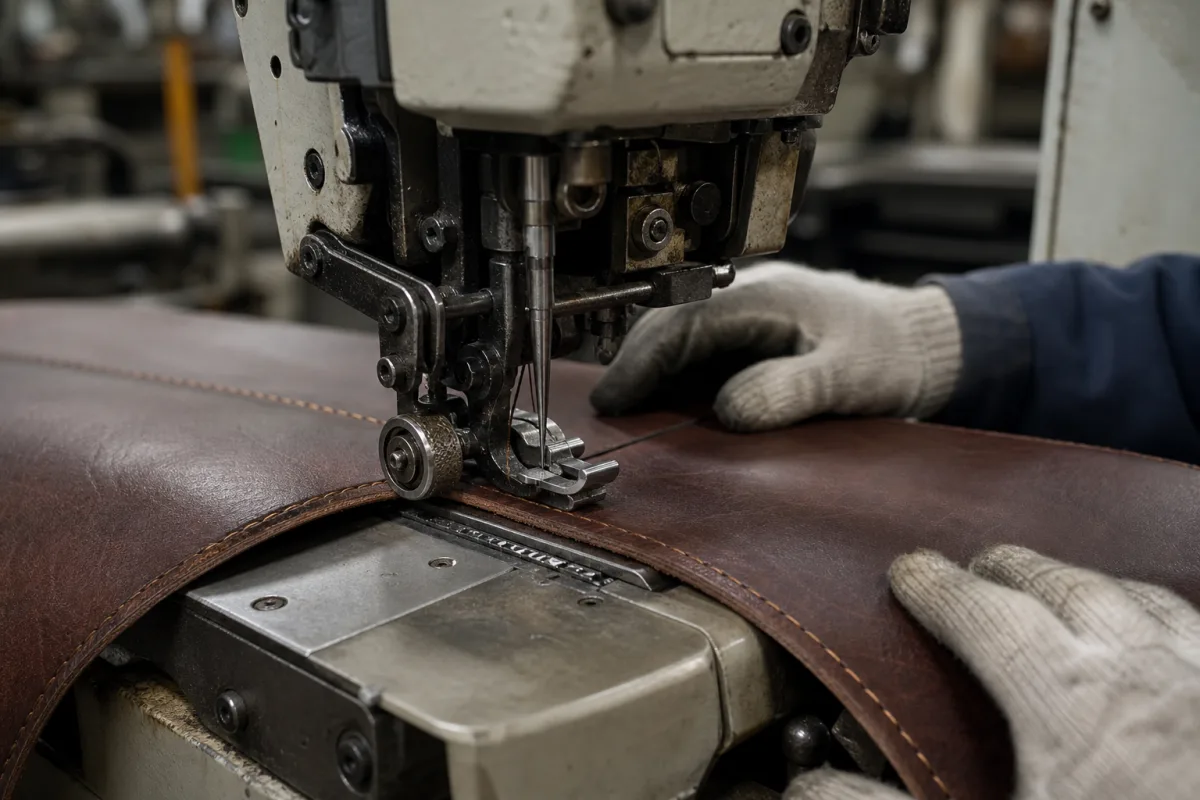
A leather seam on a boot upper or a shoe assembly has two plies that must arrive at the needle together, and the feed dog under the work only grips the bottom one. A driven roller presser solves this from above: a small wheel, toothed or knurled, presses on the top ply and turns a fixed angle per stitch, synchronised with the bottom feed, so both plies advance by the same length. The roller beside the presser in the photograph is this kind of top feed.
Driven roller (top wheel) presser feeds on industrial lockstitch machines for leather and footwear, working together with a bottom feed dog: wheel diameter and tooth pitch, stitch length, lift clearance, upper-to-lower feed difference, stepping-angle drives and dwell timing. Unison-feed walking-foot flatbed machines for upholstery are covered on the Industrial upholstery sewing machine page, complete leather goods machines and their needles on the Industrial leather stitching machine page, needle thread tension on the Needle thread tension control page, and the feed roll of edge skiving machines on the Leather edge skiving machine page.
CNFX editorial research · Sources checked October 13, 2026 · 3 sources
Dürkopp Adler 838-M: bottom feed plus a 35 mm driven top wheel on a post-bed machine
Dürkopp Adler's 838-M CLASSIC is a single- or twin-needle lockstitch post-bed machine with bottom feed and a driven roller presser foot, shown on the side seam of heavy boots (838-170522-M) and the assembly seam of safety and trekking shoes (838-270522-M). Its data table shows which roller-feed numbers a buyer can compare. [1]
Both versions give 12 mm maximum clearance when the roller presser is lifted, a clearance of 280 mm by 300 mm around the post, and pneumatic presser lift and backtacking using 0.7 NL of air per stroke at 6 bar. The leaflet lists a device that sets the difference between upper and bottom feed from +10 % to −10 % as an option, and tool-free roller presser setting by the operator as another option. [1]
Editorial calculation: a 35 mm wheel has a circumference of about 110 mm, so an 8 mm stitch turns it about 26° per stitch; at 2,000 stitches per minute and 8 mm stitches the work moves about 16 m per minute. A ±10 % feed difference on an 8 mm stitch lets the top ply run 0.8 mm per stitch ahead of or behind the bottom ply.
Dürkopp Adler also states that the 838-270522-M can be converted to needle feed with a flat presser foot instead of the driven roller presser, which it says allows textiles and leather outside the shoe industry to be sewn. [1]
Ask for the wheel diameter and tooth pitch, whether the upper-to-lower feed difference can be set and over what range, the lift clearance under the wheel and the stitch length at the speed you will run.
02
Stepping the top wheel: independent adjustment and a dwell while the needle is down
Virginio Rimoldi's US patent 3,853,078 states the problem the top roller answers: in multi-layer work the feed dog contacts only the lower layer while the presser foot holds the upper one back, so the layers slip relative to one another. [2]
In that patent a spring-loaded feed roller sits in a bifurcated end of the presser foot, forward of the needle and in line with it, and presses the upper layer against the feed dog. A crank and link device turns the main shaft's rotation into intermittent, one-way steps synchronised with the dog, and the upper stitch is set independently of the lower one while the machine runs, so that creasing of the upper layer can be removed without changing the lower layer. The patent gives the roller the job of accompanying the upper layer and neutralising slippage, with the actual feeding done by the dog below. [2]
Dürkoppwerke's US patent 4,364,321 drives an upper feed wheel through a planetary gear transmission so that its stepping angle can be varied steplessly during sewing, to follow changes in stitch length and in the advance of the bottom feed, without the brake that earlier designs used to stop over-rotation at high speed. In its curves the wheel stands practically still over approximately 180° of arm-shaft rotation, the period in which the needle passes through the work, and that dwell stays about the same for all stepping angles. [3]
Editorial note: these two patents describe the same need behind the 838-M's optional ±10 % feed-difference device — the top wheel's step has to be set against the bottom feed, not fixed to it. [2][3][1]
Ask whether the top wheel's step can be changed while sewing, how it stays still while the needle is in the leather, and whether the wheel can be swapped for a flat foot.
03
Information for a roller presser feed
Paste it into your enquiry below or into an email to a maker, then replace every bracket.
Seam: [product, e.g. boot side seam or shoe assembly; leather thickness and number of plies]
Feed: [bottom feed with driven top wheel; wheel diameter and tooth pitch]
Adjustment: [upper-to-lower feed difference range; change while sewing]
Stitch: [maximum stitch length; stitches per minute; needle size and system]
Clearance: [lift under the wheel; room around the post or bed]
Explore company information and manufacturing capabilities, then discuss the scope of your project with a relevant supplier.
Share this page
Compiled and source-reviewed by the CNFX editorial team.
Each manufacturer above links to the page on that company's own website where the product is listed, with the date we checked it. How we source and review
· Page last updated 13 October 2026
Buyer questions
What is a driven roller presser feed?
A wheel on the top ply that turns in steps with the bottom feed dog; Dürkopp Adler's 838-M combines bottom feed with a 35 mm driven top wheel. [1]
Can the top and bottom feed run at different lengths?
The 838-M offers an optional device setting the upper-to-lower feed difference from +10 % to −10 %; Rimoldi's US 3,853,078 adjusts the top roller independently while sewing. [1][2]
Why does the top layer slip without an upper feed?
Rimoldi's US 3,853,078 explains that the feed dog contacts only the lower layer while the presser foot holds the upper layer back. [2]
When does the top wheel stand still?
In Dürkoppwerke's US 4,364,321 the wheel dwells over approximately 180° of arm-shaft rotation, while the needle passes through the work. [3]
Sources and what still needs a direct check
Sources checked 2026-10-13. Roller feed data come from Dürkopp Adler's 838-M CLASSIC leaflet; the reasons for and drives of an independently adjustable top roller from US patents assigned to Virginio Rimoldi and to Dürkoppwerke.