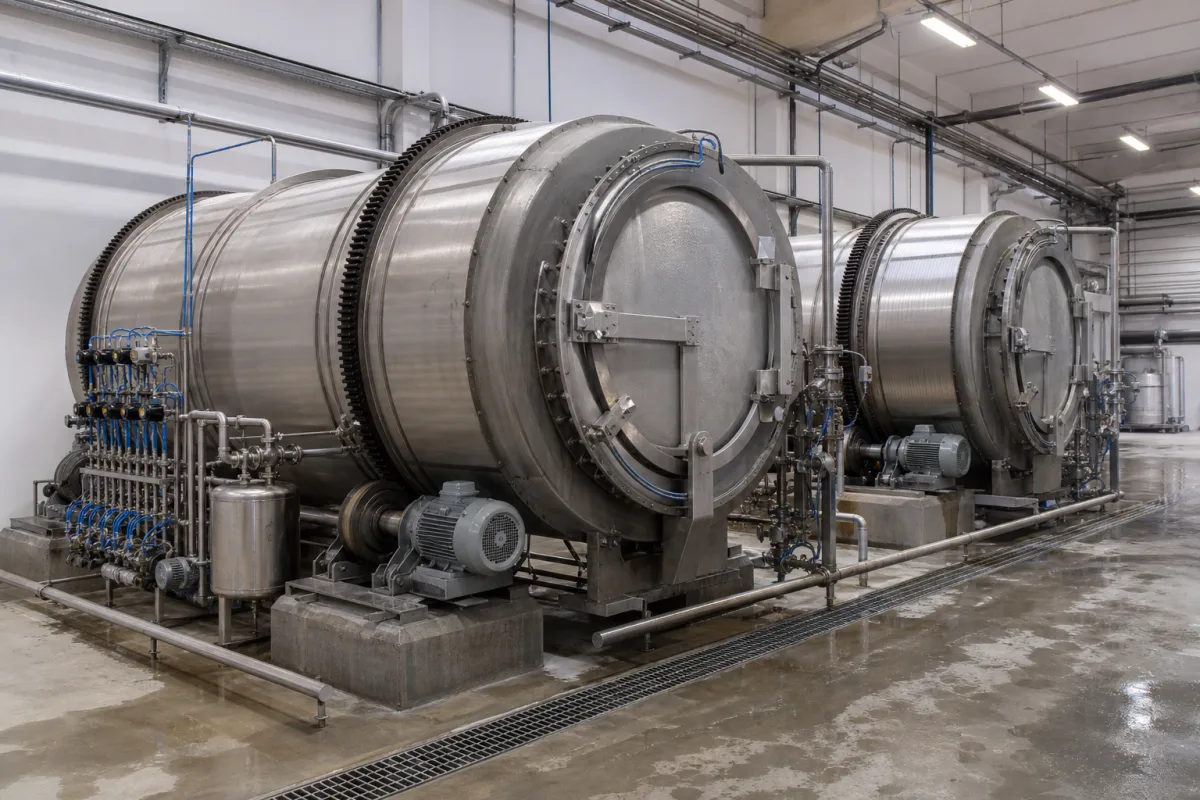
Rotating drums for leather wet processing · Which stages run in drums (liming, chrome tanning, retanning, dyeing, fatliquoring), wooden versus stainless drums, float level and usable capacity, starting torque and drive sizing, and process temperatures
A tanning drum is a large rotating vessel in which hides and process liquors (floats) are tumbled together for soaking, liming, tanning, retanning, dyeing and fatliquoring. Its size, shell, internal fittings, speed and drive determine how much leather it processes and how much mechanical action the hides receive. Ask three things first: which process stages and leather types the drum will run, what load and float it must hold, and how the drive, temperature control and dosing are arranged.
Rotating processing drums for leather wet operations, in wood, polypropylene or stainless steel, with their drives, doors, dosing and heating connections. Internal shelves, pegs and paddle fittings on their own (see leather drumming paddle assembly), hide processors with other mechanisms, and complete tannery lines are outside this page except where compared.
CNFX editorial research · Sources checked October 12, 2026 · 5 sources
US EPA's AP-42 Section 9.15 (Leather Tanning) states that tanning is the reaction of collagen fibres in the hide with tannins, chromium, alum or other agents, and that chrome tanning accounts for about 90% of US tanning production. Chrome tanning is performed as a one-bath process: the hides, in a pickled state at pH 3 or lower, receive the trivalent chromium salt, such as basic chromium sulfate, and the pH is then raised; retanning, dyeing and fatliquoring follow. Liming uses pits or drums of lime liquor, and fatliquoring is performed in a drum with an oil emulsion at about 60–66°C (140–150°F) for 30–40 minutes. [1]
The Leather Working Group's Making Leather Overview (Part 2) says drums are the main vessel for wet operations, traditionally wooden, with polypropylene and stainless steel also used; on rotation the hides and floats are mixed and forces set by rotation speed, load weight, float volume, time and internal construction govern chemical penetration and the flattening of the hide. [2]
Editorial note: tell the supplier which stages each drum will run, because chemical exposure (lime, acid pickle, chrome), temperature and the required mechanical action differ by stage.
Give the supplier the process stages per drum, hide type and weight per load, float ratios, temperatures and heating method, chemicals (lime, acids, chromium salts, dyes, fatliquors), drum material and internal fittings, rotation speed range and reversing, drive and starting arrangement, door, drain and dosing connections, automation and recipe control, floor loading and effluent connections.
02
Size load, float and drive
US patent 6,935,144 B2 (Device for leather processing) lists limitations of conventional drumming: possible damage to hides by scraping, scuffing, knotting, wrinkling or loss of area; difficulty in thoroughly cleaning the hides, with much water going to effluent; inconvenient opening for unloading and checking; floats that cannot go above axle level, so capacity use is only about 35% of drum volume; and a starting torque about three times running torque because of the concentrated load, the self-weight of a wooden drum, journal bearing friction and gear errors, so drum motors are oversized. [3]
Editorial calculation: at the patent's 35% figure, a drum with 30 m³ internal volume would hold about 10.5 m³ of hides and float; and if running needs 30 kW at the shaft, a starting torque three times running torque implies a drive and starting method sized for about three times the running torque. Ask the supplier for its load rating and start-up design. [3]
Editorial note: ask how temperature is controlled for stages such as fatliquoring at about 60–66°C, and how floats are dosed and drained. [1]
03
Set rotation speed, float and running cycles for each stage
A 2024 pilot study in Heliyon on chrome tanning in three identical stainless steel drums kept drum speed at 6–8 rpm, float at 40–100% of hide weight, temperature at 20–35 °C and basic chromium sulphate at 6%, the variables it names as governing chrome exhaustion. Its recipe ran the soaking drum on automatic for 5 minutes in every hour over a 22-hour soak, and the liming drum for 10 minutes in every hour over 22 hours, with three washes and drains after liming. A 2020 study in Environmental Science and Pollution Research ran salt-free deliming with carbon dioxide at 30 bar and 30 °C in a 20-litre high-pressure drum whose basket turned at 5 rpm with 200% water on hide weight; it reports deliming twice as fast as the conventional process, calcium falling from 8 to 4 g/kg in 60 minutes, and cites the same group's earlier tanning in a 1,700-litre drum at 30 bar. [4][5]
Editorial calculation: at 100% float, a 2,000 kg hide load needs about 2,000 L of float plus the hides in the drum; a 22-hour soak running 5 minutes each hour turns for 110 minutes, or 660–880 revolutions at 6–8 rpm, and a 22-hour lime at 10 minutes each hour doubles that. Give the drum supplier these cycles, because intermittent running sets the drive's start count and the timer or PLC programme, and a sealed pressure drum is a pressure vessel with its own design code. [4][5]
Fill the specification fields with values for your tannery
A tanning drum quotation needs values for your processes and loads. The table explains each field, gives published values where a reviewed source states them, and says what to obtain from the supplier.
Field
What it means and published values
Ask the supplier for
Drum Capacity
Usable about 35% of volume in conventional drums. [3]
Load rating.
Drum Diameter
Size and lift.
Dimensions.
Rotation Speed
Governs mechanical action; e.g. 6–8 rpm in chrome tanning trials. [2][4]
Explore company information and manufacturing capabilities, then discuss the scope of your project with a relevant supplier.
Share this page
Compiled and source-reviewed by the CNFX editorial team.
Published product pages show what a company offers, not tested performance. Confirm the legal seller, factory and scope for your order. How we source and review
· Page last updated 13 October 2026
Buyer questions
How is chrome tanning done in a drum?
AP-42 describes a one-bath process: pickled hides at pH 3 or lower receive basic chromium sulfate and the pH is then raised. [1]
How full can a tanning drum be?
US 6,935,144 says conventional drum floats cannot rise above the axle, so only about 35% of drum volume is used. [3]
Why are drum motors oversized?
The same patent says starting torque is about three times running torque because of load, drum weight, bearing friction and gear errors. [3]
How fast does a tanning drum turn?
One pilot study of chrome tanning kept drums at 6–8 rpm with 40–100% float at 20–35 °C; soaking and liming drums ran 5 to 10 minutes in each hour. [4]
Sources and what still needs a direct check
Sources checked 2026-10-12. AP-42 Section 9.15 is US EPA emission-factor guidance (1997); the LWG overview is an industry training document; the US patent (2005) summarises conventional drumming in its own terms.