Industry-Verified Manufacturing Data (2026)

Actuator (Cylinder/Motor)

Based on aggregated insights from multiple verified factory profiles within the CNFX directory, the standard Actuator (Cylinder/Motor) used in the Machinery and Equipment Manufacturing sector typically supports operational capacities ranging from standard industrial configurations to heavy-duty production requirements.

Technical Definition & Core Assembly

A canonical Actuator (Cylinder/Motor) is characterized by the integration of Piston rod and Stator/rotor. In industrial production environments, manufacturers listed on CNFX commonly emphasize Aluminum alloy construction to support stable, high-cycle operation across diverse manufacturing scenarios.

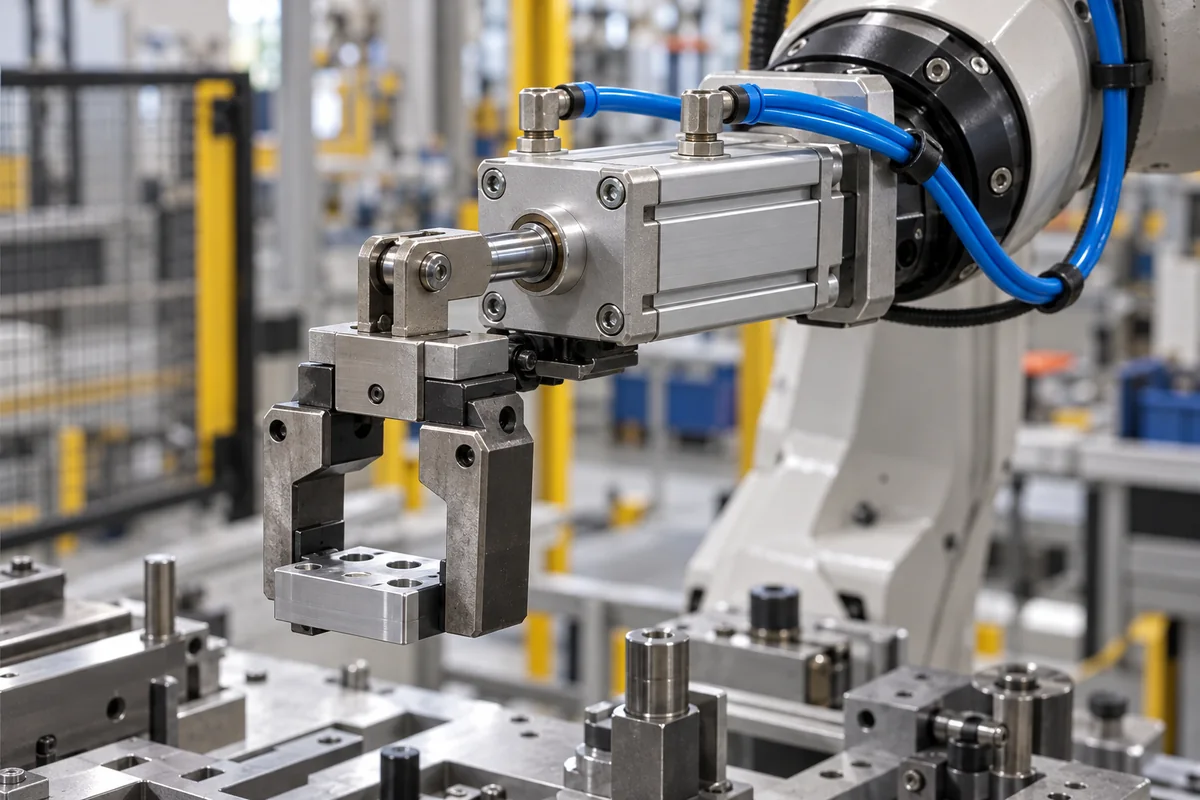
A mechanical device that converts energy into motion to drive the gripping mechanism.
Product Specifications

Technical details and manufacturing context for Actuator (Cylinder/Motor)

Definition
An actuator, specifically a cylinder or motor, serves as the power source within an end-effector gripper, providing the necessary force and movement to open, close, and apply pressure for grasping, holding, or manipulating objects in automated systems.
Working Principle
Converts pneumatic, hydraulic, or electrical energy into linear (cylinder) or rotary (motor) mechanical motion, which is transmitted through linkages or gears to operate the gripper's jaws or fingers.
Common Materials
Aluminum alloy, Stainless steel, Engineering plastics
Technical Parameters
  • Stroke length or torque output (mm) Standard Spec
Components / BOM
  • Piston rod
    Transmits linear force from the cylinder
    Material: Chrome-plated steel
  • Stator/rotor
    Converts electrical energy to rotational motion in motors
    Material: Laminated electrical steel
Engineering Reasoning
0.5-20 MPa (5-200 bar) hydraulic pressure, 0.1-2.0 m/s linear velocity, -40°C to 120°C ambient temperature
Hydraulic: 25 MPa (250 bar) burst pressure, 0.01 m/s stiction threshold, 150°C seal degradation temperature, 10⁷ cycles fatigue limit
Design Rationale: Hydraulic cylinder: Cavitation at vapor pressure <0.02 MPa absolute, causing pitting erosion. Pneumatic cylinder: Stiction from Coulomb friction coefficient >0.3 at low velocities. Electric motor: Demagnetization at 150°C Curie point for NdFeB magnets, bearing failure at DN value >1.5×10⁶ mm·rpm
Risk Mitigation (FMEA)
Trigger Hydraulic fluid contamination >ISO 4406 18/16/13
Mode: Spool valve stiction >5 N breakaway force, causing 500 ms response delay
Strategy: 5 μm absolute filtration with β₁₀₀₀≥200, HIC housing integrity class 4
Trigger Permanent magnet synchronous motor: I²t >90% of thermal capacity for 60 seconds
Mode: Insulation class H breakdown at 180°C, torque reduction >40%
Strategy: PTC thermistor protection at 155°C trip point, 150% overload capacity for 30 seconds

Industry Taxonomies & Aliases

Commonly used trade names and technical identifiers for Actuator (Cylinder/Motor).

Applied To / Applications

This component is essential for the following industrial systems and equipment:

Industrial Ecosystem & Supply Chain DNA

Complementary Systems
Downstream Applications
Specialized Tooling

Application Fit & Sizing Matrix

Operational Limits
pressure: Up to 10 bar (150 psi)
flow rate: 0.5 to 50 L/min
temperature: -20°C to +80°C
slurry concentration: Up to 5% solids by weight
Media Compatibility
✓ Hydraulic oil ✓ Compressed air ✓ Water-glycol mixtures
Unsuitable: Corrosive chemical environments (e.g., strong acids, chlorides)
Sizing Data Required
  • Required force/thrust (N or lbf)
  • Stroke length (mm or inches)
  • Operating speed/cycle time (mm/s or cycles/min)

Reliability & Engineering Risk Analysis

Failure Mode & Root Cause
Seal degradation
Cause: Contamination ingress, chemical incompatibility, excessive heat, or improper installation leading to leaks and loss of pressure
Rod scoring/bending
Cause: Misalignment, side loading, inadequate lubrication, or foreign particle abrasion causing seal damage and operational failure
Maintenance Indicators
  • Audible hissing or irregular noise during operation indicating air leaks or internal damage
  • Visible fluid leaks around seals or rod, or erratic/unstable movement during actuation
Engineering Tips
  • Implement proper filtration (5 micron or better) and moisture control in pneumatic/hydraulic systems to prevent contamination
  • Ensure correct alignment during installation and use rod wipers/scrapers to protect seals from external contaminants

Compliance & Manufacturing Standards

Reference Standards
ISO 15552: Pneumatic cylinders - Mounting dimensions ANSI/NFPA T3.6.7 R3-2015: Fluid power cylinders - Bore and rod diameters and mounting dimensions DIN ISO 6432: Pneumatic cylinders - 10 bar (1000 kPa) series, bores from 32 mm to 320 mm, mounting dimensions
Manufacturing Precision
  • Bore diameter: +/-0.02 mm
  • Rod straightness: 0.1 mm per 300 mm length
Quality Inspection
  • Pressure test: Leakage and burst pressure verification
  • Dimensional inspection: Critical mounting and interface measurements

Factories Producing Actuator (Cylinder/Motor)

Verified manufacturers with capability to produce this product in China

✓ 93% Supplier Capability Match Found

P Procurement Specialist from Germany Feb 04, 2026
★★★★★
"Impressive build quality. Especially the technical reliability is very stable during long-term operation."
Technical Specifications Verified
T Technical Director from Brazil Feb 01, 2026
★★★★★
"As a professional in the Machinery and Equipment Manufacturing sector, I confirm this Actuator (Cylinder/Motor) meets all ISO standards."
Technical Specifications Verified
P Project Engineer from Canada Jan 29, 2026
★★★★★
"Standard OEM quality for Machinery and Equipment Manufacturing applications. The Actuator (Cylinder/Motor) arrived with full certification."
Technical Specifications Verified
Verification Protocol

“Feedback is collected from verified sourcing managers during RFQ (Request for Quote) and factory evaluation processes on CNFX. These reports represent historical performance data and technical audit summaries from our B2B manufacturing network.”

8 sourcing managers are analyzing this specification now. Last inquiry for Actuator (Cylinder/Motor) from Brazil (1h ago).

Supply Chain Compatible Machinery & Devices

Heavy-Duty CNC Plasma Cutting Machine

Industrial machine for precision metal cutting using plasma arc technology

Explore Specs →
Automated Assembly Line System

Integrated production system for sequential component assembly operations

Explore Specs →
Automated Powder Coating System

Integrated industrial system for applying dry powder coatings to metal substrates.

Explore Specs →
Centrifugal Pump Impeller

Rotating component that transfers energy to fluid in centrifugal pumps.

Explore Specs →

Frequently Asked Questions

What materials are used in these actuators for durability?

Our actuators are constructed from aluminum alloy for lightweight strength, stainless steel for corrosion resistance, and engineering plastics for reduced friction and wear in demanding machinery applications.

How does this actuator convert energy into gripping motion?

The actuator uses a piston rod (in cylinder models) or stator/rotor assembly (in motor models) to transform hydraulic, pneumatic, or electrical energy into precise linear or rotational motion that drives gripping mechanisms in industrial equipment.

What industries commonly use these actuators?

These actuators are essential in machinery and equipment manufacturing for applications like robotic arms, assembly line grippers, packaging machinery, material handling systems, and automated production equipment requiring reliable motion control.

Can I contact factories directly on CNFX?

CNFX is an open directory, not a transaction platform. Each factory profile provides direct contact information and production details to help you initiate direct inquiries with Chinese suppliers.

Get Quote for Actuator (Cylinder/Motor)

Request technical pricing, lead times, or customized specifications for Actuator (Cylinder/Motor) directly from verified manufacturing units.

Your business information is encrypted and only shared with verified Actuator (Cylinder/Motor) suppliers.

Thank you! Your message has been sent. We'll respond within 1–3 business days.

Need to Manufacture Actuator (Cylinder/Motor)?

Connect with verified factories specializing in this product category

Add Your Factory Contact Us
Previous Product
Actuator (Cylinder)
Next Product
Actuator (e.g., hydraulic cylinder)