Industry-Verified Manufacturing Data (2026)

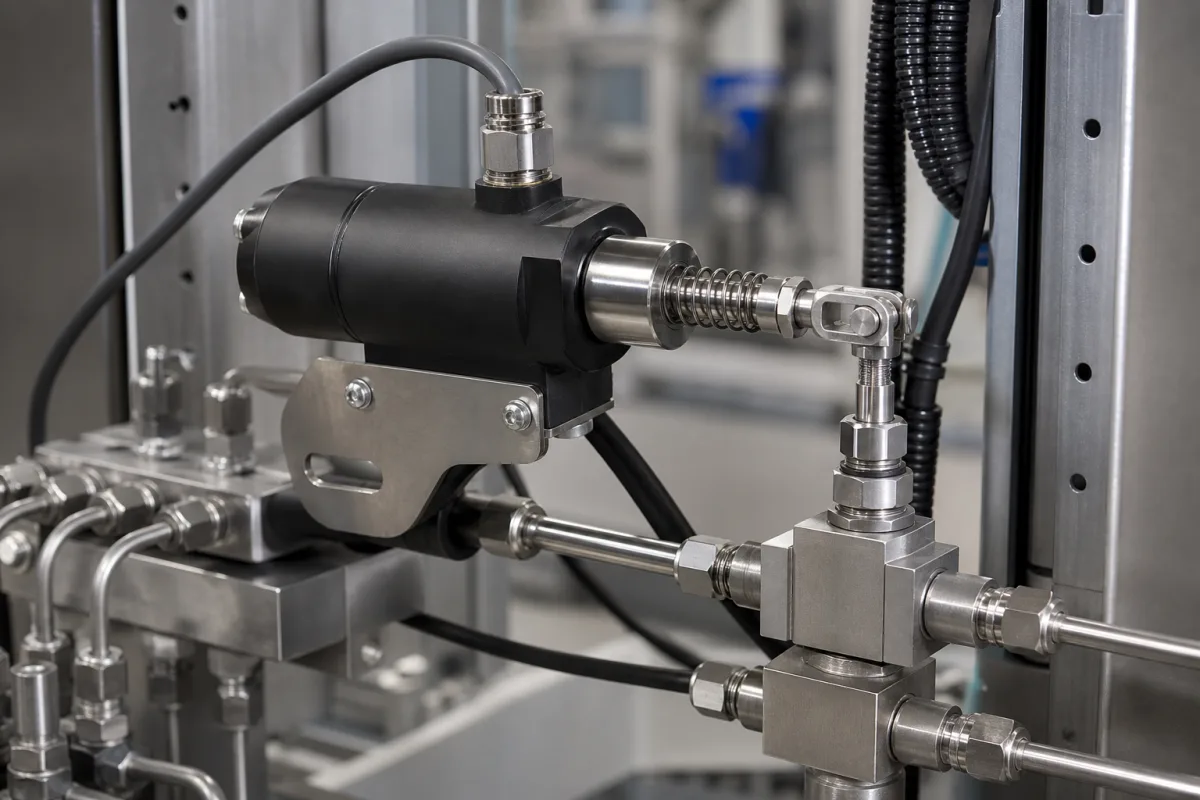
Actuator (Motor/Solenoid)

Based on aggregated insights from multiple verified factory profiles within the CNFX directory, the standard Actuator (Motor/Solenoid) used in the Machinery and Equipment Manufacturing sector typically supports operational capacities ranging from standard industrial configurations to heavy-duty production requirements.

Technical Definition & Core Assembly

A canonical Actuator (Motor/Solenoid) is characterized by the integration of Rotor/Stator Assembly (Motor) and Solenoid Coil. In industrial production environments, manufacturers listed on CNFX commonly emphasize Electrical steel laminations construction to support stable, high-cycle operation across diverse manufacturing scenarios.

A motorized or solenoid-driven component that converts electrical signals into precise mechanical motion to control dosing operations.
Product Specifications

Technical details and manufacturing context for Actuator (Motor/Solenoid)

Definition
Within a Proportioning Dosing Unit, the actuator (motor or solenoid) serves as the primary motion-generating component. It receives control signals and translates them into linear or rotary movement to precisely actuate valves, pumps, or plungers, thereby regulating the flow, volume, and timing of material dosing with high accuracy and repeatability.
Working Principle
A motor actuator uses electromagnetic principles to convert electrical energy into rotational torque, often coupled with gears or lead screws for linear motion. A solenoid actuator uses a coil to generate a magnetic field when energized, pulling a ferromagnetic plunger to create linear stroke motion. Both types are controlled by electronic signals to achieve precise positioning or on/off actuation for dosing control.
Common Materials
Electrical steel laminations, Copper windings, Permanent magnets (for certain motors), Ferromagnetic core (for solenoids), Stainless steel housing
Technical Parameters
  • Stroke length or rotational travel distance (mm) Standard Spec
Components / BOM
  • Rotor/Stator Assembly (Motor)
    Converts electrical energy to rotational motion through electromagnetic interaction
    Material: Electrical steel, copper, magnets
  • Solenoid Coil
    Generates magnetic field when energized to actuate the plunger
    Material: Copper wire, insulation
  • Plunger/Armature
    Moves linearly within the magnetic field to produce mechanical output
    Material: Ferromagnetic steel
  • Housing
    Protects internal components and provides mounting interface
    Material: Stainless steel or aluminum
Engineering Reasoning
0.5-15 N·m torque, 24-48 VDC input, 0-100 Hz frequency response
Torque output drops below 0.25 N·m at 48 VDC, temperature exceeds 85°C at 100% duty cycle for 60 minutes
Design Rationale: Permanent magnet demagnetization occurs at 150°C Curie temperature, solenoid coil insulation breakdown at 600 V/mil dielectric strength
Risk Mitigation (FMEA)
Trigger Back-EMF voltage spike exceeding 75 V during rapid deceleration
Mode: Hall effect sensor saturation causing position feedback loss
Strategy: Zener diode clamping at 60 V with 5 ns response time on feedback lines
Trigger Armature bearing lubrication degradation below 0.1 mm oil film thickness
Mode: Cogging torque variation exceeding ±15% of rated torque
Strategy: Sealed-for-life bearings with PTFE-coated retainers operating at -40°C to 120°C

Industry Taxonomies & Aliases

Commonly used trade names and technical identifiers for Actuator (Motor/Solenoid).

Applied To / Applications

This component is essential for the following industrial systems and equipment:

Industrial Ecosystem & Supply Chain DNA

Complementary Systems
Downstream Applications
Specialized Tooling

Application Fit & Sizing Matrix

Operational Limits
pressure: 0 to 10 bar
flow rate: Up to 100 L/min
temperature: -20°C to +80°C
slurry concentration: Up to 20% solids by weight
Media Compatibility
✓ Water-based fluids ✓ Chemical solutions (pH 4-9) ✓ Food-grade liquids
Unsuitable: Abrasive slurries with high particulate content
Sizing Data Required
  • Required dosing volume per stroke (mL)
  • Maximum operating pressure (bar)
  • Cycle frequency (strokes per minute)

Reliability & Engineering Risk Analysis

Failure Mode & Root Cause
Winding insulation breakdown
Cause: Thermal degradation from overheating due to overloading, poor ventilation, or voltage imbalance
Bearing failure
Cause: Lubrication loss, contamination ingress, or misalignment leading to excessive mechanical wear
Maintenance Indicators
  • Unusual audible humming or grinding noises during operation
  • Visible overheating signs such as discoloration or excessive heat emission
Engineering Tips
  • Implement regular vibration analysis and thermal imaging to detect early mechanical and electrical anomalies
  • Establish a preventive lubrication schedule and ensure proper alignment during installation and maintenance

Compliance & Manufacturing Standards

Reference Standards
ISO 13849-1: Safety of machinery - Safety-related parts of control systems ANSI/NFPA T3.21.3: Hydraulic fluid power - Actuators - Mounting dimensions for single rod cylinders, 160 bar (2500 psi) series DIN EN 1570-1: Safety requirements for lifting tables - Part 1: Lifting tables serving up to two fixed landings
Manufacturing Precision
  • Shaft runout: +/-0.01mm
  • Mounting surface flatness: 0.05mm
Quality Inspection
  • Insulation Resistance Test (megohmmeter)
  • Endurance Cycle Testing (load/stroke verification)

Factories Producing Actuator (Motor/Solenoid)

Verified manufacturers with capability to produce this product in China

✓ 98% Supplier Capability Match Found

P Procurement Specialist from Singapore Jan 23, 2026
★★★★★
"The technical documentation for this Actuator (Motor/Solenoid) is very thorough, especially regarding technical reliability."
Technical Specifications Verified
T Technical Director from Germany Jan 20, 2026
★★★★★
"Reliable performance in harsh Machinery and Equipment Manufacturing environments. No issues with the Actuator (Motor/Solenoid) so far."
Technical Specifications Verified
P Project Engineer from Brazil Jan 17, 2026
★★★★★
"Testing the Actuator (Motor/Solenoid) now; the technical reliability results are within 1% of the laboratory datasheet."
Technical Specifications Verified
Verification Protocol

“Feedback is collected from verified sourcing managers during RFQ (Request for Quote) and factory evaluation processes on CNFX. These reports represent historical performance data and technical audit summaries from our B2B manufacturing network.”

15 sourcing managers are analyzing this specification now. Last inquiry for Actuator (Motor/Solenoid) from Turkey (33m ago).

Supply Chain Compatible Machinery & Devices

Heavy-Duty CNC Plasma Cutting Machine

Industrial machine for precision metal cutting using plasma arc technology

Explore Specs →
Automated Assembly Line System

Integrated production system for sequential component assembly operations

Explore Specs →
Automated Powder Coating System

Integrated industrial system for applying dry powder coatings to metal substrates.

Explore Specs →
Centrifugal Pump Impeller

Rotating component that transfers energy to fluid in centrifugal pumps.

Explore Specs →

Frequently Asked Questions

What is the difference between motor and solenoid actuators for dosing applications?

Motor actuators use rotating components (rotor/stator) for continuous motion, while solenoid actuators use a plunger/armature for linear motion. Both convert electrical signals to mechanical motion but suit different dosing precision and speed requirements.

What materials ensure durability in industrial actuator housings?

Stainless steel housing provides corrosion resistance and structural integrity in harsh environments. Combined with electrical steel laminations and copper windings, it ensures long-term reliability in machinery manufacturing.

How do I select the right actuator for precise dosing control?

Consider motion type (linear vs. rotary), force/torque requirements, response time, and environmental conditions. Solenoid actuators offer fast linear action, while motorized versions provide continuous rotation for volumetric dosing.

Can I contact factories directly on CNFX?

CNFX is an open directory, not a transaction platform. Each factory profile provides direct contact information and production details to help you initiate direct inquiries with Chinese suppliers.

Get Quote for Actuator (Motor/Solenoid)

Request technical pricing, lead times, or customized specifications for Actuator (Motor/Solenoid) directly from verified manufacturing units.

Your business information is encrypted and only shared with verified Actuator (Motor/Solenoid) suppliers.

Thank you! Your message has been sent. We'll respond within 1–3 business days.

Need to Manufacture Actuator (Motor/Solenoid)?

Connect with verified factories specializing in this product category

Add Your Factory Contact Us
Previous Product
Actuator (Motor/Cylinder)
Next Product
Actuator (Motorized versions)