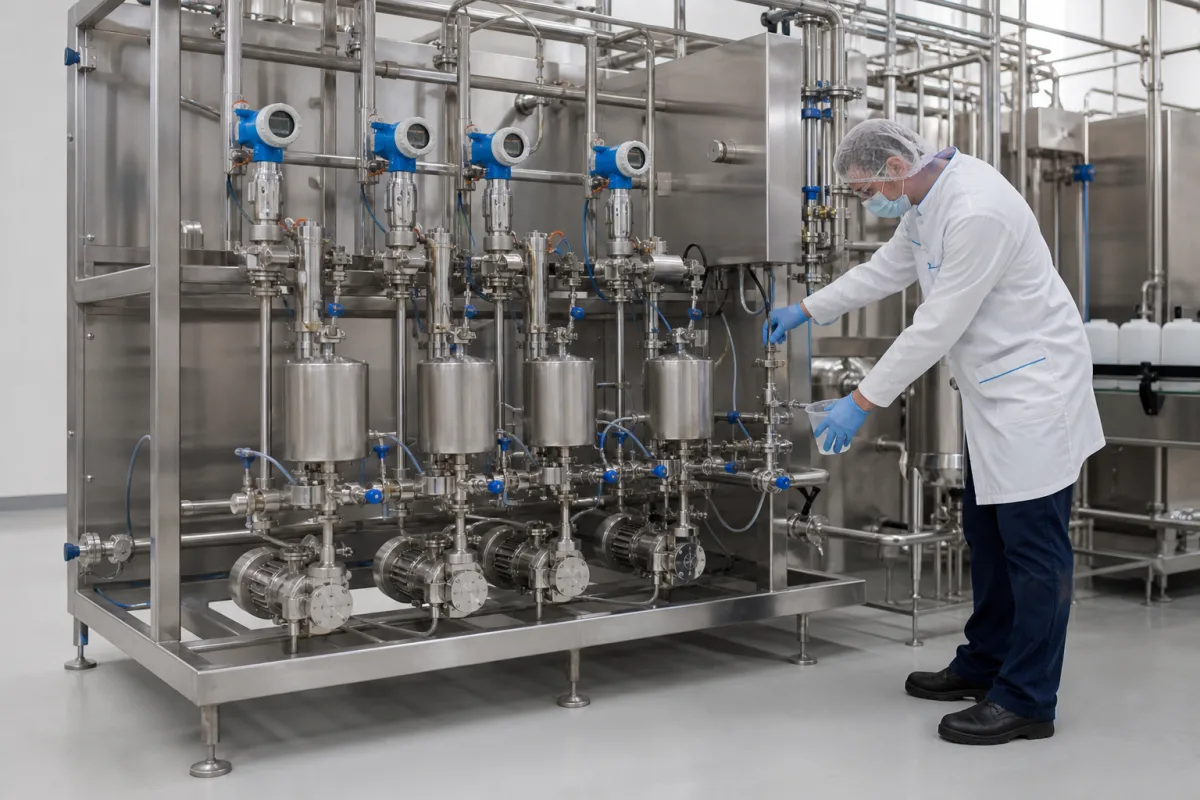
Aseptic in-line proportioning dosing unit: adding enzymes, vitamins, flavours and particles to a sterile product stream after heat treatment
Adding heat-sensitive ingredients after UHT, in proportion to the sterile product flow · 0.22 µm sterile-filtered dosing at 5–150 l/h, pre-sterilised bags injected by needle at 0.5–15 l/h per station, and particle dosing up to 10 mm
Some ingredients would be damaged by the heat that makes a drink shelf-stable: enzymes, vitamins, aromas, live cultures, fruit pieces. An aseptic dosing unit adds them afterwards, into the sterile product stream on its way to an aseptic tank or filler, in proportion to that stream. This page compares the three ways the published units keep the ingredient sterile — filtering it on the unit, buying it pre-sterilised in bags, or taking particles from aseptic containers — and what each means for dosing range, cleaning and the ratio that can be held.
Aseptic in-line dosing units that add heat-sensitive liquid ingredients or particles to a UHT-treated or otherwise sterilised beverage or dairy stream, downstream of the steriliser and upstream of an aseptic tank or filler: sterile-filter units, needle injection from pre-sterilised bags, and aseptic particle dosing. Syrup-room batch and in-line blending of beverages are covered on the Automated beverage batch blending system page; weighed, loss-in-weight and Coriolis dosing of ingredients into a batch on the Beverage ingredient dosing station page; chemical metering pumps on the Metering pump page; packaged chemical dosing skids for water treatment on the Chemical dosing pump skid page; detergent dosing for cleaning circuits on the CIP chemical dosing unit page. The unit adds an ingredient to the product; the buffer that holds finished product at the filler is covered on the Liquid storage tank ahead of the bottle filler page.
CNFX editorial research · Sources checked October 12, 2026 · 4 sources
Sterile filtration on the unit: 0.22 µm filter, 85 l tank and 5–150 l/h in Tetra Pak's Aseptic Dosing unit E
Tetra Pak's Aseptic Dosing unit E takes the ingredient from its own tank and makes it sterile on the way to the product: it is pumped through a pre-filter, then a sterile filter that removes bacteria and spores, and dosed continuously into the main flow, where a static in-line mixer blends it. [1]
The unit can be placed downstream of the steriliser in a UHT plant or upstream of an aseptic tank, and can serve one or more fillers as well as an aseptic tank. [1] Product-wetted parts are AISI 316 stainless steel. [1]
Editorial note: the sterile filter is there to remove bacteria, so it would also remove live cultures dosed as an ingredient; for those, look at the bag-and-needle units in the next section, which Tetra Pak lists for probiotic bacteria. [2]
Aseptic Dosing unit E
Published value
Ingredients
True solutions and suspensions with particles smaller than 0.22 µm: enzymes, vitamins, aromas, flavourings, colourings, salt solutions [1]
For each ingredient, give the supplier its composition, viscosity, particle content, the dose as a fraction of product flow, the product flow range of the line, and whether it may be filtered at 0.22 µm.
02
Pre-sterilised bags and a sterile needle: 0.5–15 l/h per station into lines of 1,000–20,000 l/h
The second approach does not sterilise the ingredient on site. Tetra Pak's Aseptic Dosing unit F takes ingredients pre-packed aseptically in 5 or 10 litre bags, connects each bag by a sterile hose, and injects through a sterile needle into the base product after the final heat treatment, just before filling. [2]
Tetra Pak lists enzymes, aromas, colours, lipids, probiotic bacteria and other nutritionals for unit F, in a UHT version (FDU 2000) and a chilled version (FDU 2000C). [2] GEA adds a HEPA-filtered laminar airflow in the chamber where the bags hang. [3]
Editorial calculation: one unit F station at its 0.5–15 l/h range, feeding a line in Tetra Pak's 1,000–20,000 l/h range, can hold dose ratios from 0.5 ÷ 20,000 = 0.0025% up to 15 ÷ 1,000 = 1.5% of product flow; with both stations on one ingredient the top end is 30 l/h. [2] Check that the planned dose at the line's lowest and highest flow both fall inside the station range.
For lactose-free milk, GEA points out that adding lactase after heat treatment lets lactose break down in the pack, faster at room temperature than chilled before UHT, and with less browning during heating. [3]
Tetra Pak Aseptic Dosing unit F
GEA VARI-DOS-ASEPT
Ingredient supply
Aseptically pre-packed 5 or 10 l bags; bar code reader checks the product [2]
Sterile, barcoded pouches; up to two bags hang in the weighing unit [3]
Injection
Sterile hose and needle; steam and sterile condensate barriers [2]
Patented transfer port; needle sterilised automatically in the port valve [3]
Metering
Two stations with peristaltic hose pumps and weighing; flow transmitter [2]
Between UHT system and sterile tank, or before the filling station [3]
03
Particles a filter cannot pass: Krones DosaFlex doses pieces up to 10 mm at 60–1,500 l/h
Fruit pieces, fibres and cereals cannot go through a sterile filter or a needle. Krones' DosaFlex takes particles that have been produced aseptically and doses them from aseptic containers into the juice flow shortly before filling, so they are not heated with the liquid in the UHT unit. [4]
Krones says the accuracy removes the need to overdose the expensive solids to be sure of the target concentration in the bottle, and presents the unit as small and low-cost enough for test-market drinks with particles. [4]
Editorial calculation: at the 1,500 l/h maximum, a 0.3% deviation is 4.5 l/h of particle stream; at 60 l/h it is 0.18 l/h. Whether the 0.3% refers to the dosed quantity or to concentration in the finished drink is not stated in the announcement; ask Krones which.
Paste it into your enquiry below or into an email to a maker, then replace every bracket.
Product: [milk, juice, other; flow range in l/h]
Ingredients: [type; viscosity; particles and size; filterable at 0.22 µm or not]
Dose: [ratio to product flow; accuracy required]
Supply: [tank on unit, sterile bags, aseptic containers]
Position: [after steriliser, before aseptic tank, before filler]
Cleaning: [own CIP and sterilisation or with the line]
Records: [bar code, batch traceability]
Explore company information and manufacturing capabilities, then discuss the scope of your project with a relevant supplier.
Share this page
Compiled and source-reviewed by the CNFX editorial team.
Each manufacturer above links to the page on that company's own website where the product is listed, with the date we checked it. How we source and review
· Page last updated 13 October 2026
Buyer questions
What is an aseptic dosing unit used for?
To add ingredients that would be damaged by heat, such as lactase, vitamins, aromas or probiotic cultures, into a product after UHT treatment and before filling. [1][2][3]
What dosing range does an aseptic sterile-filter dosing unit have?
Tetra Pak's Aseptic Dosing unit E doses 5–50 or 25–150 l/h through a sterile filter of maximum 0.22 µm pore size. [1]
How are probiotic cultures dosed aseptically?
Not through a 0.22 µm filter; Tetra Pak's unit F injects ingredients including probiotic bacteria from aseptically pre-packed bags by sterile needle, at 0.5–15 l/h per station. [2]
Can fruit pieces be dosed after UHT?
Krones' DosaFlex doses aseptically produced particles up to 10 mm at 60–1,500 l/h, with 0.3% deviation, shortly before filling. [4]
Sources and what still needs a direct check
Sources checked 2026-10-12. Sterile-filter dosing data come from Tetra Pak's Aseptic Dosing unit E technical leaflet and bag-and-needle dosing from its unit F leaflet (both in copies hosted by an equipment directory); GEA's VARI-DOS-ASEPT from GEA's product page; particle dosing from a 2015 Krones announcement published by PETnology.