Editorial Technical Reference

Automated Pallet System

This page explains how Automated Pallet System is classified within Machinery and Equipment Manufacturing. Technical values and manufacturer relationships are research references; confirm the current specification and supplier evidence for each order.

Technical Definition & Core Assembly

A material handling subsystem that automatically transports, positions, and exchanges pallets containing aluminum workpieces within a CNC machining cell.
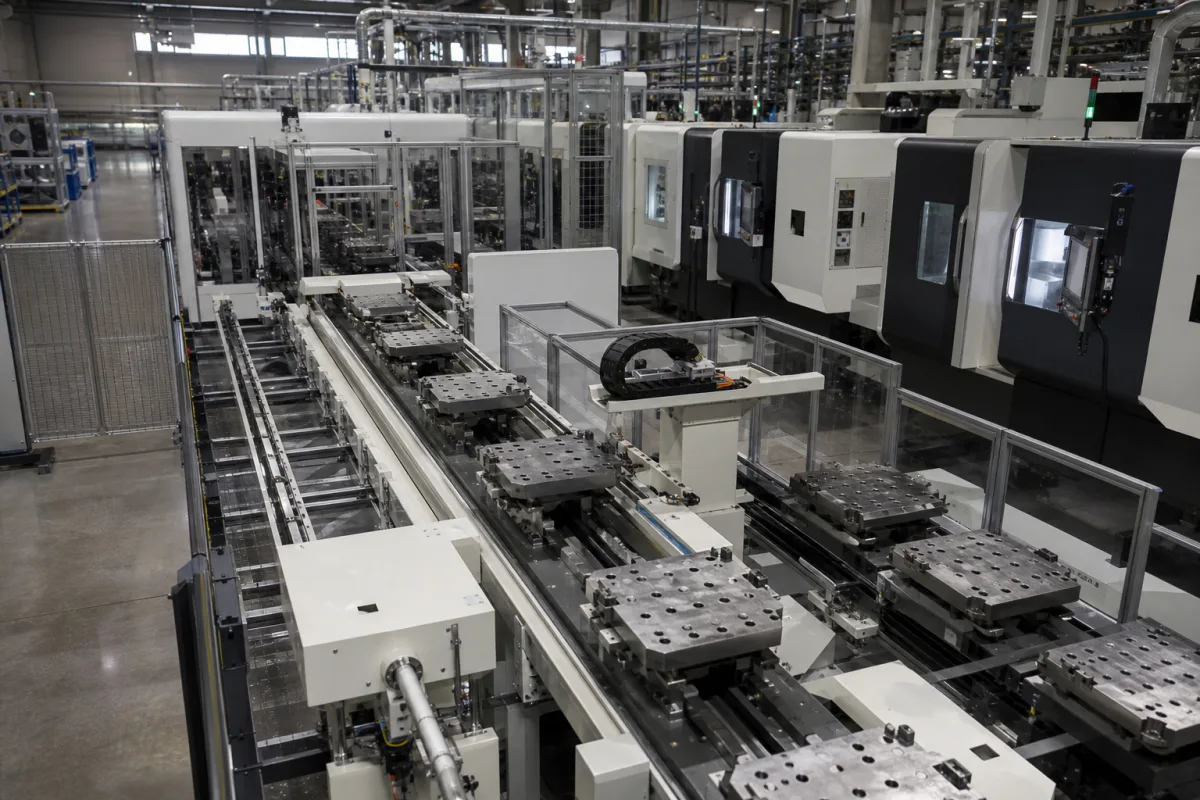
Representative product image. Confirm appearance and specifications with the manufacturer.

Product Specifications

Technical details and manufacturing context for Automated Pallet System

Definition
The Automated Pallet System is an integral component of the Aluminum CNC Machining Cell, responsible for the automated movement, precise positioning, and efficient exchange of pallets that hold aluminum workpieces. It interfaces between the CNC machine's work area and the loading/unloading stations, enabling continuous production flow, reduced manual intervention, and optimized machining cycle times. The system typically uses servo motors or linear actuators to move pallets along guided rails or conveyors. A pallet changer mechanism (often with hydraulic or pneumatic clamping) securely locks the pallet in the machining position. Programmable logic controllers (PLCs) coordinate the sequence: an empty pallet is loaded with a raw aluminum workpiece, transported to the CNC machine, precisely aligned and clamped for machining, then exchanged with a finished pallet to maintain uninterrupted operation. Key specifications include square pallets ranging from 400 to 800 mm (larger sizes on request), pallet load capacity from 500 to 2000 kg, positioning accuracy of ±0.02 mm at pallet exchange, and pallet exchange time of 15 to 30 seconds. The system can be configured with 2 to 12 pallet stations, operates on pneumatic pressure of 0.6 to 0.8 MPa, and requires a 24 V DC supply (±10%). It is designed for non-condensing environments with operating temperatures from 5 to 45 °C, and electrical enclosures rated IP54 to IP65 (IEC 60529). Pallet clamping mechanisms can be hydraulic or mechanical, and the system weight ranges from 1500 to 3500 kg depending on configuration. Control interfaces include PROFINET and EtherNet/IP (IEC 61158), with other protocols available. Materials used include aluminum alloy for frames and rails, steel for actuators and gears, and polymer for wear strips and bearings. All values are reference ranges and must be verified with the legal manufacturer for specific models and applications.
Working Principle
The system uses servo motors or linear actuators to move pallets along guided rails or conveyors. A pallet changer mechanism, often with hydraulic or pneumatic clamping, securely locks the pallet in the machining position. Programmable logic controllers (PLCs) coordinate the sequence: an empty pallet is loaded with a raw aluminum workpiece, transported to the CNC machine, precisely aligned and clamped for machining, then exchanged with a finished pallet to maintain uninterrupted operation.
Common Materials
Aluminum alloy (frame/rails), Steel (actuators/gears), Polymer (wear strips/bearings)
Technical Parameters
ParameterTypical rangeNotes & selection driver
Pallet Size400–800 mmSquare pallets; larger sizes available on request
Pallet Load Capacity500–2000 kgMax load per pallet
Positioning Accuracy±0.02 mmRepeatability at pallet exchange
Pallet Exchange Time15–30 sTime to swap pallet in machining area
Number of Pallet Stations2–12 stationsConfigurable based on cell layout
Operating Pressure0.6–0.8 MPaPneumatic system; below 0.6 MPa may cause clamping issues
Supply Voltage24 ±10% V DCFor sensors and control
Operating Temperature5–45 °CNon-condensing environment
Ingress Protection RatingIP54–IP65For electrical enclosuresIEC 60529
Pallet Clamping MechanismHydraulic/MechanicalEnsure compatibility with machine tool
System Weight1500–3500 kgDepending on configuration
Control InterfacePROFINET/EtherNet/IPOther protocols availableIEC 61158

Ranges are indicative industry figures for RFQ preparation, not a supplier commitment. Confirm every value and standard with the legal manufacturer before ordering.

Components / BOM
  • Pallet Changer Mechanism
    Physically exchanges pallets between the transport system and CNC machine table with precise alignment.
  • Linear Guide Rails
    Provide smooth, low-friction movement for pallet transportation along a defined path.
  • Servo Drive System
    Controls the motion of pallets with high precision and programmable speeds/positions.
  • Clamping Unit
    Securely locks the pallet in place during machining to prevent movement from cutting forces.
  • Control Panel (PLC Interface)
    Houses the programmable logic controller and interface for system operation and integration with the CNC.
  • Pallets
    The fixtured pallets themselves that carry the workpiece in and out of the machine.

Industrial Ecosystem & Supply Chain Structure

Complementary Systems
Downstream Applications
Specialized Tooling

Application Fit & Sizing Matrix

Operational Limits
pressure: N/A (pneumatic/hydraulic systems: 0.5-0.8 MPa typical)
other spec: Max payload: 500-2000 kg (configurable), Positioning accuracy: ±0.5 mm, Cycle time: 15-45 seconds/pallet, Power: 400V/3-phase/50-60Hz
temperature: 5°C to 40°C (operating), -10°C to 50°C (storage)
Media Compatibility
✓ Aluminum workpieces (cast/forged) ✓ Steel fixture plates ✓ Plastic/composite transport pallets
Unsuitable: Corrosive chemical environments (e.g., acid mist, salt spray) without protective enclosures
Sizing Data Required
  • Maximum workpiece dimensions (L×W×H) and weight
  • Required throughput (pallets/hour) and CNC cycle time
  • Available floor space and integration constraints with existing CNC cell

Reliability & Engineering Risk Analysis

Failure Mode & Root Cause
Conveyor belt misalignment
Cause: Worn or damaged belt tracking components, improper tensioning, or accumulation of debris causing uneven loading and belt drift.
Motor or drive system failure
Cause: Overloading due to jammed pallets or excessive weight, inadequate lubrication, electrical faults, or thermal overload from continuous operation without cooling intervals.
Maintenance Indicators
  • Unusual grinding or squealing noises from rollers or motors, indicating bearing wear or misalignment.
  • Visible pallet jams, erratic movement, or frequent system stoppages, signaling mechanical obstructions or sensor malfunctions.
Engineering Tips
  • Implement a predictive maintenance program using vibration analysis and thermal imaging to detect early signs of wear in motors, bearings, and drive components.
  • Establish regular cleaning and inspection schedules for conveyor tracks, sensors, and rollers to prevent debris buildup and ensure proper alignment and lubrication.

Indicative industry ranges for design and RFQ preparation. Confirm the exact figures and applicable standard with the manufacturer before specifying.

Compliance & Manufacturing Standards

Applicable Standards
ISO 445:2013 - Pallets for materials handling ANSI MH1.2.2 - Pallet Dimensions and Tolerances CE Marking - Machinery Directive 2006/42/EC

Quoted from the published standard.

Manufacturing Precision
  • Pallet deck flatness: +/- 1.5mm across surface
  • Fork entry opening width: +/- 3mm from nominal dimension
Quality Inspection
  • Load capacity verification test (static and dynamic)
  • Dimensional accuracy check using coordinate measuring machine (CMM)

Manufacturers of Automated Pallet System

Manufacturer profiles associated with Automated Pallet System.

Sourcing Automated Pallet System from China?
Tell us your specification and target quantity — we will match it against manufacturer records and come back with the factories that fit.
Request manufacturers We manufacture this

Manufacturer listings support early research and capability understanding. They are not certification, ranking, or transaction guarantees.

Technical documentation
Request current drawings, revision history, and a signed specification sheet.
Manufacturing capability
Verify equipment lists, process limits, capacity, and representative production evidence.
Inspection readiness
Confirm test methods, calibrated equipment, sampling plans, and traceable reports.
Supplier transparency
Check the legal entity, factory address, ownership, certifications, and direct contacts.

CNFX does not score or rank suppliers. Buyers must verify all claims and documents with the legal manufacturer before ordering.

Supply Chain Compatible Machinery & Devices

Automated Powder Coating System

Integrated industrial system for applying dry powder coatings to metal substrates.

Explore Specs →
Centrifugal Pump Impeller

The centrifugal pump impeller is a critical rotating component that converts mechanical energy from the motor into kinetic energy in fluid systems.

Explore Specs →
High-Precision CNC Laser Cutting Machine

Computer-controlled industrial machine using focused laser beams to cut sheet metal with micron-level accuracy.

Explore Specs →
Industrial-Grade Hydraulic Cylinder Piston Rod

This industrial-grade piston rod is a precision-ground cylindrical component designed for use in hydraulic cylinders.

Explore Specs →

Frequently Asked Questions

What is the pallet size range for this system?

The standard pallet size is square, ranging from 400 to 800 mm. Larger sizes are available on request. Always confirm the exact size with the manufacturer for your application.

What is the positioning accuracy at pallet exchange?

The repeatability at pallet exchange is ±0.02 mm. This value is a reference; verify the actual accuracy for the specific model and installation.

What control interfaces are supported?

The system supports PROFINET and EtherNet/IP, conforming to IEC 61158. Other protocols may be available; check with the manufacturer for compatibility.

What are the operating pressure requirements?

The pneumatic system operates at 0.6 to 0.8 MPa. Below 0.6 MPa may cause clamping issues. Ensure your air supply meets this range.

Data Basis

Editorial classification, named public sources where available, and source-reviewed manufacturer records.

Preliminary Technical Classification
This page supports structured research, RFQ preparation, and supplier evaluation. It does not replace buyer-led supplier qualification, standards review, or technical approval.
Buyer enquiry

Request manufacturing insight for Automated Pallet System

Ask for use case, specification boundaries, supplier type, and RFQ preparation information for this product.

Where it goes
Straight to the CNFX editorial desk, and to the manufacturer if this product is linked to a claimed profile. Nothing is broadcast to a supplier list.
Your details stay here
We do not sell or rent enquiry data, and we do not add you to a mailing list. Used only to answer this request.
No commission, no middleman
CNFX is a directory. We take no cut of any order and never negotiate on a supplier's behalf.
What we don't claim
A listing is not an endorsement. Qualify every supplier and verify every figure yourself before ordering.

Your business information is used only to process this request.

Thank you! Your message has been sent. We'll respond within 1–3 business days.
Sorry, we couldn't send your message. Please try again, or email us at contact@cnfx.com.

Need to Manufacture Automated Pallet System?

Compare manufacturer profiles with relevant product and process capability.

Previous Product
Automated Mold Preparation Station
Next Product
Automated Powder Coating System
Get QuotesChat