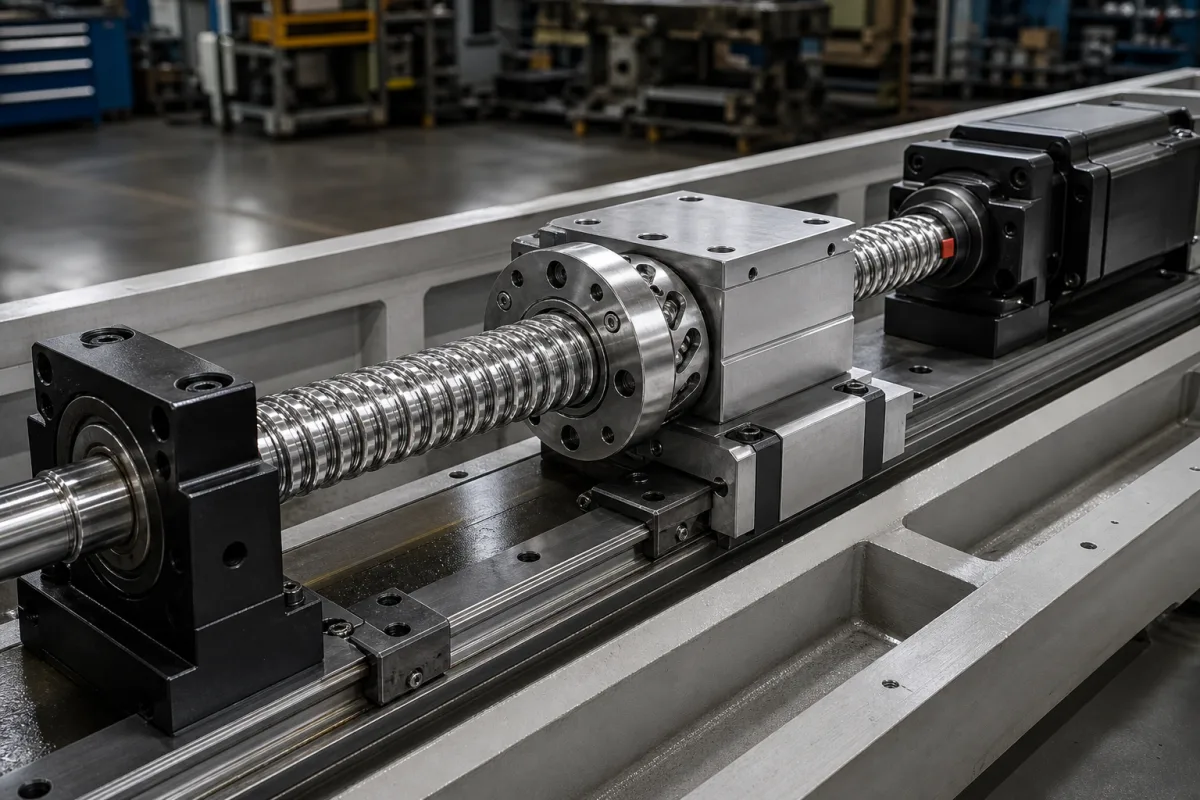
The axis in the illustration is a complete ball screw drive: a ground screw with a flanged nut in its housing, fixed and floating end supports, a linear rail and carriage beside it, and a servo motor coupled to the far end. Screw size, accuracy, critical speed and life decide whether the screw survives. Whether the axis moves as commanded depends on what the motor sees through it: the torque the lead demands, the torque the load sends back, and the inertia the moving mass adds.
Covers ball screw axes as motor-driven drives: drive torque from axial force, lead and efficiency; forward and reverse efficiency and back-driving on vertical and inclined axes; checking back-drive torque against nut, seal and bearing friction; brakes and counterbalance; reflected inertia of the moving mass and screw; and motor-to-load inertia ratios. Critical speed, d·n, buckling, lead accuracy, thermal growth and life of the screw are on Ball screws for linear axes; rail and screw alignment and lubrication are on Linear guideways and ball screws installed together; high-load screws for presses and injection machines are on Ball screw assembly.
CNFX editorial research · Sources checked October 13, 2026 · 3 sources
THK explains the basis: balls rolling between shaft and nut make the screw so efficient that the driving torque is about one third of that of a conventional sliding screw.
The steady torque the motor must supply is the axial force times the lead, divided by 2π and by the forward efficiency; acceleration adds the total inertia times angular acceleration. THK notes that because the screw is efficient in both directions it converts rotation into linear motion and linear motion back into rotation. It also points out that a preloaded nut takes axial clearance below zero for rigidity without backlash, at the cost of some friction torque.
Lead trades torque against speed: doubling the lead halves the axial force the same torque produces, but doubles linear speed at the same motor speed.
Example (assumed: 1,000 N thrust, η = 0.9)
Lead 5 mm
Lead 10 mm
Lead 20 mm
Steady drive torque F·P/(2π·η)
≈0.88 N·m
≈1.77 N·m
≈3.54 N·m
Linear speed at 3,000 rpm
15 m/min
30 m/min
60 m/min
Editorial calculation with assumed values; use the screw maker's forward efficiency for the actual model. Ask for the nut's preload drag torque, which adds to the motor's load.
02
Will a vertical load turn the screw backwards?
Danielle Collins of Linear Motion Tips explains why ball screws need more care than lead screws on vertical axes.
A screw stops a load crashing down on loss of power better than a belt or linear motor, but the high efficiency of a ball screw makes it more likely than a lead screw to back-drive and let the load fall. The back-driving torque is axial load × lead × reverse efficiency ÷ 2π, with reverse efficiency of about 0.8 to 0.9 for ball screws and lower than forward efficiency. If that torque is smaller than the friction of the assembly (nut drag, seals and end bearings), back-driving is unlikely. For lead screws, the article gives a rule of thumb of a lead below one third of the screw diameter to avoid back-driving.
The article's example, a 16 × 10 screw in a fixed-floating arrangement with 100 N load, gives 0.13 N·m back-driving torque against 0.26 N·m of friction (0.03 nut, 0.08 seals, 0.15 end bearings), so back-driving is unlikely. Even so, it stresses that the calculation is not a reason to omit a brake or counterweight on a vertical axis.
Load on the same 16 × 10 screw
Back-driving torque (η₂ = 0.8)
Against 0.26 N·m friction
100 N (article example)
≈0.13 N·m
Holds
200 N
≈0.25 N·m
Marginal
490 N (50 kg)
≈0.62 N·m
Back-drives
The 200 N and 490 N rows are Editorial calculations from the article's formula and friction values. Ask for the reverse efficiency and friction torques of the actual assembly, and specify a holding brake or counterbalance for any vertical or inclined axis.
03
Reflected inertia and the inertia ratio
Oriental Motor's engineering notes give the inertia an object in linear motion presents to the motor and the ratios motors tolerate.
A mass moving with a screw appears at the motor as J = m × (lead ÷ 2π)², to which the screw's own inertia as a solid cylinder and the coupling's are added. The inertia ratio is total load inertia (reflected through any gearing) divided by the motor's rotor inertia; exceeding the recommended ratio can make a motor miss steps, stall or vibrate, and closed-loop motors tolerate larger ratios than open-loop ones. Slower acceleration and deceleration ramps reduce the torque needed and can let a motor work beyond its guideline.
Because reflected inertia rises with the square of the lead, a coarse-lead screw that suits a fast axis also makes the load look heavier to the motor.
Motor type (Oriental Motor guideline)
Recommended inertia ratio
Open-loop stepper, 20–35 mm frames
5:1 or less
Open-loop stepper, 42–85 mm frames
10:1 or less
Closed-loop stepper
30:1 or less
Servo, auto-tuning
50:1 or less
Servo, manual tuning
100:1 or less
Example (Editorial calculation): a 100 kg table on a 10 mm lead reflects 100 × (0.01/2π)² ≈ 2.5 × 10⁻⁴ kg·m²; on a 20 mm lead, four times that. Ask the drive supplier for the inertia ratio calculation including screw, coupling and table.
04
What to give a supplier for a ball screw drive
Paste it into your enquiry below or into an email to a maker, then replace every bracket.
State the moving mass, axis orientation (horizontal, vertical, inclined), thrust and process forces, stroke, speed and acceleration profile, positioning accuracy, and the motor type intended. Ask for screw lead and diameter, forward and reverse efficiency, nut preload and drag torque, end-bearing friction, back-driving check, brake or counterbalance on vertical axes, reflected inertia, inertia ratio and the motor torque calculation.
1 company lists this product among what they make. Company figures are quoted from each
company's own website; every card states where the relationship came from.
Shuntai's site lists ball screws (ST series, miniature and non-standard), linear guides and linear modules; ask for efficiency, preload drag torque and end-support data for drive sizing.
Explore company information and manufacturing capabilities, then discuss the scope of your project with a relevant supplier.
Share this page
Compiled and source-reviewed by the CNFX editorial team.
Each manufacturer above links to the page on that company's own website where the product is listed, with the date we checked it. How we source and review
· Page last updated 13 October 2026
Buyer questions
How much torque does a ball screw need?
Axial force × lead ÷ (2π × efficiency); THK puts ball screw driving torque at about one third of a sliding screw's. [1]
Will a ball screw hold a vertical load without a brake?
Only if the back-driving torque (load × lead × reverse efficiency ÷ 2π) is below the assembly's friction, and Linear Motion Tips advises a brake or counterweight regardless. [2]
How does lead affect inertia?
Reflected inertia is m × (lead ÷ 2π)², so doubling the lead quadruples it (Oriental Motor's formula). [3]
What inertia ratio can a servo handle?
Oriental Motor's guideline is 50:1 or less with auto-tuning and 100:1 with manual tuning; open-loop steppers 5:1 to 10:1. [3]
Sources and what still needs a direct check
Sources checked 2026-10-13. A ball screw maker's product engineering pages, a motion-engineering trade article and a motor maker's engineering notes.