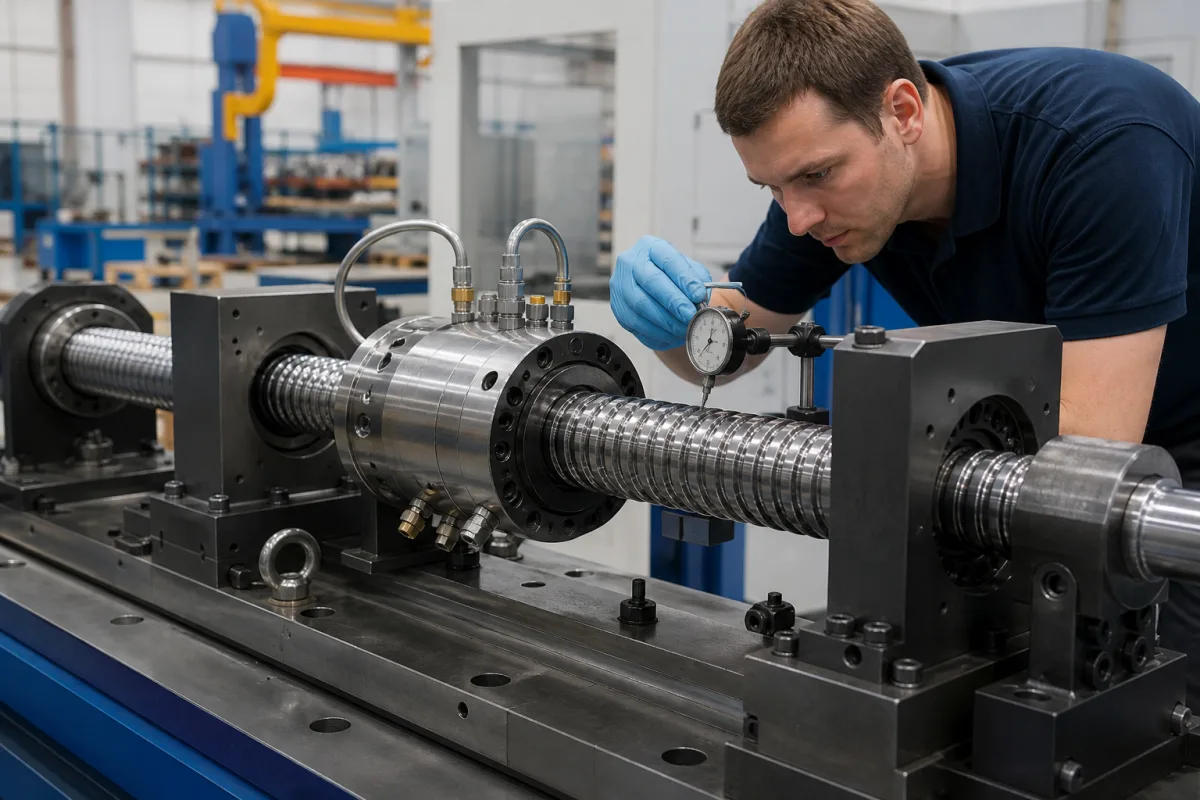
Ball screw assembly (high-load ball screw and nut assembly for electric injection moulding machines and presses, with nut cooling)
High-load ball screw assemblies for electric injection moulding machines and presses · high-load ball screw series, caged balls, large shafts, DN value and screw speed, nut cooling versus hollow-shaft cooling
A ball screw assembly here is the heavy screw-and-nut set that replaces hydraulic cylinders in electric injection moulding machines and servo presses: a large-diameter screw shaft, a nut built for high axial load, and, where heat demands it, a cooled nut. Ask three things first: what peak axial load and duty the axis sees, what speed the screw must reach within its DN limit, and how heat will be removed from the nut and shaft.
High-load ball screw assemblies for electric injection moulding machines, presses and similar high-thrust axes, including large-shaft and caged-ball types and nut or hollow-shaft cooling. General rolled and ground ball screws for machine tools and automation are covered on the Ball screws for linear axes page; installing ball screws with linear guideways on one axis on its own page; injection drives as a whole, hydraulic or electric, on the Injection drive and control system page; lead screws, roller screws and linear motors are outside this page.
CNFX editorial research · Sources checked October 12, 2026 · 4 sources
High-load series, shaft size and the DN limit on speed
NSK lists its HTF series of high-speed, high-load ball screws for injection moulding in four types: HTF-SRC for high speed and high loads, HTF-SRD with large leads for higher speed, HTF-SRE for large screws with shaft diameters of 140 mm or more, and HTF-SRM for heavy duty and high temperatures, with options of an S-HTF series in tougher steel, an A1 series with better sealing and long-life technology; it states the aims as maximum allowable dynamic load and maximum life through load distribution. [1]
Linear Motion Tips reports that THK's SBKH combines the high load capacity of its HBN caged ball screw with the speed of its SBK type, reaching "up to 92 m/min while carrying heavy loads", with end-cap recirculation suitable for a DN value of 130,000, shaft diameters of 83 to 120 mm, and a resin cage that separates the balls and retains grease, aimed at injection moulding machines and presses. [4]
Editorial calculation: DN is shaft diameter (strictly ball-centre diameter) in mm × speed in min⁻¹, so at DN 130,000 a 100 mm screw is limited to about 1,300 min⁻¹; reaching 92 m/min at that speed needs a lead of about 92,000 ÷ 1,300 ≈ 71 mm. The diameter is an assumed example; use the maker's ball-centre diameter and rated speed for your size. [4]
Give the ball screw maker the axis (injection, clamp, ejector, press ram), peak and mean axial load and duty cycle, stroke, speed and acceleration, required life, shaft diameter limits, lead, mounting and support bearings, lubrication method, cooling available, ambient temperature and quantity.
02
Cooling the nut instead of drilling the shaft
THK's nut-cooling ball screw has "a coolant channel inside of the nut", which keeps the screw at an optimal temperature during high-speed operation and stabilises positioning accuracy and preload torque; it notes that "even for long screw shafts, which are difficult to hollow out", the screw can be cooled through the nut, and that cooling can be built into a wide range of models irrespective of shaft diameter, recirculation system or preload method. [3]
NSK states that its nut cooling gives cooling capacity "greater or equal to existing hollow-shaft ball screws" without sliding seals or rotary joints, because piping attaches to the outer periphery of the nut flange; the preload torque does not increase when the nut is cooled, heat transfer to the table is blocked, and for its HMD nuts the mounting dimensions are unchanged so machine designs need not change. It lists injection moulding among the industries. [2]
Explore company information and manufacturing capabilities, then discuss the scope of your project with a relevant supplier.
Share this page
Compiled and source-reviewed by the CNFX editorial team.
Each manufacturer above links to the page on that company's own website where the product is listed, with the date we checked it. How we source and review
· Page last updated 13 October 2026
Buyer questions
How is this different from a standard ball screw?
This page covers high-load screws and cooled nuts for electric injection moulding machines and presses; general ball screws are on the Ball screws for linear axes page. [1][4]
How fast can a high-load ball screw run?
THK's SBKH is reported at up to 92 m/min with a DN value of 130,000. [4]
Why cool the nut instead of the shaft?
NSK says nut cooling matches or beats hollow-shaft cooling without sliding seals or rotary joints; THK notes long shafts are hard to hollow out. [2][3]
Is there a series for very large screws?
NSK's HTF-SRE series covers shaft diameters of 140 mm or more. [1]
Sources and what still needs a direct check
Sources checked 2026-10-12. NSK publishes its HTF series and nut-cooling ball screws; THK publishes its nut-cooling data sheet; Linear Motion Tips reported THK's SBKH.