Ball screws · Critical speed and d·n limit, buckling, C-grade lead accuracy, preload and thermal growth
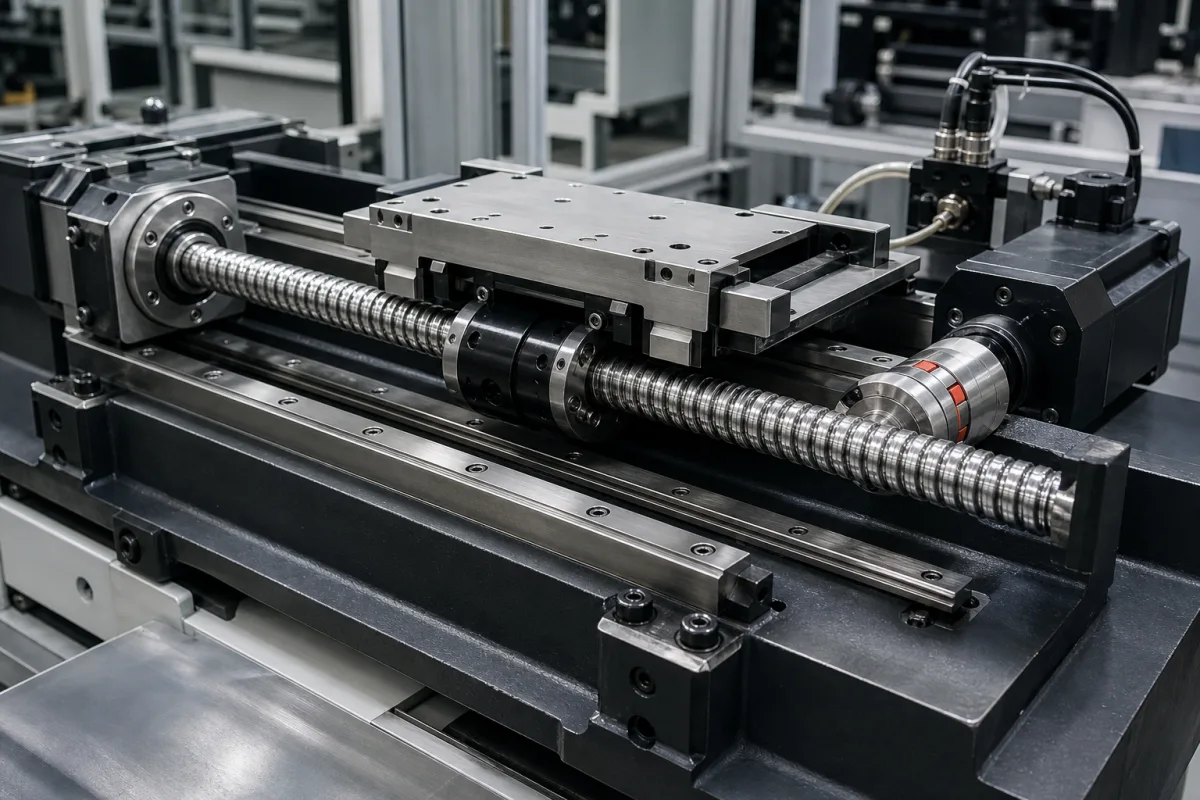
A ball screw converts rotation into linear travel through balls recirculating between a threaded shaft and a nut; with a servo motor, coupling, support bearings and guides it forms a positioning axis like the one pictured. Ask three things first: what rotational speed the shaft can safely reach at your support span, which lead accuracy grade the screw is made and inspected to, and what preload the nut carries and how heat will change the axis.
Rolled and ground ball screws with their nuts and end support, for machine tools and automation axes. Linear motors, complete linear modules and actuators, lead (sliding) screws and linear guides are outside this page.
CNFX editorial research · Sources checked October 11, 2026 · 4 sources
NSK's precision machine components catalogue says permissible rotational speed is the lower of two limits: the critical speed, where the shaft resonates, and the d·n value (shaft diameter in mm × speed in min⁻¹), which limits damage to the ball recirculation parts. 80% of the critical speed is taken as permissible. In its example, a ZFT4010-10 screw with a 34.4 mm root diameter, supported Fixed-Simple over 2,000 mm, is allowed about 1,290 min⁻¹. [1]
NSK's Table 3.2 sets allowable d·n values by nut design: 70,000 or less for standard tube recirculation (100,000 for high-speed versions), 160,000 for SRC recirculation and 180,000 for end-deflector nuts, and for these standard nuts separate maximum rotational speeds of 3,000 to 5,000 min⁻¹. If a screw must exceed critical speed, NSK says the natural frequency has to be raised, for example with an intermediate support. The catalogue gives the critical-speed factor f two ways round: Table 3.1 on page B47 lists Fixed-Fixed 15.1 (λ 3.927) and Fixed-Simple 21.9 (λ 4.730), while Table 4 on the spread B541–B542 (PDF page 476) lists Fixed–Fixed 21.9 and Fixed–Simple 15.1, the pairing that matches λ 4.730 for a beam fixed at both ends. [1] Confirm with NSK which factor its calculation used.
Editorial calculation: with the 40 mm shaft of the same model, a tube-recirculation limit of 70,000 would allow 70,000 ÷ 40 = 1,750 min⁻¹, so the 1,290 min⁻¹ critical-speed limit governs; with a 10 mm lead that is about 12.9 m/min of travel. Shortening the span helps faster, because critical speed scales with 1 ÷ L².
For compressive loads NSK calculates buckling with a 0.5 safety factor; its Fixed-Fixed example over 2,000 mm gives a permissible buckling load of 69,600 N, against 136,000 N for yield of the shaft and 68,500 N for permanent deformation at the balls (static rating 137,000 N with a factor of 2). [1]
Give the supplier the stroke, maximum speed and acceleration, axial loads through the cycle, support arrangement and span, required life, positioning accuracy, mounting orientation and operating temperature.
02
Fix the lead accuracy grade and thermal growth
NSK's lead accuracy table, based on JIS B1192, separates positioning (C) grades from transport (Ct) grades. Over 300 mm of travel the allowed variation is 3.5 µm for C0, 8 µm for C3 and 18 µm for C5, against 52 µm for Ct7 and 210 µm for Ct10. For a 1,000–1,250 mm thread, the C5 tolerance on specified travel is ±46 µm and C3 is ±24 µm. [1]
Editorial calculation: transport grades set the travel tolerance as ±(thread length ÷ 300) × υ300, so over 1,000 mm a Ct10 screw may deviate ±700 µm and a Ct7 screw about ±173 µm, an order of magnitude above C5. [1]
HIWIN's ballscrew catalogue gives thermal expansion of the shaft as ΔL = 11.6 × 10⁻⁶ × ΔT × Ls and recommends a cumulative lead target of −0.02 to −0.03 mm per metre for CNC machine tools, compensated by pretensioning the shaft. Editorial calculation: a 3 °C rise on a 1,000 mm shaft gives about 0.035 mm, close to the whole C5 tolerance for that length. [2]
HIWIN recommends that preload for CNC machine tools does not exceed 8% of the dynamic load rating C, because excess preload adds friction torque and heat; in its example, doubling nut preload raises temperature about 5 degrees for only about 5% more stiffness. [2]
03
Estimate fatigue life
NSK calculates fatigue life in revolutions as L = (Ca ÷ (Fa × fw))³ × 10⁶, with Ca the basic dynamic load rating, Fa the axial load and fw a load factor of 1.0–1.2 for smooth operation, 1.2–1.5 normal and 1.5–3.0 with impacts or vibration. Its general life targets are 20,000 hours for machine tools, 10,000 for industrial machines and 15,000 for automatic control systems and measuring equipment. [1]
Editorial calculation: because life varies with the cube of load, doubling the effective axial load (or moving from fw 1.2 to 2.4) cuts calculated life to one-eighth. NSK also recommends mounting misalignment of 1/2,000 or less and eccentricity of 0.020 mm or less for precision grades, since moment and radial loads shorten life. [1]
04
Rolled SFU, ground and miniature screws, end supports and screw-driven modules on the linked sites
Listings include rolled SFU-type screws, ground precision screws, miniature screws and end supports, and ball-screw-driven linear modules. Ask each supplier whether the screw is rolled or ground, the accuracy grade with an inspection report, and the nut recirculation design and its d·n limit.
05
Check the longest shaft each accuracy grade can be made in
Accuracy grade also caps how long a screw shaft can be made. THK's selection page lists maximum manufacturing lengths by shaft diameter and grade and asks buyers to contact THK when a shaft exceeds them. For precision (ground) screws with a 20 mm shaft, the overall length limit is 820 mm in C0, 1400 mm in C3, 1600 mm in C5 and 1800 mm in C7; for a 40 mm shaft it is 2000 mm in C0, 3400 mm in C3, 3700 mm in C5 and 4300 mm in C7. [3] THK's rolled ball screws are listed in C7, C8 and C10: a 20 mm rolled shaft can be made 2000 mm long in C7 and 2200 mm in C8 or C10, and a 40 mm rolled shaft 3000 mm in C7 and 5000 mm in C8 or C10. [3]
THK adds that for its models HBN-V, HBN-K (KA), HBN and SBKH the standard maximum shaft length is 3000 mm. [3] Editorial calculation: an axis that needs a 40 mm shaft 4000 mm long falls beyond THK's listed C5 limit of 3700 mm, so it would need grade C7 in ground form, a rolled C8 or C10 shaft, or a special request to the maker. [3] Editorial note: give the supplier the overall shaft length including journals, not only the stroke, and ask it to confirm that the grade quoted can be produced at that length.
06
Compare the electrical load of a screw-driven and a linear-motor axis
A university study measured two DMG lathes side by side: a CTX 310 Eco with ball screw feed drives and a CTX 420 Linear with linear-motor drives. At idle, the screw-drive lathe drew 1.2 kVar of reactive power against 8 kVar for the linear-drive lathe. During machining the ratio tanφ was 1.13–1.27 for the screw-drive lathe and 1.29 for the linear-drive lathe. [4]
The authors report that reactive power compensation cut reactive power consumption by nearly 70% on both machines, and cut power use by 23–30% on the screw-drive lathe and 36–47% on the linear-drive lathe. Reactive power on the screw-drive lathe swung by about 10 kVar, while the linear-drive lathe stayed within ±2 kVar; with compensation the fluctuations fell from 1,000–13,000 Var to 500–3,500 Var. [4]
Editorial calculation: 8 ÷ 1.2 ≈ 6.7, so at idle the linear-drive lathe drew about 6.7 times the reactive power of the screw-drive lathe. [4] Editorial note: these are whole-machine measurements on two different lathe models, not a test of the feed axes alone; use them to ask a machine builder for idle and cutting power data, not as a rating for a given screw.
07
Screw shaft, ball nut, preload, support bearings, pretension and drive coupling
Two rows set the speed limit worked out above: the shaft's root diameter with the support span for critical speed, and the nut's recirculation design for the d·n value. [1]
Part
Role
Fix in the order
Screw shaft
Root diameter sets critical speed and buckling. [1]
Diameter and lead, load ratings, accuracy grade, speed limit and thermal growth for a ball screw order
The example values follow NSK's ZFT4010-10 worked case, a 40 mm shaft with 34.4 mm root diameter and 10 mm lead; protection, materials and weight have no published value here. [1]
Field
What it means and published values
Ask the supplier for
Shaft Diameter (mm)
Nominal and root diameter; example 40 mm, root 34.4 mm. [1]
7 companies list this product among what they make. Company figures are quoted from each
company's own website; every card states where the relationship came from.
Areswin Precision Machinery
Manufacturing site to be confirmed for the order
Lists ball screws with ball splines, support units and bearings.
Explore company information and manufacturing capabilities, then discuss the scope of your project with a relevant supplier.
Share this page
Compiled and source-reviewed by the CNFX editorial team.
Each manufacturer above links to the page on that company's own website where the product is listed, with the date we checked it. How we source and review
· Page last updated 13 October 2026
Buyer questions
How fast can a ball screw turn?
NSK uses the lower of 80% of the shaft's critical speed and the nut's d·n limit; its 2,000 mm Fixed-Simple example allows about 1,290 min⁻¹. [1]
What is the difference between C5 and Ct10 ball screws?
In NSK's JIS-based tables C5 allows 18 µm variation per 300 mm for positioning, while Ct10 transport grade allows 210 µm per 300 mm. [1]
How much preload should a ball screw nut have?
HIWIN recommends at most 8% of the dynamic load rating for CNC machine tools, since excess preload adds heat. [2]
Does accuracy grade limit how long a ball screw can be?
Yes. THK's maximum manufacturing length table allows a 40 mm precision shaft up to 3400 mm in C3 and 3700 mm in C5, against 4300 mm in C7. [3]
Does a ball screw axis use less power than a linear motor axis?
In one university comparison of two DMG lathes, the ball-screw machine drew 1.2 kVar of reactive power at idle against 8 kVar for the linear-motor machine; both were whole-machine measurements. [4]
Sources and what still needs a direct check
Sources checked 2026-10-11. NSK, HIWIN and THK are ball screw makers; their catalogues and selection pages give their own calculation methods and limits, with NSK's accuracy tables based on JIS B1192. A university study comparing a screw-drive and a linear-drive lathe adds measured power data.