Industry-Verified Manufacturing Data (2026)

Barrel Assembly

Based on aggregated insights from multiple verified factory profiles within the CNFX directory, the standard Barrel Assembly used in the Machinery and Equipment Manufacturing sector typically supports operational capacities ranging from standard industrial configurations to heavy-duty production requirements.

Technical Definition & Core Assembly

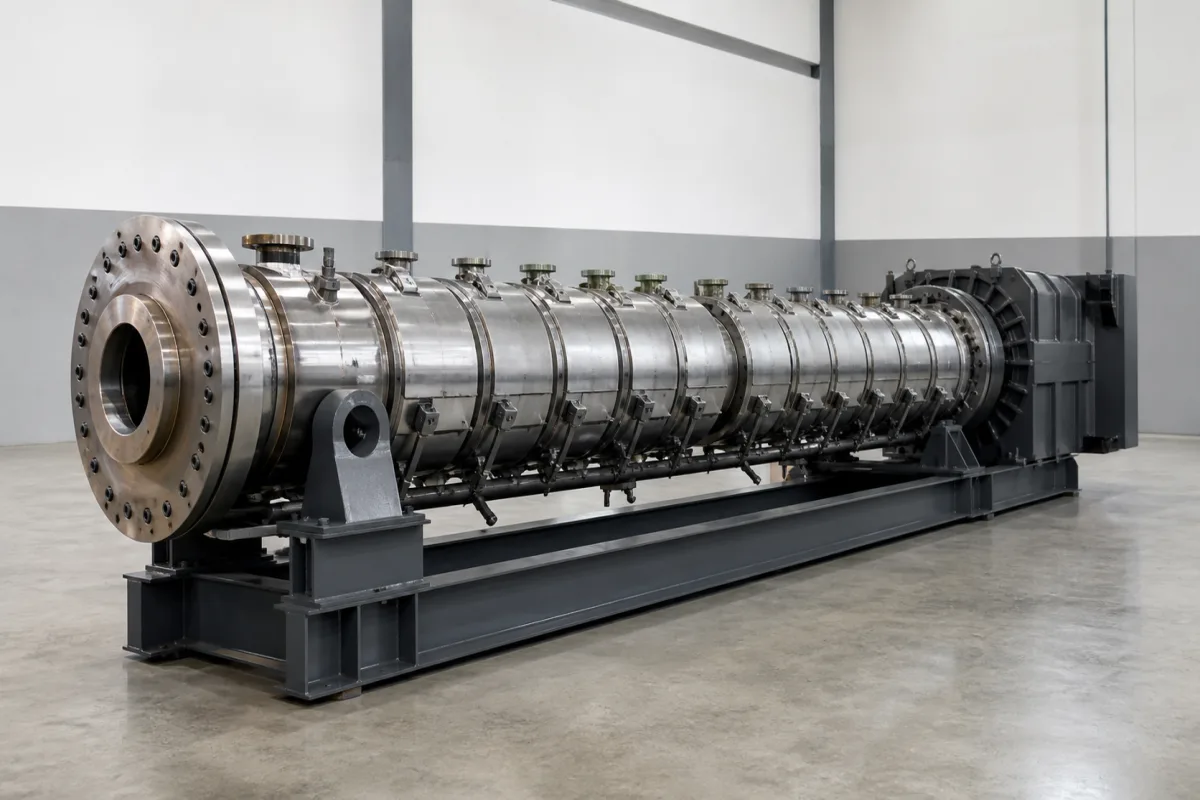
A canonical Barrel Assembly is characterized by the integration of Barrel Sections and Heating Bands. In industrial production environments, manufacturers listed on CNFX commonly emphasize Alloy Steel construction to support stable, high-cycle operation across diverse manufacturing scenarios.

The main housing component of an extrusion machine that contains and guides the material through the extrusion process.
Product Specifications

Technical details and manufacturing context for Barrel Assembly

Definition
In an Industrial Food Extrusion and Forming Machine, the Barrel Assembly serves as the primary structural housing that encloses the screw and provides the controlled environment for material processing. It typically consists of multiple barrel sections (often with heating/cooling zones) that are bolted together to form a continuous cylindrical chamber. The assembly guides food material from the feed zone through compression, melting, mixing, and metering zones under controlled temperature and pressure conditions before the material exits through the die.
Working Principle
The Barrel Assembly works in conjunction with the rotating screw to create a continuous flow channel for food materials. As the screw rotates within the barrel, it conveys, compresses, heats (through mechanical energy and/or external heating), mixes, and pressurizes the food material. The barrel's internal surface provides the necessary friction and containment to facilitate this process, while heating/cooling elements in the barrel walls maintain precise temperature control throughout different processing zones.
Common Materials
Alloy Steel, Nitrided Steel, Bimetallic Liners
Technical Parameters
  • Internal diameter of the barrel, typically ranging from 30mm to 300mm depending on machine capacity (mm) Standard Spec
Components / BOM
  • Barrel Sections
    Individual cylindrical segments that form the complete barrel assembly, often with different temperature zones
    Material: Alloy Steel
  • Heating Bands
    Electrical resistance heaters wrapped around barrel sections to provide precise temperature control
    Material: Stainless Steel with Ceramic Insulation
  • Cooling Jackets
    Water or oil circulating channels to remove excess heat from the barrel
    Material: Stainless Steel
  • Thermocouples
    Temperature sensors embedded in barrel walls for process monitoring and control
    Material: Stainless Steel with Thermocouple Wire
  • Flange Connections
    Bolted connections between barrel sections and to the feed housing/die adapter
    Material: Alloy Steel
  • Barrel Liners
    Wear-resistant inner surface that contacts the material, often replaceable
    Material: Nitrided Steel or Bimetallic Alloy
Engineering Reasoning
15-45 MPa internal pressure, 180-280°C barrel temperature, 0.1-1.5 m/s material flow velocity
Material yield strength exceeded at 55 MPa internal pressure, thermal degradation above 320°C barrel temperature, or wear exceeding 0.5 mm radial clearance
Design Rationale: Von Mises stress exceeding AISI 4140 steel yield strength (415 MPa), Arrhenius thermal degradation kinetics of polymer materials, abrasive wear following Archard's wear equation with K=2.5×10⁻⁵
Risk Mitigation (FMEA)
Trigger Insufficient barrel heating element power density (below 3 W/cm²)
Mode: Material viscosity increase causing torque overload (exceeding 850 N·m)
Strategy: Redundant heating circuits with PID control maintaining ±2°C tolerance
Trigger Misalignment exceeding 0.05 mm/m between barrel and screw
Mode: Asymmetric wear pattern reducing extrusion efficiency below 85%
Strategy: Laser-aligned mounting system with 0.01 mm/m precision and quarterly verification

Industry Taxonomies & Aliases

Commonly used trade names and technical identifiers for Barrel Assembly.

Industrial Ecosystem & Supply Chain DNA

Complementary Systems
Downstream Applications
Specialized Tooling

Application Fit & Sizing Matrix

Operational Limits
pressure: Up to 10,000 psi (689 bar) maximum operating pressure
flow rate: 0.1-500 kg/hr depending on barrel diameter and screw design
temperature: 50-400°C (typical extrusion range)
slurry concentration: Up to 70% solids by weight for abrasive slurries
Media Compatibility
✓ Thermoplastics (PP, PE, PVC) ✓ Food-grade polymers ✓ Ceramic pastes
Unsuitable: Highly corrosive acids (e.g., concentrated sulfuric acid)
Sizing Data Required
  • Material viscosity and shear sensitivity
  • Required throughput (kg/hr)
  • Barrel L/D ratio (length to diameter)

Reliability & Engineering Risk Analysis

Failure Mode & Root Cause
Bearing seizure
Cause: Inadequate lubrication leading to metal-to-metal contact, overheating, and eventual binding of rotating components.
Shaft misalignment fatigue
Cause: Improper installation or foundation settling causing uneven load distribution, resulting in cyclic stress cracks and eventual fracture.
Maintenance Indicators
  • Unusual high-frequency vibration or knocking sounds during operation
  • Visible oil leakage or discoloration around seals and joints
Engineering Tips
  • Implement precision laser alignment during installation and quarterly verification checks
  • Establish condition-based lubrication program using oil analysis to optimize intervals and detect contamination early

Compliance & Manufacturing Standards

Reference Standards
ISO 9001:2015 - Quality Management Systems ANSI B46.1 - Surface Texture (Surface Roughness, Waviness, and Lay) DIN 7184 - Hydraulic Cylinders - Barrel Assemblies
Manufacturing Precision
  • Bore Diameter: +/-0.02mm
  • Concentricity: 0.05mm TIR
Quality Inspection
  • Dimensional Verification with CMM
  • Pressure Testing (Hydrostatic/Pneumatic)

Factories Producing Barrel Assembly

Verified manufacturers with capability to produce this product in China

✓ 92% Supplier Capability Match Found

P Project Engineer from United States Jan 05, 2026
★★★★★
"Impressive build quality. Especially the technical reliability is very stable during long-term operation."
Technical Specifications Verified
S Sourcing Manager from United Arab Emirates Jan 02, 2026
★★★★★
"As a professional in the Machinery and Equipment Manufacturing sector, I confirm this Barrel Assembly meets all ISO standards."
Technical Specifications Verified
P Procurement Specialist from Australia Dec 30, 2025
★★★★★
"Standard OEM quality for Machinery and Equipment Manufacturing applications. The Barrel Assembly arrived with full certification."
Technical Specifications Verified
Verification Protocol

“Feedback is collected from verified sourcing managers during RFQ (Request for Quote) and factory evaluation processes on CNFX. These reports represent historical performance data and technical audit summaries from our B2B manufacturing network.”

19 sourcing managers are analyzing this specification now. Last inquiry for Barrel Assembly from Brazil (1h ago).

Supply Chain Compatible Machinery & Devices

Heavy-Duty CNC Plasma Cutting Machine

Industrial machine for precision metal cutting using plasma arc technology

Explore Specs →
Automated Assembly Line System

Integrated production system for sequential component assembly operations

Explore Specs →
Automated Powder Coating System

Integrated industrial system for applying dry powder coatings to metal substrates.

Explore Specs →
Centrifugal Pump Impeller

Rotating component that transfers energy to fluid in centrifugal pumps.

Explore Specs →

Frequently Asked Questions

What are the advantages of bimetallic liners in barrel assemblies?

Bimetallic liners combine wear-resistant inner surfaces with tough outer shells, extending barrel life, reducing downtime, and maintaining consistent material flow in high-abrasion extrusion applications.

How do heating bands and cooling jackets work together in barrel assemblies?

Heating bands maintain optimal melt temperatures while cooling jackets prevent overheating, ensuring precise thermal control throughout the extrusion process for consistent material viscosity and output quality.

What maintenance is required for barrel assemblies in continuous extrusion operations?

Regular inspection of liners for wear, monitoring thermocouple accuracy, checking flange connections for leaks, and maintaining proper cooling system function are essential for optimal performance and longevity.

Can I contact factories directly on CNFX?

CNFX is an open directory, not a transaction platform. Each factory profile provides direct contact information and production details to help you initiate direct inquiries with Chinese suppliers.

Get Quote for Barrel Assembly

Request technical pricing, lead times, or customized specifications for Barrel Assembly directly from verified manufacturing units.

Your business information is encrypted and only shared with verified Barrel Assembly suppliers.

Thank you! Your message has been sent. We'll respond within 1–3 business days.

Need to Manufacture Barrel Assembly?

Connect with verified factories specializing in this product category

Add Your Factory Contact Us
Previous Product
Barrel
Next Product
Barrel Liners