Industry-Verified Manufacturing Data (2026)

Thermocouples

Based on aggregated insights from multiple verified factory profiles within the CNFX directory, the standard Thermocouples used in the Machinery and Equipment Manufacturing sector typically supports operational capacities ranging from standard industrial configurations to heavy-duty production requirements.

Technical Definition & Core Assembly

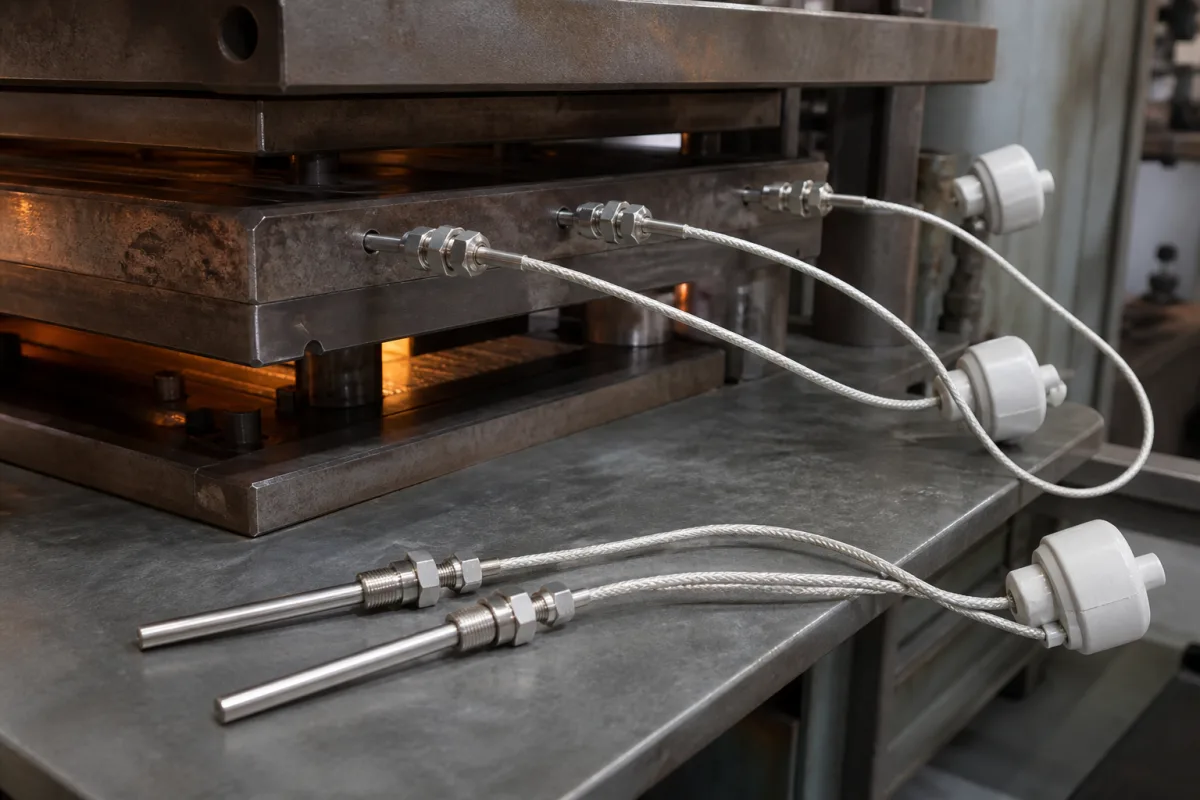
A canonical Thermocouples is characterized by the integration of Measuring Junction and Thermocouple Wires. In industrial production environments, manufacturers listed on CNFX commonly emphasize Nickel-Chromium/Nickel-Aluminum (Type K) construction to support stable, high-cycle operation across diverse manufacturing scenarios.

Temperature sensors that generate a voltage proportional to temperature difference, used for monitoring and controlling heat in heating platens.
Product Specifications

Technical details and manufacturing context for Thermocouples

Definition
Thermocouples are essential temperature sensing components integrated into heating platens. They consist of two dissimilar metal wires joined at one end (the measuring junction) that produce a small voltage when heated, which is proportional to the temperature difference between the measuring junction and the reference junction. In heating platens, thermocouples are strategically embedded to provide real-time temperature feedback to control systems, ensuring precise thermal management for processes like plastic molding, laminating, or metal forming.
Working Principle
Thermocouples operate on the Seebeck effect: when two dissimilar metals are joined at one end and exposed to a temperature gradient, a voltage (thermoelectric EMF) is generated. This voltage is measured and converted to a temperature reading by the control system, enabling closed-loop temperature regulation in the heating platen.
Common Materials
Nickel-Chromium/Nickel-Aluminum (Type K), Iron/Constantan (Type J), Platinum-Rhodium/Platinum (Type S/R)
Technical Parameters
  • Temperature measurement range, typically from -200°C to +1300°C depending on thermocouple type. (°C) Standard Spec
Components / BOM
  • Measuring Junction
    Point where two dissimilar metal wires are joined; exposed to the temperature being measured.
    Material: Depends on thermocouple type (e.g., chromel-alumel for Type K)
  • Thermocouple Wires
    Conduct the generated voltage from the measuring junction to the reference junction/connector.
    Material: Two dissimilar metal alloys (e.g., nickel-chromium and nickel-aluminum)
  • Protective Sheath
    Insulates and protects the thermocouple wires from the environment, chemicals, or mechanical damage.
    Material: Stainless steel, Inconel, or ceramic
  • Connector/Terminal Head
    Provides electrical connection to the temperature controller or transmitter.
    Material: Plastic, aluminum, or stainless steel
Engineering Reasoning
-200°C to 2300°C
Seebeck coefficient deviation exceeding ±0.75% of nominal value at 100°C reference junction
Design Rationale: Thermoelectric inhomogeneity in the conductor due to grain boundary oxidation at temperatures above 500°C, causing localized Seebeck coefficient variations along the wire length
Risk Mitigation (FMEA)
Trigger Thermal cycling between 20°C and 800°C at rates exceeding 10°C/s
Mode: Type K thermocouple EMF output drift of 15μV/°C from calibration curve
Strategy: Annealing at 1100°C for 1 hour after cold working to stabilize grain structure
Trigger Atmospheric sulfur concentration exceeding 50 ppm at 600°C operating temperature
Mode: Chromel leg embrittlement and fracture at bend radii below 5mm
Strategy: Molybdenum disilicide (MoSi2) protective sheath with 0.5mm wall thickness

Industry Taxonomies & Aliases

Commonly used trade names and technical identifiers for Thermocouples.

Applied To / Applications

This component is essential for the following industrial systems and equipment:

Industrial Ecosystem & Supply Chain DNA

Complementary Systems
Downstream Applications
Specialized Tooling

Application Fit & Sizing Matrix

Operational Limits
pressure: Typically up to 1000 bar (depends on sheath material and construction)
other spec: Response time: 0.1 to 10 seconds (depends on sheath diameter and construction)
temperature: -200°C to +1800°C (depending on thermocouple type)
Media Compatibility
✓ Molten metals (aluminum, zinc) ✓ High-temperature gases (furnace atmospheres) ✓ Industrial heating fluids (thermal oils, steam)
Unsuitable: Strong oxidizing or reducing atmospheres without proper sheath protection
Sizing Data Required
  • Required temperature measurement range
  • Process pressure conditions
  • Required response time/thermal mass considerations

Reliability & Engineering Risk Analysis

Failure Mode & Root Cause
Thermocouple Drift
Cause: Gradual changes in thermoelectric properties due to metallurgical changes, contamination, or oxidation from prolonged exposure to high temperatures, leading to inaccurate temperature readings.
Open Circuit Failure
Cause: Breakage or separation of thermocouple wires due to mechanical stress, vibration, thermal cycling, or corrosion, resulting in loss of signal.
Maintenance Indicators
  • Erratic or unstable temperature readings on the control system display or data logger.
  • Visible physical damage such as cracked insulation, exposed wires, or a bent or broken thermocouple sheath.
Engineering Tips
  • Ensure proper installation with adequate mechanical support and strain relief to minimize vibration and thermal stress on the thermocouple junction and leads.
  • Select thermocouple type and sheath material compatible with the process environment (temperature, chemical exposure) and use protective thermowells where possible to shield from direct contact with harsh media.

Compliance & Manufacturing Standards

Reference Standards
ASTM E230/E230M-23: Standard Specification and Temperature-Electromotive Force (EMF) Tables for Standardized Thermocouples IEC 60584-1: Thermocouples - Part 1: EMF specifications and tolerances ANSI MC96.1-1982: Temperature Measurement Thermocouples
Manufacturing Precision
  • Wire diameter: +/-0.02mm for standard tolerance class
  • EMF output: +/-1.5°C or +/-0.4% of temperature (whichever is greater) for Type K thermocouples
Quality Inspection
  • Calibration verification against NIST-traceable standards
  • Insulation resistance test (typically >100 MΩ at 500VDC)

Factories Producing Thermocouples

Verified manufacturers with capability to produce this product in China

✓ 95% Supplier Capability Match Found

P Project Engineer from Brazil Feb 22, 2026
★★★★★
"Great transparency on the Thermocouples components. Essential for our Machinery and Equipment Manufacturing supply chain."
Technical Specifications Verified
S Sourcing Manager from Canada Feb 19, 2026
★★★★★
"The Thermocouples we sourced perfectly fits our Machinery and Equipment Manufacturing production line requirements."
Technical Specifications Verified
P Procurement Specialist from United States Feb 16, 2026
★★★★★
"Found 57+ suppliers for Thermocouples on CNFX, but this spec remains the most cost-effective."
Technical Specifications Verified
Verification Protocol

“Feedback is collected from verified sourcing managers during RFQ (Request for Quote) and factory evaluation processes on CNFX. These reports represent historical performance data and technical audit summaries from our B2B manufacturing network.”

15 sourcing managers are analyzing this specification now. Last inquiry for Thermocouples from Turkey (1h ago).

Supply Chain Compatible Machinery & Devices

Heavy-Duty CNC Plasma Cutting Machine

Industrial machine for precision metal cutting using plasma arc technology

Explore Specs →
Automated Assembly Line System

Integrated production system for sequential component assembly operations

Explore Specs →
Automated Powder Coating System

Integrated industrial system for applying dry powder coatings to metal substrates.

Explore Specs →
Centrifugal Pump Impeller

Rotating component that transfers energy to fluid in centrifugal pumps.

Explore Specs →

Frequently Asked Questions

What is the difference between Type K, Type J, and Type S/R thermocouples for machinery manufacturing?

Type K (Nickel-Chromium/Nickel-Aluminum) offers wide temperature range and general-purpose use, Type J (Iron/Constantan) is cost-effective for lower temperatures, and Type S/R (Platinum-Rhodium/Platinum) provides high accuracy and stability for extreme temperatures in precision equipment.

How do thermocouples help control heating platen temperatures in manufacturing equipment?

Thermocouples generate voltage proportional to temperature differences, enabling real-time monitoring of heating platens. This allows automated control systems to maintain optimal temperatures for processes like plastic molding, metal forming, or composite curing, ensuring consistent product quality and energy efficiency.

What factors should I consider when selecting a protective sheath for industrial thermocouples?

Consider temperature range, chemical exposure, mechanical stress, and installation environment. Common sheath materials include stainless steel for general use, Inconel for high temperatures, and ceramic for corrosive environments. Proper sheath selection extends sensor life and maintains measurement accuracy in harsh manufacturing conditions.

Can I contact factories directly on CNFX?

CNFX is an open directory, not a transaction platform. Each factory profile provides direct contact information and production details to help you initiate direct inquiries with Chinese suppliers.

Get Quote for Thermocouples

Request technical pricing, lead times, or customized specifications for Thermocouples directly from verified manufacturing units.

Your business information is encrypted and only shared with verified Thermocouples suppliers.

Thank you! Your message has been sent. We'll respond within 1–3 business days.

Need to Manufacture Thermocouples?

Connect with verified factories specializing in this product category

Add Your Factory Contact Us
Previous Product
Thermocouple/RTD Sensor
Next Product
Thermowell