Industry-Verified Manufacturing Data (2026)

Barrel Liners

Based on aggregated insights from multiple verified factory profiles within the CNFX directory, the standard Barrel Liners used in the Machinery and Equipment Manufacturing sector typically supports operational capacities ranging from standard industrial configurations to heavy-duty production requirements.

Technical Definition & Core Assembly

A canonical Barrel Liners is characterized by the integration of Wear-resistant inner surface layer and Structural backing. In industrial production environments, manufacturers listed on CNFX commonly emphasize Bimetallic alloys (stellite/cobalt-based) construction to support stable, high-cycle operation across diverse manufacturing scenarios.

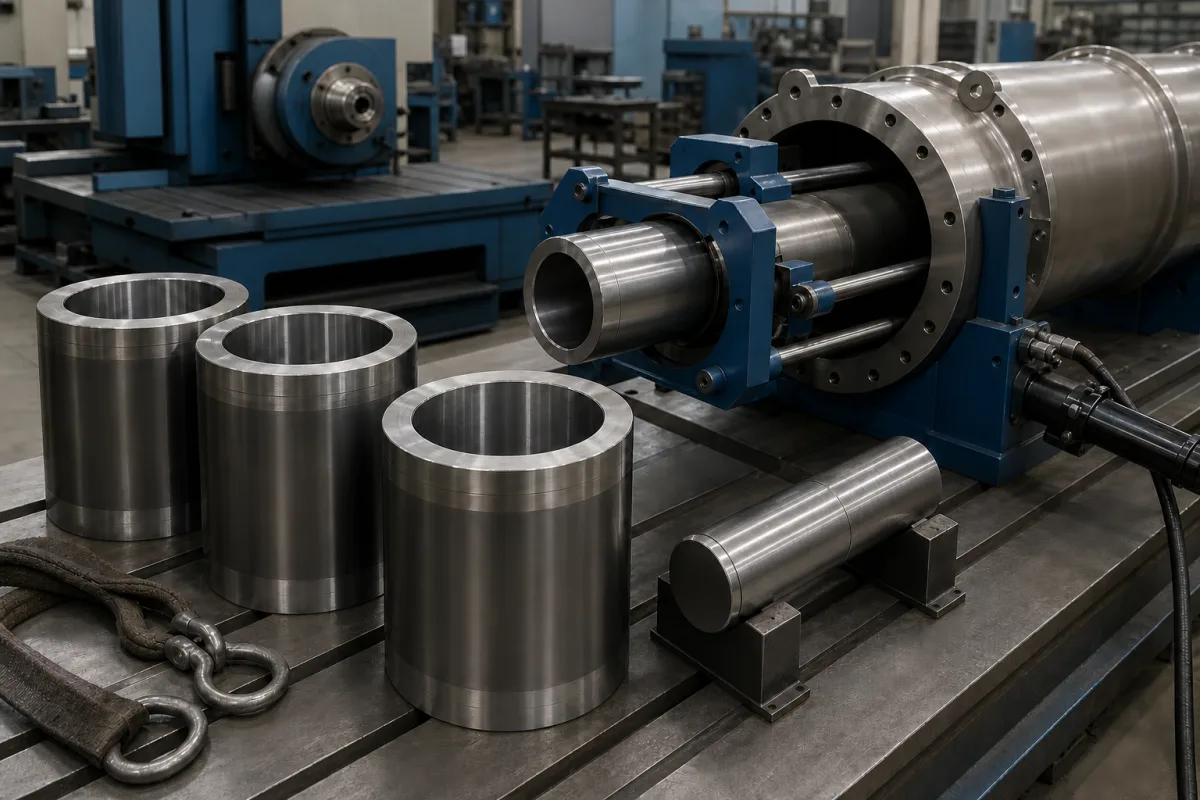
Replaceable cylindrical sleeves that form the inner surface of extrusion or injection molding barrels.
Product Specifications

Technical details and manufacturing context for Barrel Liners

Definition
Barrel liners are critical wear components installed inside the barrel assembly of plastic processing machinery such as extruders and injection molding machines. They provide a durable, smooth inner surface that guides and contains the plastic material as it's conveyed, melted, and pressurized. Liners protect the main barrel body from abrasion, corrosion, and thermal degradation while maintaining precise dimensional tolerances for consistent processing.
Working Principle
Barrel liners function as sacrificial wear surfaces that directly contact the plastic material during processing. They withstand continuous friction from the rotating screw, high pressure (up to 300+ bar), and elevated temperatures (typically 150-350°C). The liner's smooth bore ensures consistent material flow while its wear-resistant properties maintain dimensional stability over thousands of operating hours. When worn beyond tolerance, liners can be replaced without replacing the entire barrel assembly.
Common Materials
Bimetallic alloys (stellite/cobalt-based), Nitrided steel, Tool steel with hard chrome plating, Ceramic-metal composites
Technical Parameters
  • Inner diameter tolerance typically ±0.05mm to ±0.10mm for precision applications (mm) Customizable
Components / BOM
  • Wear-resistant inner surface layer
    Provides abrasion and corrosion resistance against plastic compounds and additives
    Material: Cobalt-based alloy or nitrided layer
  • Structural backing
    Supports the wear layer and transfers thermal/mechanical loads to barrel
    Material: Carbon steel or alloy steel
  • Cooling channels (if applicable)
    Facilitates heat transfer for temperature control in barrel zones
    Material: Steel with precision machined passages
Engineering Reasoning
15-250 MPa pressure, 150-350°C temperature, 0.1-1.5 m/s surface velocity
Material yield strength exceeded at 450 MPa compressive stress, or 600°C thermal degradation threshold
Design Rationale: Thermal fatigue from cyclic heating/cooling (ΔT > 200°C) causing microcrack propagation via Paris' Law (da/dN = C(ΔK)^m), compounded by abrasive wear from Archard's equation (V = K*W*s/H)
Risk Mitigation (FMEA)
Trigger Polymer degradation at barrel temperatures exceeding 400°C
Mode: Carbon deposit buildup increasing friction coefficient from 0.15 to 0.45
Strategy: Integrate platinum-catalyzed bimetallic lining with thermal conductivity of 45 W/m·K
Trigger Misalignment exceeding 0.05 mm/mm between screw and liner
Mode: Concentrated wear reducing liner thickness below 2.5 mm minimum
Strategy: Laser-guided alignment system with 0.001 mm precision and hydrodynamic bearing design

Industry Taxonomies & Aliases

Commonly used trade names and technical identifiers for Barrel Liners.

Applied To / Applications

This component is essential for the following industrial systems and equipment:

Industrial Ecosystem & Supply Chain DNA

Complementary Systems
Downstream Applications
Specialized Tooling

Application Fit & Sizing Matrix

Operational Limits
pressure: Up to 30,000 psi (2,070 bar) for high-pressure applications
flow rate: 0.1 to 500 kg/hr (process dependent)
temperature: -40°C to 400°C (depending on material grade)
slurry concentration: Up to 70% solids by weight (abrasion-resistant grades)
Media Compatibility
✓ Polymer melts (PE, PP, PVC) ✓ Food-grade compounds (FDA-approved liners) ✓ Engineering plastics with fillers (glass, carbon fiber)
Unsuitable: Highly corrosive chemicals (concentrated acids, strong oxidizers)
Sizing Data Required
  • Barrel inner diameter (ID) and length
  • Required wear resistance (abrasion index of processed material)
  • Thermal expansion coefficient matching with barrel housing

Reliability & Engineering Risk Analysis

Failure Mode & Root Cause
Abrasive Wear
Cause: Continuous contact with hard particulate materials in the processed media, leading to material removal and thinning of the liner surface.
Thermal Fatigue Cracking
Cause: Cyclic heating and cooling during operation causing expansion/contraction stresses that exceed the material's fatigue limit, resulting in crack initiation and propagation.
Maintenance Indicators
  • Visible material thinning or localized wear patterns observed during inspection
  • Unusual grinding or scraping noises during operation indicating liner contact with moving components
Engineering Tips
  • Implement regular thickness monitoring using ultrasonic testing to track wear rates and schedule replacements before failure
  • Optimize operating parameters to minimize thermal cycling and ensure proper material compatibility with processed media

Compliance & Manufacturing Standards

Reference Standards
ISO 9001:2015 (Quality Management Systems) ASTM A276/A276M-17 (Standard Specification for Stainless Steel Bars and Shapes) CE Marking (EU Machinery Directive 2006/42/EC)
Manufacturing Precision
  • Bore Diameter: +/-0.01mm
  • Surface Roughness: Ra ≤ 0.4μm
Quality Inspection
  • Dimensional Verification with CMM (Coordinate Measuring Machine)
  • Hardness Testing (Rockwell C Scale)

Factories Producing Barrel Liners

Verified manufacturers with capability to produce this product in China

✓ 97% Supplier Capability Match Found

P Project Engineer from Canada Jan 09, 2026
★★★★★
"As a professional in the Machinery and Equipment Manufacturing sector, I confirm this Barrel Liners meets all ISO standards."
Technical Specifications Verified
S Sourcing Manager from United States Jan 06, 2026
★★★★★
"Standard OEM quality for Machinery and Equipment Manufacturing applications. The Barrel Liners arrived with full certification."
Technical Specifications Verified
P Procurement Specialist from United Arab Emirates Jan 03, 2026
★★★★★
"Great transparency on the Barrel Liners components. Essential for our Machinery and Equipment Manufacturing supply chain."
Technical Specifications Verified
Verification Protocol

“Feedback is collected from verified sourcing managers during RFQ (Request for Quote) and factory evaluation processes on CNFX. These reports represent historical performance data and technical audit summaries from our B2B manufacturing network.”

15 sourcing managers are analyzing this specification now. Last inquiry for Barrel Liners from USA (1h ago).

Supply Chain Compatible Machinery & Devices

Hydraulic Press

Industrial machine using hydraulic pressure to compress, form, or assemble materials

Explore Specs →
Heavy-Duty CNC Plasma Cutting Machine

Industrial machine for precision metal cutting using plasma arc technology

Explore Specs →
Automated Assembly Line System

Integrated production system for sequential component assembly operations

Explore Specs →
Automated Powder Coating System

Integrated industrial system for applying dry powder coatings to metal substrates.

Explore Specs →

Frequently Asked Questions

What materials are best for high-wear barrel liners in extrusion machinery?

Bimetallic alloys (stellite/cobalt-based) and ceramic-metal composites offer superior wear resistance for high-temperature extrusion applications, extending barrel life and reducing downtime.

How do cooling channels affect barrel liner performance in injection molding?

Integrated cooling channels in barrel liners help maintain precise temperature control, preventing material degradation and improving cycle consistency in injection molding processes.

What are the key specifications to consider when replacing barrel liners?

Critical specs include inner diameter tolerance, hardness rating (HRC), thermal conductivity, and compatibility with your barrel's structural backing and existing mounting systems.

Can I contact factories directly on CNFX?

CNFX is an open directory, not a transaction platform. Each factory profile provides direct contact information and production details to help you initiate direct inquiries with Chinese suppliers.

Get Quote for Barrel Liners

Request technical pricing, lead times, or customized specifications for Barrel Liners directly from verified manufacturing units.

Your business information is encrypted and only shared with verified Barrel Liners suppliers.

Thank you! Your message has been sent. We'll respond within 1–3 business days.

Need to Manufacture Barrel Liners?

Connect with verified factories specializing in this product category

Add Your Factory Contact Us
Previous Product
Barrel Assembly
Next Product
Base Unit / Drive