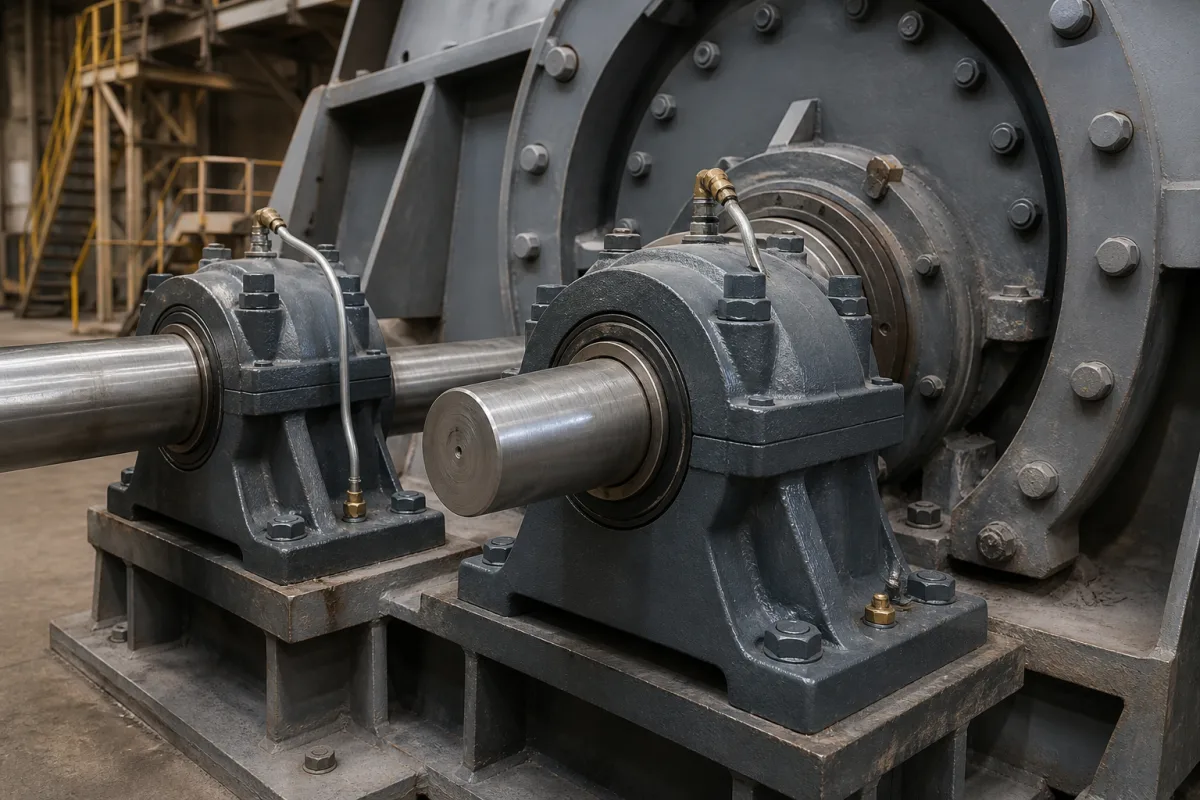
Heavy-duty split bearing housings for crushers, mills and other shock-loaded machinery
Heavy-duty split bearing housings for crushers, mills and conveyor drive pulleys · four-bolt caps, safe load by load angle, cast iron versus cast steel, shafts up to 20 in and beyond
A heavy-duty split bearing housing is a horizontally split cast block with a four-bolt cap and a four-bolt base, built round a spherical roller bearing for machines whose loads are large, shock-laden or not directed straight into the foundation: crushers, hammer mills, kilns, ball mills, steel-mill equipment and conveyor drive pulleys. Three decisions set the housing: which way and how hard the load acts on the cap and bolts, whether grey cast iron is enough or cast steel or ductile iron is needed, and how the shaft is located, sealed and lubricated in dirty plant.
Heavy-duty split housings of the SDAF, SDAFS, SDJ and extended-range types for spherical roller bearings on shafts from about 4 in (100 mm) upward, used on crushers, mills, kilns and conveyor drive pulleys. Standard split plummer block housings of the SNL/SNV type and one-piece mounted units with ball-bearing inserts are covered on the Pillow block housing page.
CNFX editorial research · Sources checked October 12, 2026 · 3 sources
Read the safe load for the angle at which the crusher load hits the cap
SKF publishes recommended safe loads for its split pillow blocks at five load angles, P 60° to P 180°, set with a safety factor of 5 against base fracture and a minimum factor of 2 against cap bolt yield. [1] Timken's SAF catalogue gives its load ratings for loads directed toward the base of the pillow block and asks for engineering review if the housing is mounted so the load can act in any other direction. [2]
Values are recommended safe loads in pounds force from SKF's inch split pillow block tables. [1] SKF notes that a higher safe load can be reached on cast-iron SDAF housings with cap bolts of SAE grade 5 or higher, after consulting its applications engineering. [1]
SKF recommends doweling the housing to its mounting surface, or providing shear blocks, when the load acts between 60° and 120° or when the axial load exceeds 25% of the P 180° value; for a purely axial force the load on the casting should not exceed 65% of P 180°. [1] Editorial calculation for an SDAF 240 in cast iron: 25% of 60,000 lbf is 15,000 lbf of axial load before doweling is advised, and 65% is 39,000 lbf for a pure axial load; 60,000 lbf is about 267 kN (× 4.448 N/lbf).
For its largest extended-range SDAF housings (shafts of 10 to 20 in), SKF gives safe loads in class 40 cast iron to ASTM A48B, from 294,000 lbf at P 60° for the 3152/3248 size up to 1,050,000 lbf for the 3096/3184/3280 size, and notes that with load straight through the base the capacity depends solely on the bearing. [1]
SKF housing
P 60°
P 90°
P 120°
P 150°
P 180°
Cap bolts, torque, SAE grade
SDAF 222 (cast iron)
51,770
31,000
19,600
17,600
21,200
4 × 7/8-9, 165 ft-lbf, grade 2
SDAFS 222 (cast steel)
81,830
49,000
30,500
27,500
33,500
4 × 7/8-9, 600 ft-lbf, grade 8
SDAF 240 (cast iron)
150,300
90,000
56,000
50,000
60,000
4 × 1 1/4-7, 500 ft-lbf, grade 2
SDAFS 240 (cast steel)
238,810
143,000
88,000
80,000
95,000
4 × 1 1/4-7, 1,820 ft-lbf, grade 8
Give the supplier the load magnitude and its direction relative to the base, the axial load, shock or out-of-balance loads from the crusher or mill, and how the housing is fixed to the frame.
02
Move from grey cast iron to cast steel or ductile iron for shock
Editorial calculation from the table above: the cast-steel SDAFS 222 and SDAFS 240 carry about 1.58 times the P 180° safe load of the same cast-iron SDAF size (33,500 / 21,200 and 95,000 / 60,000); across all sizes SKF lists in both materials the ratio runs from 1.48 (size 226) to 1.62 (size 244), and their grade-8 cap bolts are tightened to 600 and 1,820 ft-lbf instead of 165 and 500 ft-lbf. [1]
SKF describes the SDAF as designed for heavy thrust loads and shock, with a four-bolt cap and four-bolt base of rugged proportions, caps tapped for lifting eyes, shaft sizes from 3 15/16 in to 9 9/16 in, triple-ring seals as standard, and taconite seals or end plugs as options; it lists the housings in cast iron (SDAF), cast steel (SDAFS) and ductile iron (SDAFD). Among split pillow block applications it names crushers, hammer mills and kilns. [1]
Timken makes its SAF and SDAF caps and bases from stress-relieved cast iron, with cast steel available (SDAFS), and suggests the larger SDAF block for extreme-duty applications. Caps and bases are doweled together early in manufacture and machined as a pair, so they are not interchangeable as separate parts. Its standard range covers 35 to 300 mm shafts, with special sizes to 1,000 mm and beyond for uses such as ball mills. [2]
HOLK describes its SDJ series as very large heavy-duty split housings with a heavily ribbed lower half that takes load at right angles to the foundation surface, intended for spherical roller bearings of the 231 series on adapter sleeves, for grease lubrication, and offered in grey cast iron (SDJC), ductile iron (SDJD) and cast steel (SDJS); it names crusher, cement and steel-industry use and states a maximum housing fabrication capability of 5 tons per piece. [3]
03
Fix or float the bearing, close the shaft end and seal against abrasive dust
In Timken's split blocks a stabilizing ring between the bearing outer ring and the housing shoulder makes a fixed unit; without it the bearing can float axially by up to 3/8 in to absorb thermal expansion of the shaft. Housings ordered by catalogue number are fixed units, with float units ordered by suffix. [2]
Where the shaft ends inside the housing, Timken suggests at least 1/8 in clearance between shaft end and closure at maximum thermal expansion. Its blocks take grease or oil-bath lubrication and can be adapted to circulating oil or oil-air mist; triple-ring labyrinth seals are standard, the base has large oil return holes under the seal grooves, and DUSTAC seals are offered where dust or abrasive material is beyond what a labyrinth keeps out. The bearings allow ±1.5° misalignment. [2]
Timken recommends direct straight-bore mounting on a shouldered shaft where heavy thrust or exact axial location is needed, and adapter mounting on plain shafting otherwise; for heavy shock, vibration or unbalanced rotating loads it asks for engineering review. [2]
04
Data for a heavy-duty split housing enquiry
Paste it into your enquiry below or into an email to a maker, then replace every bracket.
Machine: [crusher, hammer mill, kiln, ball mill, conveyor drive pulley]
Shaft: [diameter; adapter or straight bore; fixed or float position]
Bearing: [series, e.g. 222, 231, 232]
Load: [radial and axial magnitude; direction relative to base; shock]
Material: [grey cast iron, ductile iron, cast steel]
Mounting: [bolt pattern; dowels or shear blocks]
Sealing and lubrication: [labyrinth, taconite, contact; grease, oil bath, circulating oil]
Extras: [lifting eyes; end cover; sensor holes]
2 companies list this product among what they make. Company figures are quoted from each
company's own website; every card states where the relationship came from.
HOLK Bearing Co., Ltd.
Manufacturing site to be confirmed for the order
Lists SDJ heavy-duty split plummer block housings (SDJC grey iron, SDJD ductile iron, SDJS cast steel) for crusher, cement and steel-industry use, alongside SN, SNL and SD series housings.
Explore company information and manufacturing capabilities, then discuss the scope of your project with a relevant supplier.
Share this page
Compiled and source-reviewed by the CNFX editorial team.
Each manufacturer above links to the page on that company's own website where the product is listed, with the date we checked it. How we source and review
· Page last updated 13 October 2026
Buyer questions
How much load can a heavy-duty split housing take sideways?
It depends on angle and material: SKF lists 17,600 lbf at P 150° for a cast-iron SDAF 222 and 27,500 lbf for the cast-steel SDAFS 222, against 51,770 and 81,830 lbf at P 60°. [1]
When should the housing be doweled to its base?
SKF recommends dowels or shear blocks when the load acts between 60° and 120° or the axial load exceeds 25% of the P 180° value. [1]
Can a cap from one split housing be used on another base?
No. Timken and SKF machine cap and base as a doweled, mated pair that is not interchangeable. [2][1]
Sources and what still needs a direct check
Sources checked 2026-10-12. Safe loads, cap bolt data and material versions come from SKF's split pillow block (inch series) catalogue section; construction, fixed and float units and sealing from Timken's SAF split-block housed unit catalogue; the SDJ description from HOLK's product page.