Industry-Verified Manufacturing Data (2026)

Main Crushing Rollers

Based on aggregated insights from multiple verified factory profiles within the CNFX directory, the standard Main Crushing Rollers used in the Food Manufacturing sector typically supports operational capacities ranging from standard industrial configurations to heavy-duty production requirements.

Technical Definition & Core Assembly

A canonical Main Crushing Rollers is characterized by the integration of Roller Shell/Body and Shaft/Journals. In industrial production environments, manufacturers listed on CNFX commonly emphasize Alloy Steel construction to support stable, high-cycle operation across diverse manufacturing scenarios.

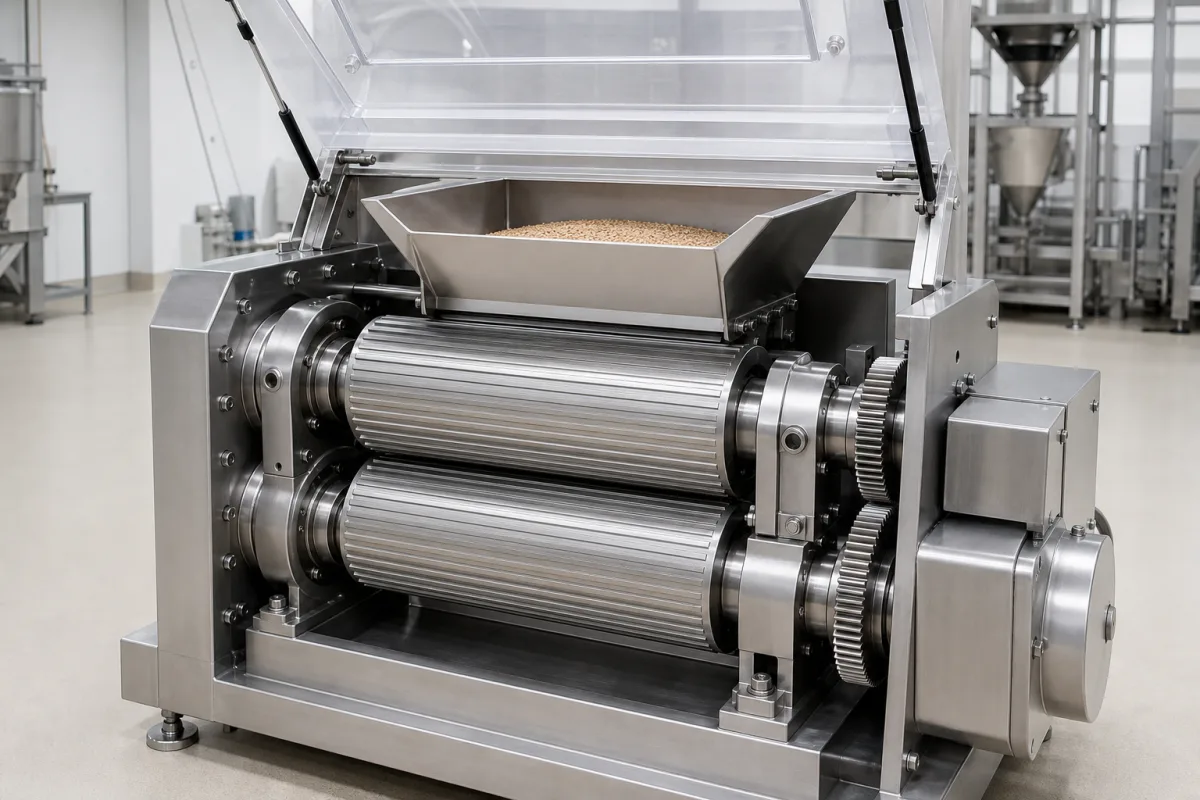
The primary crushing mechanism in an industrial oilseed flaking mill that applies compressive force to break oilseeds into smaller particles.
Product Specifications

Technical details and manufacturing context for Main Crushing Rollers

Definition
Main Crushing Rollers are the core mechanical components in an Industrial Oilseed Flaking Mill responsible for the initial size reduction of oilseeds (such as soybeans, canola, sunflower seeds). They consist of two counter-rotating, heavy-duty rollers that apply high pressure to crush the seeds, rupturing their cellular structure to facilitate oil extraction in subsequent processing stages. Their precise gap setting and surface texture are critical for achieving optimal particle size and flake quality.
Working Principle
Oilseeds are fed into the nip (gap) between two parallel, counter-rotating rollers. The rollers, driven by a motor and gear system, rotate towards each other. As seeds pass through the adjustable gap, they are subjected to intense compressive and shearing forces, which crush and flatten them. The gap width controls the final particle/flake thickness, directly impacting oil yield and extraction efficiency.
Common Materials
Alloy Steel, Chilled Cast Iron
Technical Parameters
  • Roller diameter and working length, defining the crushing capacity and throughput of the mill. (mm) Standard Spec
Components / BOM
  • Roller Shell/Body
    The main cylindrical body that makes contact with and crushes the oilseeds. Often has a hardened or specially textured surface.
    Material: Alloy Steel or Chilled Cast Iron
  • Shaft/Journals
    The central axle on which the roller rotates, supported by bearings within the mill housing. Transmits torque from the drive system.
    Material: Forged Steel
  • Bearing Housings
    Houses the bearings that support the roller shafts, allowing smooth rotation and accommodating axial/radial loads.
    Material: Cast Iron or Steel
  • Gap Adjustment Mechanism
    A system (often using hydraulic cylinders or screw jacks) to precisely set and maintain the nip gap between the two rollers.
    Material: Steel
Engineering Reasoning
15-35 MPa compressive stress at roller surface
Material yield strength exceeded at 42 MPa compressive stress (for forged alloy steel 34CrNiMo6)
Design Rationale: Hertzian contact stress exceeding material fatigue limit (S-N curve for 34CrNiMo6 steel at 10^7 cycles: 580 MPa), leading to subsurface crack initiation and spalling
Risk Mitigation (FMEA)
Trigger Seed contamination with tramp metal (Mohs hardness >7)
Mode: Surface pitting and micro-spalling on roller face
Strategy: Installation of in-line electromagnetic separators with 0.5T magnetic field strength upstream of feed hopper
Trigger Thermal gradient exceeding 150°C across roller diameter during operation
Mode: Differential thermal expansion causing circumferential cracking
Strategy: Implementation of closed-loop cooling system maintaining surface temperature at 65±5°C with water-glycol mixture at 3 m/s flow velocity

Industry Taxonomies & Aliases

Commonly used trade names and technical identifiers for Main Crushing Rollers.

Industrial Ecosystem & Supply Chain DNA

Complementary Systems
Downstream Applications
Specialized Tooling

Application Fit & Sizing Matrix

Operational Limits
pressure: Up to 300 MPa (43,500 psi) compressive force at roller surface
flow rate: 10-100 tons/hour oilseed throughput, depending on roller diameter and gap setting
temperature: Ambient to 80°C (176°F) - limited by bearing lubrication and material thermal expansion
slurry concentration: Not applicable - dry material processing only (max moisture content 12%)
Media Compatibility
✓ Soybeans ✓ Canola/Rapeseed ✓ Sunflower seeds
Unsuitable: High-moisture or sticky materials (e.g., wet grains, fibrous biomass with >15% moisture)
Sizing Data Required
  • Required throughput capacity (tons/hour)
  • Seed type and initial particle size distribution
  • Desired final flake thickness/gap setting

Reliability & Engineering Risk Analysis

Failure Mode & Root Cause
Fatigue cracking
Cause: Cyclic loading from irregular feed material and impact forces, leading to stress concentration at weld joints or material imperfections.
Surface spalling and material degradation
Cause: Abrasive wear from hard, sharp feed materials combined with insufficient hardness or inadequate wear protection on roller surfaces.
Maintenance Indicators
  • Unusual vibration or knocking sounds during operation indicating imbalance or internal damage
  • Visible surface cracks, pitting, or excessive material loss on roller faces
Engineering Tips
  • Implement regular ultrasonic thickness testing and vibration analysis to detect early fatigue and wear patterns
  • Apply hard-facing or specialized wear-resistant coatings to high-impact zones and maintain proper material feed consistency to reduce shock loading

Compliance & Manufacturing Standards

Reference Standards
ISO 12100:2010 - Safety of machinery ASTM A36/A36M-19 - Standard Specification for Carbon Structural Steel CE Marking - Machinery Directive 2006/42/EC
Manufacturing Precision
  • Bore diameter: +/-0.02mm
  • Surface hardness variation: +/-2 HRC
Quality Inspection
  • Ultrasonic Testing (UT) for internal defects
  • Dimensional verification with coordinate measuring machine (CMM)

Factories Producing Main Crushing Rollers

Verified manufacturers with capability to produce this product in China

✓ 96% Supplier Capability Match Found

P Project Engineer from Australia Jan 29, 2026
★★★★★
"The technical documentation for this Main Crushing Rollers is very thorough, especially regarding technical reliability."
Technical Specifications Verified
S Sourcing Manager from Singapore Jan 26, 2026
★★★★★
"Reliable performance in harsh Food Manufacturing environments. No issues with the Main Crushing Rollers so far."
Technical Specifications Verified
P Procurement Specialist from Germany Jan 23, 2026
★★★★★
"Testing the Main Crushing Rollers now; the technical reliability results are within 1% of the laboratory datasheet."
Technical Specifications Verified
Verification Protocol

“Feedback is collected from verified sourcing managers during RFQ (Request for Quote) and factory evaluation processes on CNFX. These reports represent historical performance data and technical audit summaries from our B2B manufacturing network.”

12 sourcing managers are analyzing this specification now. Last inquiry for Main Crushing Rollers from USA (1h ago).

Supply Chain Compatible Machinery & Devices

Automated Food Packaging Integrity Tester

Automated system for non-destructive testing of food package seals and integrity.

Explore Specs →
Automated Food Moisture Analyzer

Automated system for precise moisture content measurement in food products

Explore Specs →
Automated Food Color Consistency Analyzer

Automated inline system for real-time color measurement and consistency control in food processing.

Explore Specs →
Control Panel

A centralized interface for monitoring and controlling industrial equipment and processes

Explore Specs →

Frequently Asked Questions

What materials are used for main crushing rollers in food manufacturing?

Main crushing rollers are typically constructed from alloy steel or chilled cast iron, chosen for their durability, compressive strength, and resistance to wear in continuous oilseed processing applications.

How do main crushing rollers function in an oilseed flaking mill?

These rollers apply precise compressive force to break oilseeds into smaller particles, serving as the primary crushing mechanism that prepares seeds for further processing in oil extraction systems.

What components make up a main crushing roller assembly?

Key components include the roller shell/body, shaft/journals, bearing housings, and gap adjustment mechanism, which work together to ensure consistent crushing performance and operational control.

Can I contact factories directly on CNFX?

CNFX is an open directory, not a transaction platform. Each factory profile provides direct contact information and production details to help you initiate direct inquiries with Chinese suppliers.

Get Quote for Main Crushing Rollers

Request technical pricing, lead times, or customized specifications for Main Crushing Rollers directly from verified manufacturing units.

Your business information is encrypted and only shared with verified Main Crushing Rollers suppliers.

Thank you! Your message has been sent. We'll respond within 1–3 business days.

Need to Manufacture Main Crushing Rollers?

Connect with verified factories specializing in this product category

Add Your Factory Contact Us
Previous Product
Intelligent Food Grade Metal Detector
Next Product
Main Roller Assembly