Pulse-Jet Cleaning System
View system integration details
This page explains how Blow Pipe is classified within Machinery and Equipment Manufacturing. Technical values and manufacturer relationships are research references; confirm the current specification and supplier evidence for each order.
A tubular component in pulse-jet cleaning systems that directs compressed air pulses into filter bags to dislodge accumulated dust.
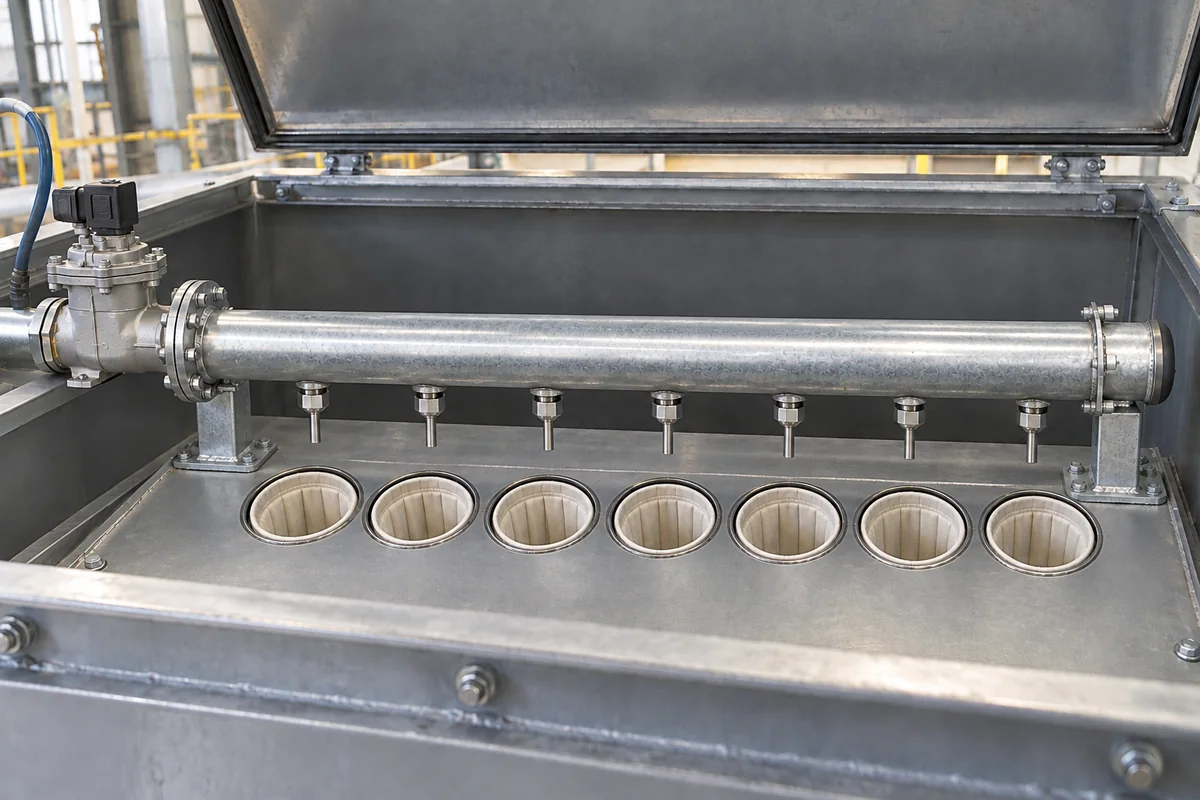
Technical details and manufacturing context for Blow Pipe
| Parameter | Typical range | Notes & selection driver |
|---|---|---|
| Nominal Diameter | 25–100 mm | Matches filter bag inlet sizeISO 1127 |
| Length | 500–6000 mm | Custom to filter housing |
| Wall Thickness | 2–6 mm | Thicker for higher pressure |
| Operating Pressure | 0.3–0.8 MPa | Below 0.3 MPa pulse force insufficient |
| Operating Temperature | -20–120 °C | Above 120°C may deform plastic nozzles |
| Surface Roughness | Ra ≤ 3.2 μm | Smooth bore reduces pressure lossISO 1302 |
| Straightness | ≤ 1.5 mm/m | Ensures even pulse distributionISO 1101 |
| Nozzle Hole Diameter | 6–20 mm | Determines pulse flow rate |
| Nozzle Hole Spacing | 50–200 mm | Matches bag pitch |
| Material | 304/316L | 316L for corrosive environmentsASTM A312 |
| Weight | 1.5–20 kg | Depends on length and wall thickness |
Ranges are indicative industry figures for RFQ preparation, not a supplier commitment. Confirm every value and standard with the legal manufacturer before ordering.
| pressure: | Up to 10 bar (150 psi) |
| flow rate: | 0.5-5.0 m³/min (17.7-176.6 SCFM) |
| temperature: | -20°C to 150°C |
| pulse duration: | 50-200 milliseconds |
Indicative industry ranges for design and RFQ preparation. Confirm the exact figures and applicable standard with the manufacturer before specifying.
Quoted from the published standard.
A practical evidence checklist for RFQ preparation and supplier evaluation.
Compare the published product scope and source details, then include your specifications and quantity in an enquiry.
Manufacturer profiles associated with Blow Pipe.
Explore company information and manufacturing capabilities, then discuss the scope of your project with a relevant supplier.
Ask for use case, specification boundaries, supplier type, and RFQ preparation information for this product.
The blow pipe delivers short, high-pressure air pulses from solenoid valves to the filter bags. The pulses create a reverse air flow that flexes the bags and dislodges accumulated dust, allowing continuous filtration.
Common materials include carbon steel, stainless steel, and aluminum. For corrosive environments, stainless steel grades such as 316L are often specified. The choice depends on the application and required durability.
Typical operating pressure is 0.3 to 0.8 MPa, and operating temperature is -20°C to 120°C. These are reference ranges; actual limits must be confirmed with the manufacturer for the specific model.
Check the nominal diameter, length, wall thickness, nozzle hole diameter and spacing, and material grade against your system requirements. Refer to relevant standards (e.g., ISO 1127 for dimensions) and confirm with the supplier that the product meets your needs.
This component is essential for the following industrial systems and equipment:
Editorial classification, named public sources where available, and source-reviewed manufacturer records.
Compare manufacturer profiles with relevant product and process capability.