Industry-Verified Manufacturing Data (2026)

Bottom Rolls

Based on aggregated insights from multiple verified factory profiles within the CNFX directory, the standard Bottom Rolls used in the Machinery and Equipment Manufacturing sector typically supports operational capacities ranging from standard industrial configurations to heavy-duty production requirements.

Technical Definition & Core Assembly

A canonical Bottom Rolls is characterized by the integration of Roll Body and Bearings. In industrial production environments, manufacturers listed on CNFX commonly emphasize Alloy Steel construction to support stable, high-cycle operation across diverse manufacturing scenarios.

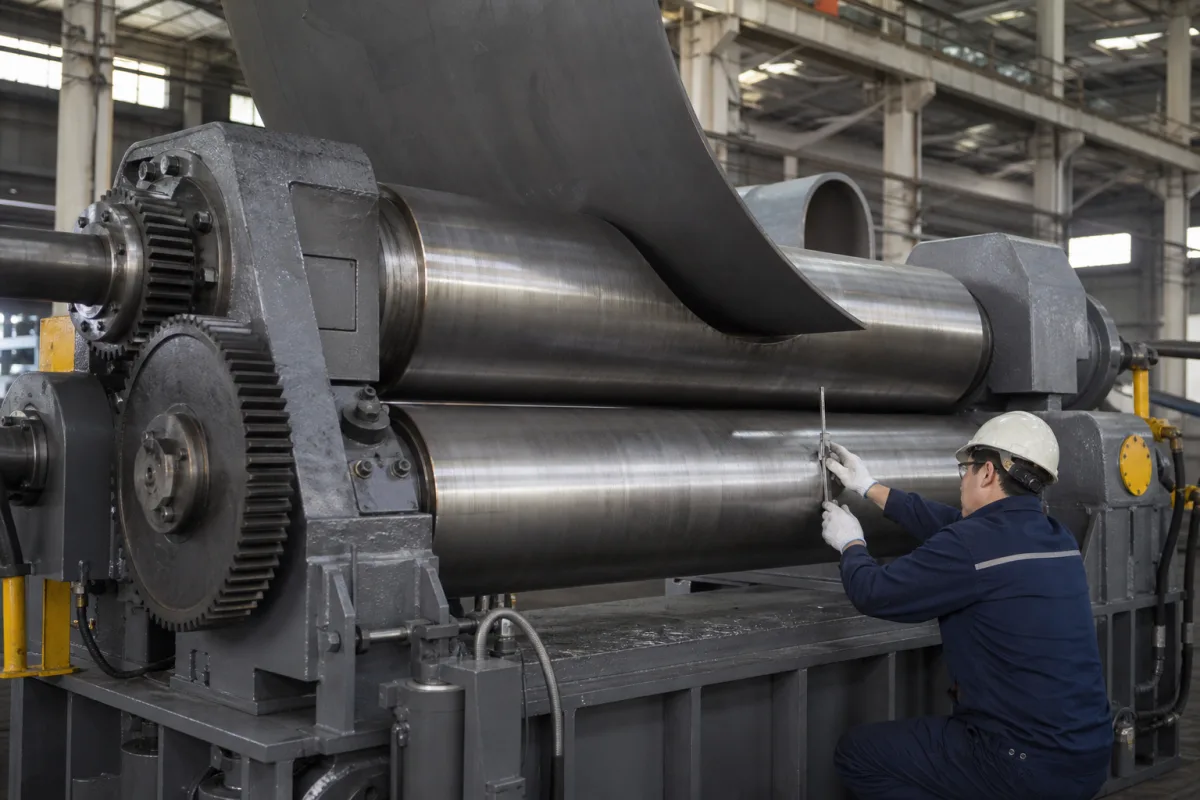
The lower set of cylindrical rolls in a metal plate rolling machine that support and apply pressure to the workpiece.
Product Specifications

Technical details and manufacturing context for Bottom Rolls

Definition
Bottom rolls are the stationary or driven lower rollers in a metal plate rolling machine that work in conjunction with upper rolls to bend and form metal plates into cylindrical or conical shapes through controlled pressure and rotation.
Working Principle
Bottom rolls provide the foundational support surface for the metal plate during the rolling process. They rotate to feed the plate through the machine while maintaining consistent contact and pressure against the upper rolls, creating the desired curvature through plastic deformation of the metal.
Common Materials
Alloy Steel, Hardened Steel
Technical Parameters
  • Diameter and length of the bottom rolls, determining the maximum plate width and bending capacity (mm) Customizable
Components / BOM
  • Roll Body
    Main cylindrical surface that contacts and supports the metal plate
  • Bearings
    Support the roll shaft and allow smooth rotation under load
  • Shaft
    Central structural component that transfers rotational force and supports the roll body
Engineering Reasoning
50-200 kN radial load, 0.1-2.0 m/s surface speed, 20-150°C operating temperature
Hertzian contact stress exceeding 1500 MPa, surface temperature exceeding 250°C, radial deflection exceeding 0.5 mm
Design Rationale: Hertzian contact fatigue due to cyclic loading exceeding material yield strength (σ_y = 690 MPa for 42CrMo4 steel), thermal softening at temperatures above 250°C reducing hardness by 40%, plastic deformation from combined bending and contact stresses
Risk Mitigation (FMEA)
Trigger Insufficient lubrication film thickness (h < 1 μm) causing boundary lubrication regime
Mode: Adhesive wear and galling on roll surface
Strategy: Forced lubrication system with minimum film thickness ratio Λ > 3, surface roughness Ra < 0.4 μm, DLC coating with hardness > 2000 HV
Trigger Cyclic bending stress exceeding fatigue limit (σ_f = 350 MPa for 42CrMo4 at 10^7 cycles)
Mode: Subsurface crack initiation and propagation leading to spalling
Strategy: Shot peening to induce compressive residual stress of -400 MPa, subsurface hardness gradient design with core hardness 280-320 HB, ultrasonic testing at 5 MHz frequency for crack detection

Industry Taxonomies & Aliases

Commonly used trade names and technical identifiers for Bottom Rolls.

Applied To / Applications

This component is essential for the following industrial systems and equipment:

Industrial Ecosystem & Supply Chain DNA

Complementary Systems
Downstream Applications
Specialized Tooling

Application Fit & Sizing Matrix

Operational Limits
pressure: Up to 500 MPa (72,500 psi) maximum contact pressure
other spec: Maximum workpiece thickness: 300 mm (11.8 in), Minimum bending radius: 1.5x roll diameter
temperature: Ambient to 150°C (302°F) continuous operation
Media Compatibility
✓ Carbon steel plates ✓ Stainless steel alloys ✓ Aluminum sheets
Unsuitable: Abrasive slurry environments with high particulate concentration
Sizing Data Required
  • Maximum workpiece thickness (mm/in)
  • Required bending radius (mm/in)
  • Material yield strength (MPa/psi)

Reliability & Engineering Risk Analysis

Failure Mode & Root Cause
Surface fatigue spalling
Cause: Cyclic Hertzian contact stresses from material processing loads exceeding material endurance limit, often accelerated by improper alignment or overload conditions
Bearing seizure
Cause: Lubrication failure due to contamination, improper grease selection, or inadequate lubrication intervals leading to metal-to-metal contact and thermal runaway
Maintenance Indicators
  • Abnormal vibration patterns or audible knocking during rotation indicating imbalance or bearing damage
  • Visible surface scoring, pitting, or material transfer on roll face suggesting lubrication failure or foreign object damage
Engineering Tips
  • Implement precision laser alignment during installation and quarterly verification to minimize edge loading and uneven stress distribution
  • Establish condition-based lubrication program using ultrasonic monitoring to detect bearing degradation before failure, coupled with proper grease purging procedures

Compliance & Manufacturing Standards

Reference Standards
ISO 286-2:2010 (Geometrical product specifications - Limits and fits) ANSI B46.1-2009 (Surface Texture, Surface Roughness, Waviness, and Lay) DIN 1543-1:1995 (Steel for general structural purposes - Technical delivery conditions for flat products)
Manufacturing Precision
  • Bore diameter: +/-0.02 mm
  • Surface flatness: 0.1 mm per meter length
Quality Inspection
  • Dye Penetrant Test for surface defects
  • Spectrographic Analysis for material composition verification

Factories Producing Bottom Rolls

Verified manufacturers with capability to produce this product in China

✓ 93% Supplier Capability Match Found

P Procurement Specialist from Germany Feb 08, 2026
★★★★★
"Reliable performance in harsh Machinery and Equipment Manufacturing environments. No issues with the Bottom Rolls so far."
Technical Specifications Verified
T Technical Director from Brazil Feb 05, 2026
★★★★★
"Testing the Bottom Rolls now; the technical reliability results are within 1% of the laboratory datasheet."
Technical Specifications Verified
P Project Engineer from Canada Feb 02, 2026
★★★★★
"Impressive build quality. Especially the technical reliability is very stable during long-term operation."
Technical Specifications Verified
Verification Protocol

“Feedback is collected from verified sourcing managers during RFQ (Request for Quote) and factory evaluation processes on CNFX. These reports represent historical performance data and technical audit summaries from our B2B manufacturing network.”

14 sourcing managers are analyzing this specification now. Last inquiry for Bottom Rolls from USA (1h ago).

Supply Chain Compatible Machinery & Devices

Hydraulic Press

Industrial machine using hydraulic pressure to compress, form, or assemble materials

Explore Specs →
Heavy-Duty CNC Plasma Cutting Machine

Industrial machine for precision metal cutting using plasma arc technology

Explore Specs →
Automated Assembly Line System

Integrated production system for sequential component assembly operations

Explore Specs →
Automated Powder Coating System

Integrated industrial system for applying dry powder coatings to metal substrates.

Explore Specs →

Frequently Asked Questions

What materials are bottom rolls typically made from?

Bottom rolls are commonly manufactured from alloy steel or hardened steel to withstand high pressure and provide durability in metal plate rolling applications.

What components make up a bottom roll assembly?

A complete bottom roll assembly consists of three main components: the roll body (cylindrical surface), shaft (central support), and bearings (for smooth rotation under load).

How do bottom rolls function in a plate rolling machine?

Bottom rolls form the lower set of cylindrical rollers that support the metal workpiece and apply upward pressure against the top roll to achieve precise bending and shaping of plates.

Can I contact factories directly on CNFX?

CNFX is an open directory, not a transaction platform. Each factory profile provides direct contact information and production details to help you initiate direct inquiries with Chinese suppliers.

Get Quote for Bottom Rolls

Request technical pricing, lead times, or customized specifications for Bottom Rolls directly from verified manufacturing units.

Your business information is encrypted and only shared with verified Bottom Rolls suppliers.

Thank you! Your message has been sent. We'll respond within 1–3 business days.

Need to Manufacture Bottom Rolls?

Connect with verified factories specializing in this product category

Add Your Factory Contact Us
Previous Product
Bottle Positioning System
Next Product
Boundary Definition Interface