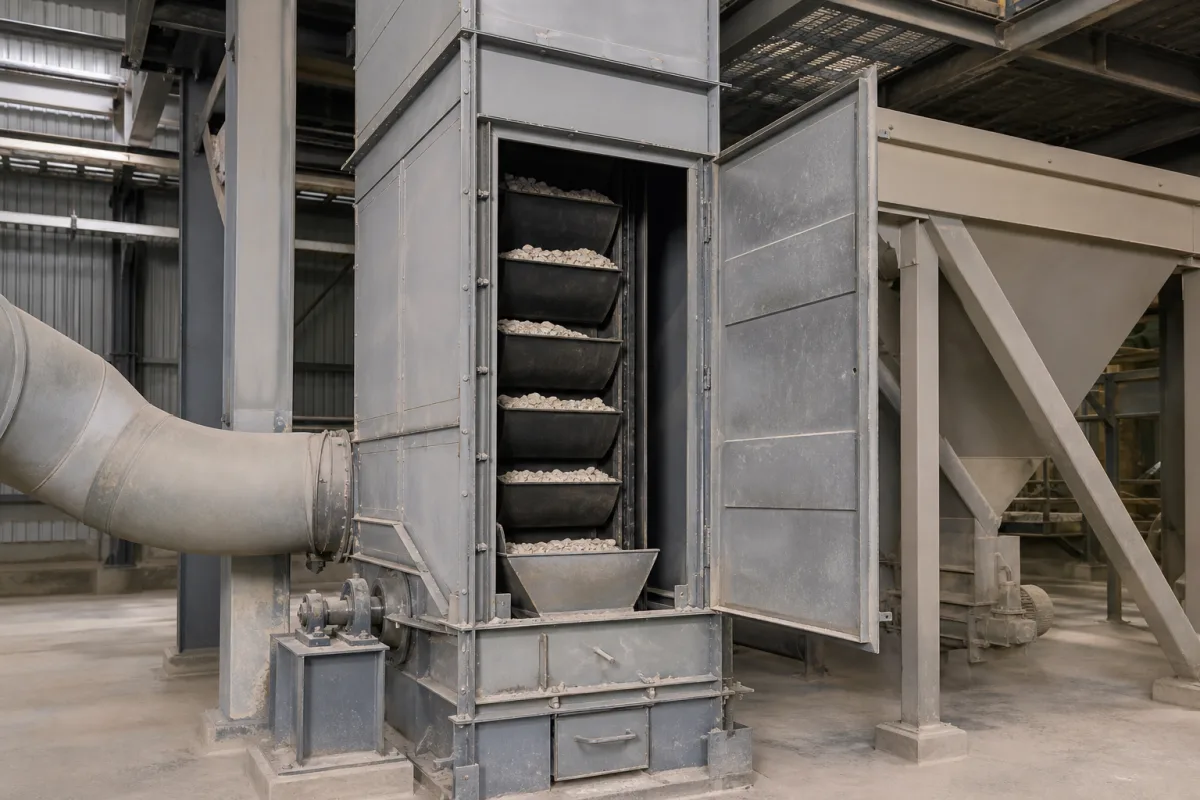
Bulk handling · Discharge type, capacity and dust safety
A bucket elevator lifts material in a tall, enclosed leg where dust, misaligned belts and hot bearings can start fires and explosions. Choose centrifugal or continuous discharge for the material, size the buckets for the capacity you need, and specify the speed, alignment and bearing monitoring and the access doors that keep the leg safe to run and inspect.
Belt and chain bucket elevators for grain, feed, fertilizer, cement, minerals and other bulk solids, including small Z-type elevators feeding packing machines. Belt and screw conveyors have their own pages.
CNFX editorial research · Sources checked October 10, 2026 · 7 sources
FEECO, a bucket elevator manufacturer, explains that the first sizing step is choosing between continuous and centrifugal designs: fragile materials or those needing gentle handling suit continuous elevators, while centrifugal elevators are chosen where degradation is not a concern and rely on speed to throw material out at the head. It notes two exceptions: potash elevators are almost all continuous and sand elevators almost all centrifugal. [2]
FEECO writes that "The most common types of buckets used with centrifugal elevators are the AA and AC designs", which dig and scoop material from the boot, and that with a continuous elevator "medium-front (MF), high-front (HF), and super-capacity (SC) are the most common selections"; continuous elevators which use the back of the preceding bucket to guide material into the discharge chute. [2]
Bucket spacing is set by the discharge action: FEECO notes that centrifugal belt elevators allow minor spacing adjustment, while continuous and chain elevators do not. [2]
Give the supplier the material name, bulk density, particle size, temperature, moisture and whether it is fragile, abrasive or easily aerated. These decide the discharge type before capacity is considered.
02
Size buckets, fill, spacing and speed for capacity
FEECO explains that bucket volume is rated on water-level capacity, that solids can heap so fill can exceed 100% in some materials, and that bulk density converts volume into tonnage. Belt or chain speed must stay in the range that gives the right discharge, so it allows only small capacity changes. [2][3]
As an editorial calculation example only: 5 L buckets at 80% fill, spaced 0.3 m apart on a belt running at 1.5 m/s, pass 18,000 buckets an hour and lift about 72 m³/h; at a bulk density of 0.75 t/m³ that is about 54 t/h. Ask the supplier to confirm fill and speed for your material.
For more capacity on an existing leg, FEECO lists raising speed, increasing fill, reducing spacing on centrifugal units, or changing bucket style, and warns that faster chain elevators wear faster and may need a new drive; for a significant increase FEECO says "replacement often becomes the only option", because the casing size must also be increased. [3]
03
Fit the safeguards required for dusty materials
OSHA's grain handling standard (29 CFR 1910.272), which applies to grain elevators, feed mills, flour mills and similar plants, requires that bucket elevators not be jogged to free a choked leg, that belts bought after 1988 be conductive (surface resistance not over 300 megohms), and that the head and boot have access for inspection and clean-out. [1]
The standard also requires bearings mounted outside the leg casing or monitored for vibration or temperature, a motion detector that shuts the elevator down when belt speed drops by no more than 20%, and a belt alignment alarm or automatic tracking; some of these do not apply where an operational fire and explosion suppression system protects head and boot, or dust is kept at least 25% below the lower explosive limit. [1]
Even outside grain plants, ask the supplier which speed, alignment and bearing monitors and explosion protection are offered, and which standards the elevator is built to for your material and market.
04
Ring-chain and plate-chain legs for cement, belt elevators, a feed elevator and a Z-type packing feeder
The listed elevators range from ring-chain and plate-chain legs for cement and minerals to Jochamp's Z-shape bucket elevator feeding a pouch packing machine. [4][5][7]
Pingyuan lists belt, ring-chain, plate-chain, cement and silo bucket elevators; Excellent lists belt and chain bucket elevators with a cement project; Deci lists a feed bucket elevator. [4][5][6]
05
Buckets, belt or chain, head drive, boot, casing and monitors
Three rows carry OSHA requirements for grain plants: the conductive belt, inspection access at the boot, and the speed, alignment and bearing monitors. [1]
Capacity, lift height, belt speed, bucket volume, drive power and belt material for an elevator order
Capacity follows from bucket volume, fill, spacing and speed, as in the 54 t/h example above; give the bulk density so the supplier can convert volume to tonnage.
Field
What it means and published values
Ask the supplier for
Capacity (m³/h)
From bucket volume, fill, spacing, speed and bulk density. [2]
12 companies list this product among what they make. Company figures are quoted from each
company's own website; every card states where the relationship came from.
Henan Pingyuan Mining Machinery Co., Ltd.
Manufacturing site to be confirmed for the order
Lists belt, ring-chain, plate-chain, cement and silo bucket elevators.
Explore company information and manufacturing capabilities, then discuss the scope of your project with a relevant supplier.
Share this page
Compiled and source-reviewed by the CNFX editorial team.
Each manufacturer above links to the page on that company's own website where the product is listed, with the date we checked it. How we source and review
· Page last updated 13 October 2026
Buyer questions
Centrifugal or continuous bucket elevator?
FEECO advises continuous elevators for fragile or gentle-handling materials and centrifugal elevators where speed can throw material out at the head. [2]
What safeguards does OSHA require on grain bucket elevators?
29 CFR 1910.272 requires no jogging to free a choked leg, conductive belts, head and boot access, external or monitored bearings, a speed-drop shutdown at no more than 20%, and belt alignment monitoring, with stated exemptions. [1]
Can buckets be filled above 100%?
FEECO explains bucket volume is rated on water level, so heaping solids can exceed 100% in some materials, but overfilling must be done with caution. [2][3]
Sources and what still needs a direct check
Sources checked 2026-10-10. OSHA 29 CFR 1910.272 is a US regulation for grain handling facilities. FEECO is a bucket elevator manufacturer. Supplier pages describe their own offers. NFPA 61 and other dust-explosion standards were not read for this page.