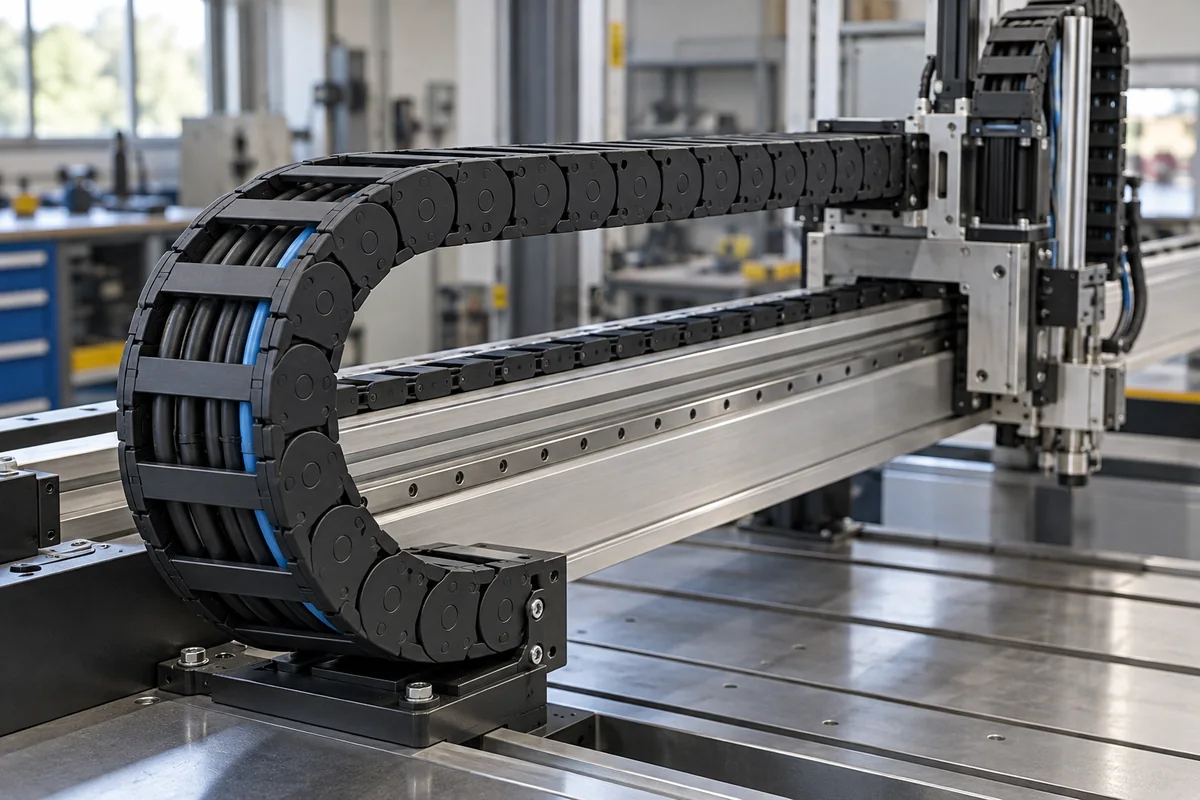
Small plastic cable carrier for light, fast axes: 5–25 mm inner-height chains on gantries, pick-and-place heads and measuring machines
Small plastic cable carriers, 5 to about 25 mm inner height · bend radius and installation height, self-supporting travel and the light additional load it allows, opening style, noise
A gantry on a laser or engraving table, a pick-and-place head or a measuring machine axis moves only a handful of servo, encoder and sensor cables and perhaps an air line, but moves them fast, back and forth. A small plastic cable carrier, with a 5 to about 25 mm inner height and links a few centimetres long, does that job. Choosing one comes down to the bend radius the cables allow, the installation height that radius produces, how far the chain can run without support at the weight it carries, and how it opens for fitting cables.
Small plastic cable carriers (energy chains) with inner heights from 5 mm to about 25 mm and bend radii up to about 125 mm, one-piece or two-piece, openable or closed, for light, fast axes such as gantries, pick-and-place heads, measuring machines, laser and engraving tables. Plastic and steel cable carriers chosen by filling rules, bend radius and strain relief, and the unsupported spans of heavier steel series, are covered on the Drag chain page. Steel and heavy-duty carriers, long gliding travels in guide troughs, drag-chain conveyors and the cables themselves are outside this page; cable ducts for control panels and finished cable harnesses have their own pages.
CNFX editorial research · Sources checked October 12, 2026 · 5 sources
Inner height, bend radius and the installation height they produce
Tsubaki Kabelschlepp's smallest MONO carrier has a 13 mm pitch, 10 mm inner height and 6–20 mm inner widths, with bending radii of 20, 28 and 37 mm; its EasyTrax ET0320 has a 32 mm pitch and 18 mm inner height with radii from 28 to 125 mm. Each radius gives a fixed installation height H for the self-supporting chain. [1][3]
Editorial calculation: in each Kabelschlepp table H rises by twice the radius step, so H is two bend radii plus a constant link height: 12.5 mm for the MONO 0130 (52.5 − 2 × 20), 15 mm for the MONO 0202 (51 − 2 × 18) and 25.5 mm for the ET0320 (81.5 − 2 × 28). [1][2][3] Choosing the next radius up on an ET0320, 28 to 48 mm, adds 40 mm of height above the moving end.
igus tells buyers to check the cable maker's minimum bend radius before choosing the chain's radius, and its E2 micro range starts at 5 mm inner height with radii as small as 18 mm. [5][4]
Give the supplier the largest cable or hose diameter, the minimum bend radius from the cable data sheet and the height available above the axis; the radius sets the installation height.
02
Self-supporting travel against the weight of cables per metre
Small carriers trade travel for load. Kabelschlepp lists, for the self-supporting (unsupported) arrangement, up to 1.15 m of travel with up to 0.5 kg/m of additional load for the MONO 0130, 1.95 m with 1.25 kg/m for the MONO 0202 and 2.9 m with 1.2 kg/m for the ET0320, each at up to 10 m/s and 50 m/s². [1][2][3]
Kabelschlepp notes that the maximum load changes with inner width and that, for the MONO series, sagging is technically permitted for longer travels depending on the application. [2][1] igus says its E2.1 micro chains, with a stop-dog system, reach up to 25% greater unsupported lengths and 100% higher additional loads than comparable igus types. [4]
Editorial calculation: the MONO 0202 can carry about seven times its own weight in cables (1.25 ÷ 0.18), and the MONO 0130 about three times (0.5 ÷ 0.16). [2][1] Six servo and encoder cables at 0.2 kg/m each, an assumed weight, would already exceed the MONO 0130 and come close to the MONO 0202's figure. igus notes that mounting the fixed end at the centre of the travel needs only half the chain of an end-fixed layout. [5]
Up to 80 m; 2.5 m/s; 25 m/s² (design 030 only) [3]
03
Opening style, noise and temperature for small chains
Kabelschlepp builds the MONO 0130 family in three designs: 0132 with a closed frame that cannot be opened, 0130 with crossbars that open on the outside radius at any position and 0134 that opens on the inside radius; a slotted MONO 0202 lets cables with pre-assembled connectors be pressed in without opening the chain. [1][2]
igus measured 42 dB(A) for an E2 micro Series 06 chain running unsupported at 1.0 m/s in its laboratory, and attributes quiet running to the small pitch; Series 03 and Series 14 carry a UL94-V0 classification, and an electrically conductive ESD version is available on request. [4] igus gives a standard temperature range for its plastic chains of −40 °C to +130 °C, and +170 °C for short periods. [5]
igus states that its test laboratory of 3,800 m² runs about 10 billion test cycles a year on 180 stations at speeds up to 8 m/s, which it cites as the basis of a 4-year guarantee on chains and cables. [5] Editorial note: ask for the expected life of the chain and cables at your stroke, speed and cycle count rather than a general guarantee.
04
Send the cables, the stroke and the height available
Paste it into your enquiry below or into an email to a maker, then replace every bracket.
Cables and hoses: [number; outer diameters; weight per metre; minimum bend radius]
Axis: [stroke; speed; acceleration; cycles per day; horizontal, vertical or side-mounted]
Space: [height available above the axis; width]
Chain: [opening style: outer, inner, closed or slotted; separators]
Environment: [temperature; cleanroom; ESD; flammability class]
Mounting: [end brackets with strain relief; fixed point at the end or centre]
1 company lists this product among what they make. Company figures are quoted from each
company's own website; every card states where the relationship came from.
JLCMC
Manufacturing site to be confirmed for the order
Lists 10, 15, 18, 20 and 25 series cable carriers in bridge-type, semi-enclosed and fully enclosed designs, with outer- or inner-radius opening and silent-operation versions.
Explore company information and manufacturing capabilities, then discuss the scope of your project with a relevant supplier.
Share this page
Compiled and source-reviewed by the CNFX editorial team.
Each manufacturer above links to the page on that company's own website where the product is listed, with the date we checked it. How we source and review
· Page last updated 13 October 2026
Buyer questions
How far can a small cable carrier run without support?
Kabelschlepp lists 1.15 m for its MONO 0130 with 0.5 kg/m, 1.95 m for the MONO 0202 with 1.25 kg/m and 2.9 m for the EasyTrax ET0320 with 1.2 kg/m. [1][2][3]
How does bend radius affect installation height?
In Kabelschlepp's tables H is two bend radii plus the link height, so an ET0320 at 28 mm radius is 81.5 mm high and at 48 mm radius 121.5 mm. [3]
How small can a cable carrier be?
igus lists E2 micro chains from 5 mm inner height with an 18 mm bend radius and 10 mm pitch. [4]
How quiet is a small cable carrier?
igus measured 42 dB(A) for an E2 micro Series 06 chain at 1.0 m/s unsupported. [4]
Sources and what still needs a direct check
Sources checked 2026-10-12. Tsubaki Kabelschlepp and igus describe their own cable carrier series; Kabelschlepp's figures are maximum values per series from its product pages.