Industry-Verified Manufacturing Data (2026)

Cleaning Mechanism (e.g., Shaker, Pulse Jet Valve)

Based on aggregated insights from multiple verified factory profiles within the CNFX directory, the standard Cleaning Mechanism (e.g., Shaker, Pulse Jet Valve) used in the Machinery and Equipment Manufacturing sector typically supports operational capacities ranging from standard industrial configurations to heavy-duty production requirements.

Technical Definition & Core Assembly

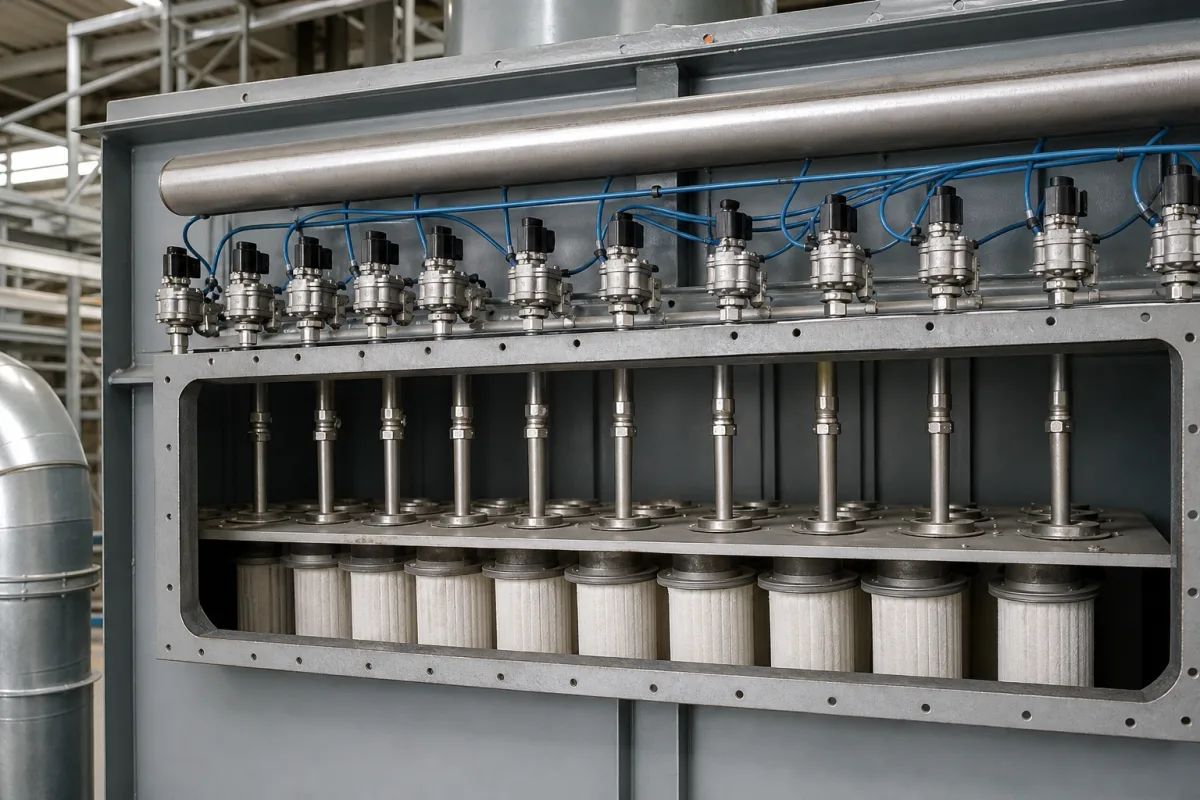
A canonical Cleaning Mechanism (e.g., Shaker, Pulse Jet Valve) is characterized by the integration of Solenoid Valve and Diaphragm. In industrial production environments, manufacturers listed on CNFX commonly emphasize Carbon Steel construction to support stable, high-cycle operation across diverse manufacturing scenarios.

A device or system within a filter unit that removes accumulated dust or particulate matter from the filter media to maintain filtration efficiency and airflow.
Product Specifications

Technical details and manufacturing context for Cleaning Mechanism (e.g., Shaker, Pulse Jet Valve)

Definition
The cleaning mechanism is a critical sub-assembly of a filter unit, such as a baghouse or cartridge filter. Its primary function is to periodically dislodge and remove the dust cake that builds up on the filter media surface during operation. This prevents excessive pressure drop, ensures consistent airflow, and extends the operational life of the filter elements. Common types include mechanical shakers that vibrate the filter bags and pulse jet systems that use compressed air bursts to clean the filters.
Working Principle
Operates on principles of mechanical vibration (shaker) or high-pressure air pulse (pulse jet) to create a shockwave or reverse airflow that dislodges particulate matter from the filter media surface, allowing it to fall into a collection hopper.
Common Materials
Carbon Steel, Stainless Steel, Aluminum Alloy, Synthetic Rubber (Seals)
Technical Parameters
  • Diameter or dimensions of the cleaning mechanism's interface with the filter element (e.g., valve nozzle diameter, shaker arm length). (mm) Per Request
Components / BOM
  • Solenoid Valve
    Electrically controls the rapid opening and closing of the air flow to the pulse jet nozzle.
    Material: Brass/Stainless Steel
  • Diaphragm
    Flexible membrane within the pulse valve that seals and releases to create the air pulse.
    Material: Synthetic Rubber/Nitrile
  • Shaker Motor
    Provides the rotational or vibrational force to mechanically shake the filter bags.
    Material: Steel/Copper Windings
  • Timer/Controller
    Electronic unit that regulates the timing and sequence of cleaning cycles.
    Material: Plastic/Electronic Components
Engineering Reasoning
0.5-7.0 bar differential pressure across filter media
Pulse pressure exceeding 8.5 bar causes filter media delamination
Design Rationale: Exceeding the 8.5 bar threshold induces tensile stress beyond the 15 MPa yield strength of the PTFE membrane coating, leading to fiber separation and permanent porosity increase
Risk Mitigation (FMEA)
Trigger Solenoid coil insulation breakdown at 180°C Curie temperature
Mode: Valve fails to open, causing 0% cleaning efficiency
Strategy: Install Class H (180°C) insulation with 500V dielectric strength and thermal monitoring at 150°C
Trigger Compressed air moisture content exceeding 5 g/m³ at 7 bar
Mode: Ice formation in valve orifice at -40°C expansion temperature
Strategy: Implement refrigerated dryer maintaining dew point at -20°C with 3 μm particulate filtration

Industry Taxonomies & Aliases

Commonly used trade names and technical identifiers for Cleaning Mechanism (e.g., Shaker, Pulse Jet Valve).

Applied To / Applications

This component is essential for the following industrial systems and equipment:

Industrial Ecosystem & Supply Chain DNA

Complementary Systems
Downstream Applications
Specialized Tooling

Application Fit & Sizing Matrix

Operational Limits
pressure: Up to 10 bar
flow rate: 0.5 to 50 m³/min
temperature: -20°C to 150°C
slurry concentration: Up to 500 g/m³
Media Compatibility
✓ Polyester needle felt ✓ PTFE membrane ✓ Glass fiber fabric
Unsuitable: Highly corrosive chemical environments (e.g., chlorine gas, strong acids)
Sizing Data Required
  • Filter media surface area (m²)
  • Dust loading rate (g/m³)
  • Required cleaning frequency (cycles/hour)

Reliability & Engineering Risk Analysis

Failure Mode & Root Cause
Valve diaphragm rupture
Cause: Fatigue failure from cyclic pressure loading and material degradation due to exposure to moisture or contaminants in compressed air
Solenoid coil burnout
Cause: Overheating from continuous duty cycling beyond design limits, voltage spikes, or insulation breakdown from environmental contaminants
Maintenance Indicators
  • Audible hissing or air leakage during filter cleaning cycles
  • Reduced cleaning efficiency evidenced by increased differential pressure across filter media
Engineering Tips
  • Install moisture separators and regulators in compressed air supply lines to prevent water and oil contamination
  • Implement predictive maintenance using ultrasonic leak detection and monitor valve actuation timing to identify performance degradation before failure

Compliance & Manufacturing Standards

Reference Standards
ISO 14644-1:2015 (Cleanrooms and associated controlled environments) ANSI/ASHRAE Standard 52.2-2017 (Method of Testing General Ventilation Air-Cleaning Devices) DIN EN 1822-1:2019 (High efficiency air filters (EPA, HEPA and ULPA))
Manufacturing Precision
  • Valve seat flatness: 0.05mm maximum deviation
  • Solenoid actuation timing: +/- 5 milliseconds
Quality Inspection
  • Leakage test (pressure decay method) at 150% operating pressure
  • Cycle life test (minimum 1 million cycles without failure)

Factories Producing Cleaning Mechanism (e.g., Shaker, Pulse Jet Valve)

Verified manufacturers with capability to produce this product in China

✓ 97% Supplier Capability Match Found

P Project Engineer from Canada Feb 06, 2026
★★★★★
"Testing the Cleaning Mechanism (e.g., Shaker, Pulse Jet Valve) now; the technical reliability results are within 1% of the laboratory datasheet."
Technical Specifications Verified
S Sourcing Manager from United States Feb 03, 2026
★★★★★
"Impressive build quality. Especially the technical reliability is very stable during long-term operation."
Technical Specifications Verified
P Procurement Specialist from United Arab Emirates Jan 31, 2026
★★★★★
"As a professional in the Machinery and Equipment Manufacturing sector, I confirm this Cleaning Mechanism (e.g., Shaker, Pulse Jet Valve) meets all ISO standards."
Technical Specifications Verified
Verification Protocol

“Feedback is collected from verified sourcing managers during RFQ (Request for Quote) and factory evaluation processes on CNFX. These reports represent historical performance data and technical audit summaries from our B2B manufacturing network.”

16 sourcing managers are analyzing this specification now. Last inquiry for Cleaning Mechanism (e.g., Shaker, Pulse Jet Valve) from UAE (1h ago).

Supply Chain Compatible Machinery & Devices

Automated Assembly Line System

Integrated production system for sequential component assembly operations

Explore Specs →
Automated Powder Coating System

Integrated industrial system for applying dry powder coatings to metal substrates.

Explore Specs →
Centrifugal Pump Impeller

Rotating component that transfers energy to fluid in centrifugal pumps.

Explore Specs →
High-Precision CNC Laser Cutting Machine

Computer-controlled industrial machine using focused laser beams to cut sheet metal with micron-level accuracy.

Explore Specs →

Frequently Asked Questions

What is the difference between shaker and pulse jet cleaning mechanisms?

Shaker mechanisms use mechanical vibration to dislodge dust from filter media, while pulse jet systems use compressed air bursts. Pulse jet is more common for continuous operation with minimal downtime.

How often should cleaning mechanisms be maintained?

Maintenance frequency depends on operating conditions, but typically includes monthly inspections of seals and diaphragms, quarterly solenoid valve checks, and annual comprehensive system reviews.

Which material is best for corrosive environments?

Stainless steel cleaning mechanisms offer superior corrosion resistance for harsh environments. Aluminum alloy provides good corrosion resistance at lower cost, while synthetic rubber seals handle various chemical exposures.

Can I contact factories directly on CNFX?

CNFX is an open directory, not a transaction platform. Each factory profile provides direct contact information and production details to help you initiate direct inquiries with Chinese suppliers.

Get Quote for Cleaning Mechanism (e.g., Shaker, Pulse Jet Valve)

Request technical pricing, lead times, or customized specifications for Cleaning Mechanism (e.g., Shaker, Pulse Jet Valve) directly from verified manufacturing units.

Your business information is encrypted and only shared with verified Cleaning Mechanism (e.g., Shaker, Pulse Jet Valve) suppliers.

Thank you! Your message has been sent. We'll respond within 1–3 business days.

Need to Manufacture Cleaning Mechanism (e.g., Shaker, Pulse Jet Valve)?

Connect with verified factories specializing in this product category

Add Your Factory Contact Us
Previous Product
Cleaning Mechanism
Next Product
Cleaning Nozzle Array