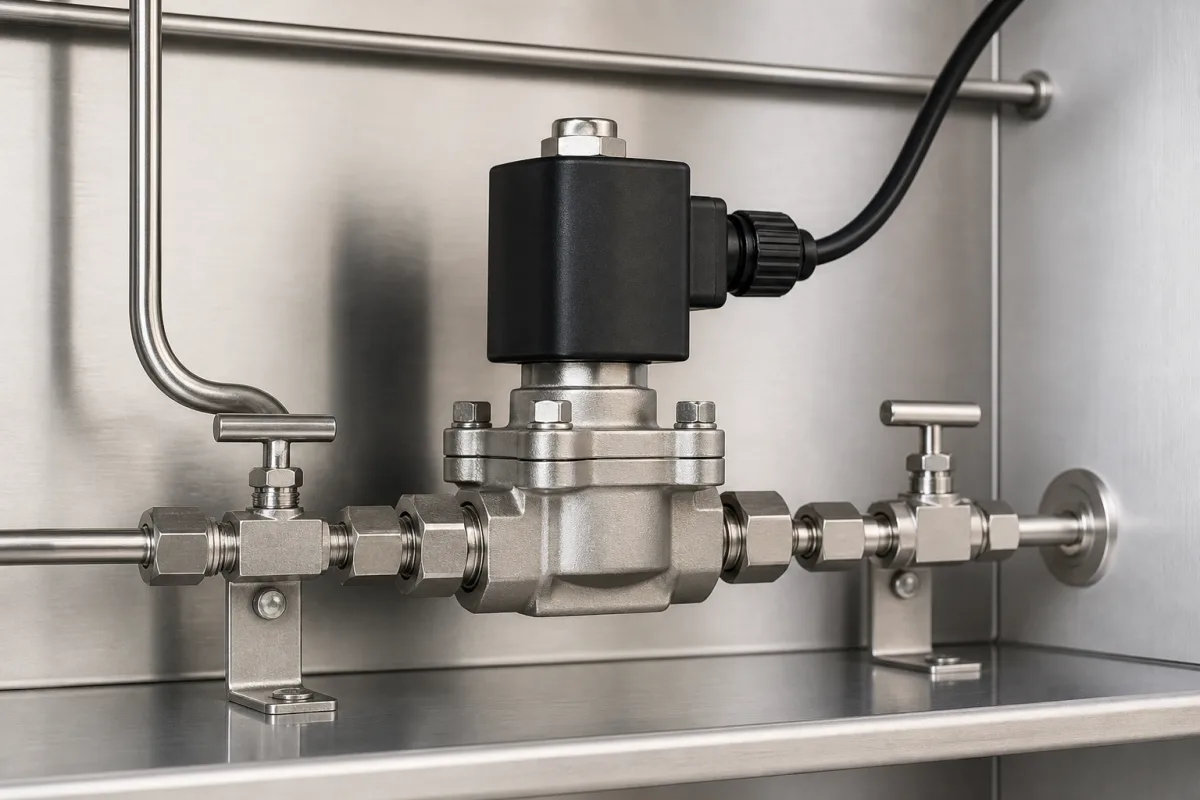
A solenoid valve opens or closes when its coil is energised. Whether it works in your line depends less on port size than on how it is operated: direct-acting valves work from zero pressure but only with small orifices, while pilot-operated valves switch large flows but need a minimum pressure difference to open and stay open.
On-off solenoid valves for water, air, oil, gas and hydraulic service: direct-acting, pilot (servo) operated, pneumatic directional and hydraulic cartridge types. Proportional and process control valves are separate products.
CNFX editorial research · Sources checked October 12, 2026 · 7 sources
In a direct-acting valve the solenoid lifts the seal off the orifice itself. ASCO gives the rough relation Fs = p × A: a typical solenoid with about 15 N pull can hold an orifice of only about 4.4 mm against 10 bar. Pilot-operated valves use a small pilot orifice to move a diaphragm or piston, which ASCO says lets large orifices be switched at pressures up to 15 MPa. [1]
Operation
How it works
What it needs
Direct-acting
Armature opens the main orifice directly; orifice size limited by coil pull force. [1]
No minimum pressure differential, but limited orifice and flow at high pressure.
Pilot (servo) operated
Coil opens a pilot orifice larger than the equalising orifice; pressure above the diaphragm falls and line pressure lifts it. Danfoss's EV220B 15–50 works this way. [2]
A minimum differential pressure; Danfoss lists 0.3 bar to open and keep open. [2]
Pneumatic directional (3/2, 5/2, 5/3)
Internally piloted valves that switch air to actuators. AKS lists 5/3 centre-closed and 3/2 versions. [3]
AKS states a minimum of 3 bar for proper operation and clean air only, not vacuum. [3]
Hydraulic cartridge
Screw-in poppet or spool cartridges, 2/2 and 2/3 way, in a manifold. [4]
Cavity size, flow, pressure and coil connector for the manifold.
A pilot-operated valve that opens on the bench can fail to open, or chatter, in a line where the pressure difference across it is lower than its minimum, for example on a low-head gravity supply or at the end of a long run. Give the supplier the inlet and outlet pressures in every operating case.
As a calculation example using ASCO's relation, an orifice of 3 mm (area 7.1 mm²) against 10 bar needs about 10⁶ Pa × 7.1 × 10⁻⁶ m² ≈ 7 N of pull, before allowing for spring and friction. [1]
02
State the maximum pressure differential the valve must close and open against
ASCO explains that a continuously energised coil heats up according to its size and power, and that this sets the maximum differential pressure rating in the catalogue. The coil and the pressure rating belong together; a smaller coil on the same body may carry a lower rating. [1]
Published examples show the spread. Danfoss's EV220B 15–50 lists 0.3 bar minimum and up to 16 bar maximum opening differential, 16 bar maximum working pressure and 20 bar test pressure. Bluesky's CNG dispenser solenoid valve lists 10–250 bar. Hydraulic cartridge valves are specified by their cartridge series and cavity. [2][5][4]
Ask for the minimum and maximum operating pressure differential for the exact body, orifice and coil combination, and the proof or test pressure.
03
Choose the coil for voltage, temperature and duty
ASCO designs its coils for continuous duty and offers insulation classes E, F and H, with maximum operating temperatures of 120, 155 and 180 °C. It states a life of 20,000 hours for class F and 30,000 hours for class H at their maximum temperatures. [1]
Ambient and fluid temperature cut into the margin
The coil's own temperature rise is added to the ambient and fluid temperature. In ASCO's class F table the permitted ambient for the solenoid operator ranges from 75 °C down to 25 °C depending on the coil type and its temperature rise. Hot fluid, an enclosed cabinet or direct sun all reduce the margin. [1]
AC and DC coils behave differently when hot
ASCO notes that when a coil heats up its resistance roughly doubles. For a DC coil that halves the current and the pull force falls; for an AC coil the change in current is only about ±10% because impedance is dominated by inductance. A DC valve that switches reliably cold may not open when hot at the top of its pressure range. [1]
Specify supply voltage and tolerance, AC or DC, connector type and enclosure rating. Suppliers list DIN and Deutsch connectors and 12/24 V DC or 110/220 V AC coils; AKS lists IP65 for its pneumatic valves. [4][3]
04
Match seals and body to the medium
Danfoss's EV220B data sheet ties each seal to media and temperature: EPDM for water and drinking water at −30 to 120 °C, FKM for oil and air at 0 to 100 °C (water up to 60 °C), and NBR for oil, water and air at −10 to 90 °C, with viscosity up to 50 cSt. [2]
Water quality matters for brass bodies. Danfoss recommends hardness of 6–18 °dH to limit scaling and conductivity of 50–800 µS/cm to avoid dezincification, and warns against stagnant water inside the valve above 25 °C. [2]
Body materials in the published examples include brass, DZR brass and stainless steel (Danfoss), brass for small water valves (Basidewt), plastic for irrigation (Mingwang) and hardened steel cartridges with NBR or FKM seals for hydraulics (Hydraflu). Name the medium, its temperature and any drinking-water or food approval needed. [2][6][7][4]
05
Check opening and closing times and water hammer
Pilot-operated valves open and close as the diaphragm chamber fills and empties through the orifices, so larger valves are slower. Danfoss's indicative times for water run from 40 ms to open (350 ms to close) for DN15 to 5,000 ms to open (10,000 ms to close) for DN50, and it notes that closing time can be changed by replacing the equalising orifice and that the valve is water-hammer damped. [2]
If a fast-closing valve sits on a long water line, the sudden stop can cause a pressure surge. Ask for opening and closing times at your pressures, and whether an adjustable or slow-closing version is available.
06
Trace the solenoid valve components
This is a functional reference built from the sources cited; it is not one maker's parts list. Materials and ratings come from the data sheet of the valve you order.
Part
Role and published construction
Fix in the order
Solenoid coil
Creates the magnetic field; insulation class sets temperature limit and life. [1]
Voltage and tolerance, AC/DC, power, insulation class, connector and enclosure.
Armature (plunger) and armature tube
Moves under the magnetic field and carries the pilot or main seal; the core runs in a sealed tube. [1][2]
Armature material for the medium and any manual override.
Armature spring
Returns the armature and holds the pilot closed when de-energised in normally closed valves. [2]
Normally closed or normally open function.
Valve body and cover
Contain pressure; brass, DZR brass, stainless steel, plastic or hardened steel are published. [2][7][4]
Body material, connection size and thread or flange standard.
Diaphragm or piston (pilot-operated)
Opens and closes the main orifice using line pressure. [2]
Seal material for medium and temperature.
Pilot and equalising orifices
Their size ratio makes the diaphragm move and sets opening and closing speed. [2]
Minimum differential pressure and opening/closing times.
07
Fill the specification fields with values for your line
A solenoid-valve quotation needs line-specific values. The table explains each field, gives published values where a reviewed source states them, and says what to obtain from the supplier.
Field
What it means and published values
Ask the supplier for
Port size
Connection size; AKS lists 1/4–1/2 in pneumatic valves, Danfoss DN15–DN50. [3][2]
Port size and thread or flange standard, and orifice size.
Flow coefficient (Kv/Cv)
Danfoss lists Kv 4 m³/h at DN15 to 40 m³/h at DN50. [2]
Send the medium, pressures and electrical data together
Paste it into your enquiry below or into an email to a maker, then replace every bracket.
Medium: [fluid; cleanliness; viscosity; temperature; water quality if water]
Pressures: [inlet and outlet in every operating case; minimum and maximum differential; proof pressure]
Function: [2/2, 3/2, 5/2 or 5/3; normally closed or open; direct or pilot operated]
Flow: [required flow; Kv or Cv; port and orifice size]
Response: [opening and closing time; water-hammer limits]
Coil: [voltage and tolerance; AC or DC; power; insulation class; duty; connector; IP rating]
Environment: [ambient temperature; enclosure or outdoor; hazardous-area requirement]
Materials: [body; seals; approvals for drinking water, food or gas]
Documents: [data sheet; coil data; test certificate; installation instructions]
These companies make or supply solenoid valves for different applications: pneumatic, hydraulic, water treatment, irrigation, fuel and CNG dispensers, and forklift transmissions.
AKS Pneumatic Components Co., Ltd.
Liushi, Yueqing, Zhejiang — published address
Lists internally piloted pneumatic solenoid valves, 3/2 and 5/3 way, 1/4–1/2 in ports, 220 V AC or 24 V DC coils, HNBR seals, −5 to 60 °C, IP65, minimum 3 bar, clean air only.
Lists screw-in hydraulic solenoid cartridge valves in 2/2 and 2/3 way, poppet and spool types, sold as Hydraforce parts or stated equivalents, with DIN or Deutsch coils. Confirm brand, origin and authorisation of the parts quoted.
Lists mainly plastic solenoid valves for irrigation on/off control, plus hydraulic control and pressure-reducing valves. Ask for pressure range, coil type and normally open or closed function.
Explore company information and manufacturing capabilities, then discuss the scope of your project with a relevant supplier.
Share this page
Compiled and source-reviewed by the CNFX editorial team.
Published product pages show what a company offers, not tested performance. Confirm the legal seller, factory and scope for your order. How we source and review
· Page last updated 13 October 2026
Buyer questions
Why does my pilot-operated valve not open at low pressure?
Pilot-operated valves use line pressure to lift the diaphragm and need a minimum pressure differential; Danfoss lists 0.3 bar for its EV220B 15–50. Below that, use a direct-acting or assisted-lift valve. [2]
Can a solenoid coil stay energised continuously?
ASCO designs its coils for continuous service, but the coil's temperature rise plus ambient and fluid temperature must stay within its insulation class; class F is rated 155 °C with 20,000 hours life. [1]
Why does a DC valve fail to open when hot?
ASCO notes that coil resistance roughly doubles when hot, halving DC current and pull force, while AC current changes only about 10%. Check the hot-coil rating at your maximum pressure. [1]
Sources and what still needs a direct check
Sources checked 2026-10-12. ASCO and Danfoss are manufacturer publications: their equations, ratings and recommendations describe their own products. Supplier pages describe their own offers.