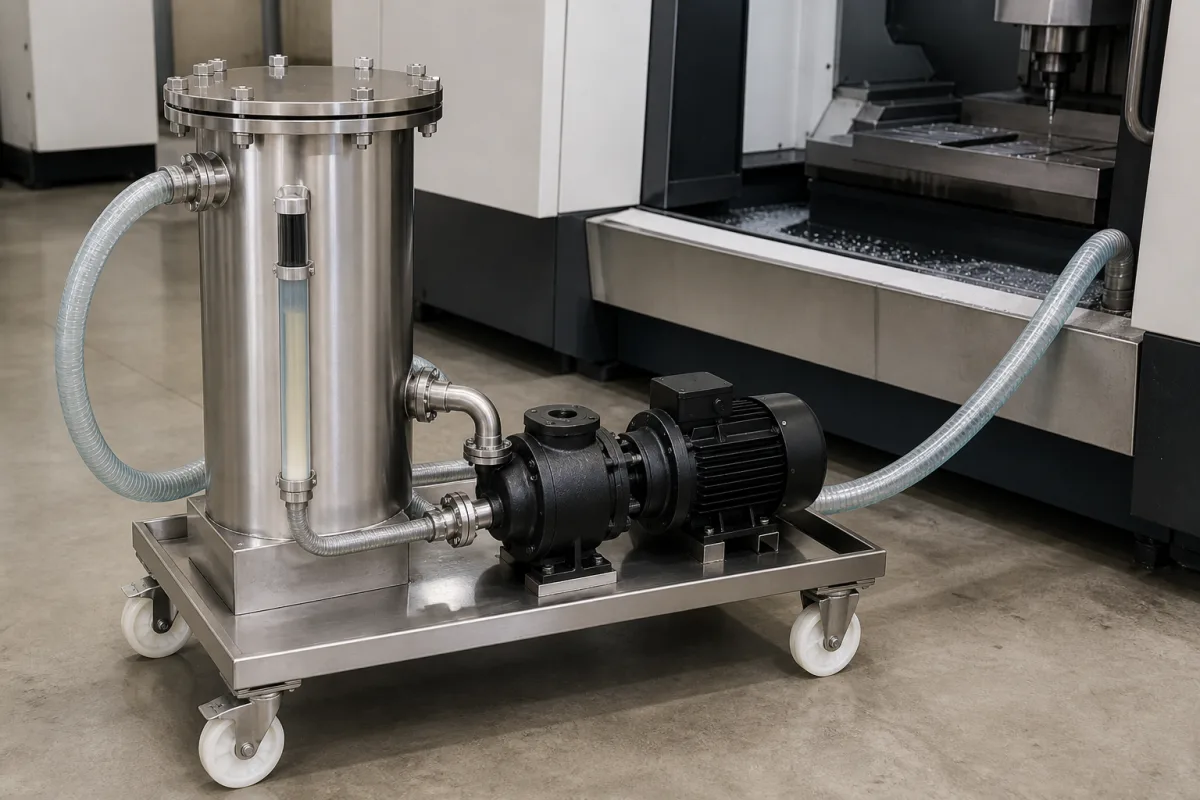
Filter unit for machine tool coolant: a portable pump-and-bag cart that cleans each sump in turn
Portable filter units for machine tool coolant sumps · A pump and bag housing on a cart that cleans one sump after another, 25 µm felt or 100 µm mesh bags, clarity targets by operation from general machining to honing, Beta ratings, and why filtration alone does not stop bacteria
This page covers portable filter units for metalworking fluids: carts with a pump and a bag or cartridge housing that clean machine tool sumps one after another, and wheeled reclamation units that add oil removal and treatment. Ask three things first: what particle size your operation needs removed and how that is rated, what flow the cart really delivers at your hose length and head, and what else the fluid needs, such as tramp oil removal or microbial control.
Portable and wheeled filter units for machine tool coolant and metalworking fluid sumps, with bag or cartridge housings and pumps. Machine-side coolant tanks and their built-in filtration are covered on the Coolant system for CNC machine tools page, high-pressure through-spindle coolant units on their own page, tramp oil skimmers on their own page and chip conveyors on their own page. Dust collector filter cartridges, cleanroom fan filter units and hydraulic oil filter carts are outside this page.
CNFX editorial research · Sources checked October 12, 2026 · 5 sources
A pump and a bag on wheels: pull from the sump, filter, return, move to the next machine
Keller's PFA-1002 pulls coolant from the sump and continuously returns filtered fluid at high flow: a 1 in. air-operated diaphragm pump and a large bag filter on a 20 × 30 in. cart, with 8 ft wands whose discharge scours the sump bottom so the inlet wand picks up suspended chips and sludge; it recirculates 20 gpm, needs 5 SCFM of air at 50 psig and no electrics, ships with 25 µm polyester felt bags, takes 100 µm reusable nylon mesh bags and an optional bag filter magnet for steel and iron particles. [1] Rosedale's two-wheel portable filter cart pairs a 1/2 hp self-priming centrifugal pump with a bag housing for coolants up to 300 SSU compatible with aluminium and steel, moving from machine to machine or drum to tank; its pump delivers 2,280 GPH of water at 10 ft of head, 1,440 at 30 ft and 360 at 50 ft, less with pipe smaller than 1 in. [2]
Eriez's SumpDoc goes further on one cart: a sump cleaner removing chips and solids of 50 µm and larger, a pleated bag filter down to 10 µm, a high-speed centrifuge for emulsified tramp oil and fines down to 3–5 µm, and an ozone generator for microbiological treatment, wheeled next to a machine tool, parts washer or rinse tank without interrupting production. [4]
Editorial calculation: a 200 gallon sump at Keller's 20 gpm passes once every 10 minutes; Rosedale's cart at 30 ft of head gives about 24 gpm, but only about 6 gpm at 50 ft, so measure the head and hose run before relying on the nameplate flow. [1][2]
Give the supplier the coolant type and concentration, sump volumes and access, chip type and amount, the operations run (general machining, grinding, honing), the target clarity, power or compressed air available, and whether tramp oil and microbial control are needed.
02
How fine to filter: clarity targets by operation, Beta ratings, and the bacteria a filter leaves behind
Rosedale's coolant filter guide lists clarity targets by operation and explains Beta ratings: if 100 particles of 5 µm go in and 50 come out, the bag has a Beta 5 of 2, or 50% efficiency at that size. [3]
A 2025 study of an industrial band saw's water-based coolant found particles from 7.3 µm to 3,530 µm, with those under 50 µm predominating, primarily aluminium and iron oxides from tool wear, and culturable microorganisms above 1,000 CFU/mL; the best of six nanofiber filters removed 70.8% of particles of 7.3 µm and larger, but filtration did little for the microbial load, while ozonation cut viable microorganisms by over 95% and lowered pH from 9 to 8. [5]
5 companies list this product among what they make. Company figures are quoted from each
company's own website; every card states where the relationship came from.
Explore company information and manufacturing capabilities, then discuss the scope of your project with a relevant supplier.
Share this page
Compiled and source-reviewed by the CNFX editorial team.
Each manufacturer above links to the page on that company's own website where the product is listed, with the date we checked it. How we source and review
· Page last updated 13 October 2026
Buyer questions
What does a portable coolant filter unit do?
It pumps coolant from a machine sump through a bag filter and back, its return flow stirring up chips and sludge for pickup, then moves to the next machine; Keller's cart runs 20 gpm through 25 µm bags. [1]
How fine should machine coolant be filtered?
Rosedale's targets range from an average particle size under 20 µm for general machining to under 15 µm for grinding and under 10 µm for honing and lapping. [3]
Does filtering coolant remove bacteria?
Not much: a band saw coolant study found filtration removed metal particles but barely changed microbial load, while ozonation cut viable microorganisms by over 95%. [5]
Sources and what still needs a direct check
Sources checked 2026-10-12. Rosedale, Keller (via a distributor) and Eriez describe their own carts and filters; a 2025 peer-reviewed study measured contamination in a band saw coolant.