Industry-Verified Manufacturing Data (2026)

Compression Chamber

Based on aggregated insights from multiple verified factory profiles within the CNFX directory, the standard Compression Chamber used in the Machinery and Equipment Manufacturing sector typically supports operational capacities ranging from standard industrial configurations to heavy-duty production requirements.

Technical Definition & Core Assembly

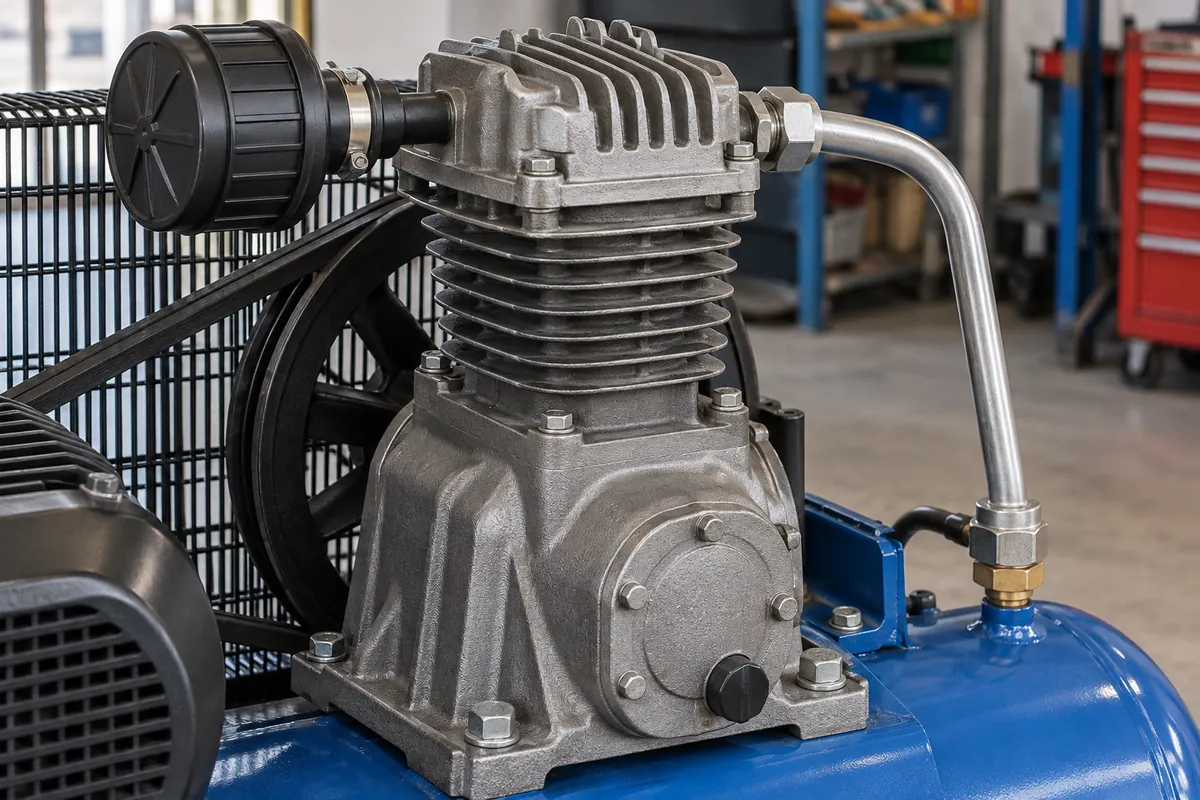
A canonical Compression Chamber is characterized by the integration of Cylinder Liner and Cooling Fins. In industrial production environments, manufacturers listed on CNFX commonly emphasize Cast Iron construction to support stable, high-cycle operation across diverse manufacturing scenarios.

The sealed enclosure within an air compressor where air is compressed by reducing its volume.
Product Specifications

Technical details and manufacturing context for Compression Chamber

Definition
A critical component of air compressors that forms the primary workspace for air compression. It's the chamber where atmospheric air is drawn in, confined, and compressed through mechanical action (typically piston movement or rotary mechanisms) to increase pressure before being discharged to the storage tank or application system.
Working Principle
Air enters the compression chamber through intake valves. As the compressor's piston moves (in reciprocating compressors) or rotors turn (in rotary compressors), the chamber volume decreases, compressing the trapped air. The compressed air is then forced out through discharge valves when pressure reaches the designed level.
Common Materials
Cast Iron, Aluminum Alloy, Steel
Technical Parameters
  • Internal diameter or dimensions of the compression chamber (mm) Customizable
Components / BOM
  • Cylinder Liner
    Provides a wear-resistant surface for piston movement and maintains compression efficiency
    Material: Cast Iron or Steel
  • Cooling Fins
    Dissipate heat generated during compression to prevent overheating and maintain efficiency
    Material: Aluminum Alloy
  • Valve Ports
    Openings for intake and discharge valves to control air flow into and out of the chamber
    Material: Steel
Engineering Reasoning
0.1-35 bar
40 bar internal pressure at 120°C wall temperature
Design Rationale: Yield strength reduction of AISI 304 stainless steel (206 MPa at 20°C to 172 MPa at 120°C) combined with hoop stress exceeding material limits
Risk Mitigation (FMEA)
Trigger Lubricant thermal breakdown at 180°C
Mode: Piston ring seizure due to increased friction coefficient from 0.08 to 0.35
Strategy: Integrate PTFE-coated piston rings with embedded thermocouples and automatic shutdown at 150°C
Trigger Condensate accumulation exceeding 3% volume fraction
Mode: Hydrostatic lock causing connecting rod bending stress exceeding 250 MPa
Strategy: Install capacitive moisture sensors with automatic drain valves activated at 2% volume fraction

Industry Taxonomies & Aliases

Commonly used trade names and technical identifiers for Compression Chamber.

Applied To / Applications

This component is essential for the following industrial systems and equipment:

Industrial Ecosystem & Supply Chain DNA

Complementary Systems
Downstream Applications
Specialized Tooling

Application Fit & Sizing Matrix

Operational Limits
pressure: Up to 500 bar
flow rate: 0.5 to 1000 m³/min
temperature: -20°C to 150°C
slurry concentration: Up to 30% solids by volume
Media Compatibility
✓ Dry air ✓ Nitrogen gas ✓ Industrial gases (O2, CO2, Argon)
Unsuitable: Corrosive chemical vapors (e.g., chlorine, ammonia)
Sizing Data Required
  • Required air flow rate (CFM or m³/min)
  • Operating pressure (PSI or bar)
  • Duty cycle (continuous/intermittent operation)

Reliability & Engineering Risk Analysis

Failure Mode & Root Cause
Fatigue cracking
Cause: Cyclic pressure loading leading to stress concentration at geometric discontinuities (e.g., weld joints, bolt holes), exacerbated by thermal cycling and material degradation over time.
Corrosion/erosion
Cause: Chemical attack from process fluids (moisture, acids, contaminants) combined with abrasive particle impingement, often accelerated by improper material selection, inadequate coatings, or poor environmental control.
Maintenance Indicators
  • Audible hissing or whistling indicating gas leakage through cracks or seal failures
  • Visible external discoloration, bulging, or weeping at seams/welds suggesting material degradation or overpressure
Engineering Tips
  • Implement routine non-destructive testing (e.g., ultrasonic thickness gauging, dye penetrant inspection) at high-stress areas to detect subsurface flaws before catastrophic failure
  • Maintain strict control of operating parameters (pressure, temperature, fluid purity) within design limits and install real-time monitoring with automated shutdown protocols for abnormal conditions

Compliance & Manufacturing Standards

Reference Standards
ISO 1217:2009 (Displacement compressors - Acceptance tests) ASME B19.3:2019 (Safety Standard for Compressors for Process Industries) DIN 1945-1:2010 (Reciprocating positive displacement compressors - Part 1: Acceptance tests)
Manufacturing Precision
  • Bore diameter: +/-0.025 mm
  • Surface flatness: 0.05 mm per 100 mm
Quality Inspection
  • Hydrostatic pressure test (1.5x operating pressure)
  • Dimensional verification with CMM (Coordinate Measuring Machine)

Factories Producing Compression Chamber

Verified manufacturers with capability to produce this product in China

✓ 92% Supplier Capability Match Found

P Procurement Specialist from United States Feb 08, 2026
★★★★★
"The Compression Chamber we sourced perfectly fits our Machinery and Equipment Manufacturing production line requirements."
Technical Specifications Verified
T Technical Director from United Arab Emirates Feb 05, 2026
★★★★★
"Found 41+ suppliers for Compression Chamber on CNFX, but this spec remains the most cost-effective."
Technical Specifications Verified
P Project Engineer from Australia Feb 02, 2026
★★★★★
"The technical documentation for this Compression Chamber is very thorough, especially regarding technical reliability."
Technical Specifications Verified
Verification Protocol

“Feedback is collected from verified sourcing managers during RFQ (Request for Quote) and factory evaluation processes on CNFX. These reports represent historical performance data and technical audit summaries from our B2B manufacturing network.”

17 sourcing managers are analyzing this specification now. Last inquiry for Compression Chamber from USA (40m ago).

Supply Chain Compatible Machinery & Devices

Hydraulic Press

Industrial machine using hydraulic pressure to compress, form, or assemble materials

Explore Specs →
Heavy-Duty CNC Plasma Cutting Machine

Industrial machine for precision metal cutting using plasma arc technology

Explore Specs →
Automated Assembly Line System

Integrated production system for sequential component assembly operations

Explore Specs →
Automated Powder Coating System

Integrated industrial system for applying dry powder coatings to metal substrates.

Explore Specs →

Frequently Asked Questions

What materials are commonly used for compression chambers in industrial air compressors?

Compression chambers are typically manufactured from durable materials like cast iron for heavy-duty applications, aluminum alloy for lightweight and efficient cooling, and steel for high-strength requirements in machinery and equipment manufacturing.

How do cooling fins in a compression chamber improve air compressor performance?

Cooling fins on compression chambers, especially in aluminum alloy designs, dissipate heat generated during air compression. This maintains optimal operating temperatures, reduces thermal stress on components, and improves overall compressor efficiency and longevity.

What are the key components in a compression chamber's bill of materials (BOM)?

The essential BOM components include cylinder liners for wear resistance and sealing, cooling fins for heat management, and valve ports that control air intake and discharge during the compression cycle in industrial machinery applications.

Can I contact factories directly on CNFX?

CNFX is an open directory, not a transaction platform. Each factory profile provides direct contact information and production details to help you initiate direct inquiries with Chinese suppliers.

Get Quote for Compression Chamber

Request technical pricing, lead times, or customized specifications for Compression Chamber directly from verified manufacturing units.

Your business information is encrypted and only shared with verified Compression Chamber suppliers.

Thank you! Your message has been sent. We'll respond within 1–3 business days.

Need to Manufacture Compression Chamber?

Connect with verified factories specializing in this product category

Add Your Factory Contact Us
Previous Product
Compound Reservoir
Next Product
Compressor